The New Vintage Port in 2024: Modern Incarnation of a Classic

The roller coaster of climate change has produced the same erratic vintages in Port as everywhere else. Historically Port has had two or three vintages every decade that were commonly declared. It was extremely unusual when in 2016 and 2017 there were almost universal declarations for successive vintages (and a little problematic for a market unaccustomed to such a surfeit of riches). Then there was hiatus of 7 years, with erratic rainfall increasing water stress, prolonged heatwaves (47°C in July 2022), and compressed ripening periods leading to earlier harvests. There wasn’t much that could be regarded as classic. Then came 2024: wet winter, no prolonged summer heatwaves, slow, even ripening across all varieties bringing homogeneity,  and a small crop bringing concentration.  Touriga Nacional has been exceptional, but Touriga Franca has excelled.

The result is a vintage that is classic in some regards but thoroughly modern in others. It’s classic in the sense that it’s full of ripe black fruits, sweet on the palate (of course), but with the underlying structure holding it together and preventing it from becoming jammy. It’s modern in the sense that tannins are ripe and supple, not obtrusive or jagged in the old style, present but subsumed by the fruits¾leaving the wines almost ready to drink on release! To say it is unusually accessible is an understatement. This is a huge contrast with the old idea that you buy vintage Port to leave for the next generation, not to enjoy yourself.

Approachability is the hallmark of the vintage. Although most can be enjoyed almost immediately, or at least within the next couple of years, flavor variety will widen with time, and the wines will last another two, three, or even four decades. Beyond approachability, there is great delineation of fruit flavors, conveying an unusual sense of fruit purity. I cannot recall another vintage with this combination of immediacy and longevity. Precision is not a word I often use of Port given its characteristic richness and breadth of flavors, but it often comes to mind here. Suggesting a delay of two or three years before starting to enjoy the vintage is really pro forma as most have a balance that allows almost immediate enjoyment, and some are already overtly delicious.

Until recently, vintage Port was always a blend. Exceptional single vineyards might be used to produce a vintage in years that were not quite good enough for the house to declare a vintage. Now there is more of a trend to representing single vineyards in special cuvées in great vintages also. Partly this is because some smaller growers only produce Port from single vineyards, partly because the larger houses have started to make some single quintas in years that they declare. There is an interesting tradeoff here. The blended Port tends to be deeper, richer, and broader; the single Quinta tends to be finer and more precise. It will be fascinating to see how this difference plays out at maturity, but the trend hasn’t been going on long enough yet to tell¾this being vintage Port, we need decades, not years.

Will 2024 establish the precedent for the New Port: enjoy immediately but hold for decades?

Notes from a tasting in London, June 2026

Alcheny Wines, Blackett  Port
Fine impression to palate with aromatic black fruits showing cherries. Long finish but flavor variety has yet to develop. Some dryness on finish takes edge of sweetness and suggests underlying structure.   92 Drink 2029-2047

Alves de Sousa, Amphitheatrum
Ripe, rich impressions show youth. Dense black fruits have granular texture. Flavors are undeveloped. More of a traditional impression than most.   91 Drink 2029-2045

Churchills
Very typical of the house. Great sense of purity and delineation of fruits, focusing on black cherries and blackcurrants, with finesse and precision on finish. All it needs is time to develop increasing flavor variety, but it can be started immediately because the texture is so fine.   94 Drink 2028-2048

Dow’s Port
At a similar level to Warre’s. Sweet, ripe, and fine, sense of finesse, a touch grapey on the finish, nice sense of grip and structure 20% 99g r.s.  92 Drink 2028-2043

Ferreira
Sweet and ripe, tannins not directly in evidence, but shows bitter chocolate on finish. Rich and grapey with a great sense of fruit delineation. 20% 100g r.s.  92 Drink 2028-2048

Graham’s Port
Great sense of finesse and delineation of fruits and precision, very much showing the purity of Graham’s style, a very fine result for the vintage. Purity is the hallmark. 20% 107g r.s. 94 Drink 2028-2048

Graham’s, Quinta do Vesuvio
A little deeper and more structured than the Graham’s blend. Great sense of grip to palate, structure in the background, can enjoy now but will become increasingly sophisticated as the structure resolves. 20% 110g r.s.  95 Drink 2029-2048

Kopke
Black fruit palate shows faint sense of applies in background. Not very developed yet although that contrasting sense of freshness and fruits makes it delicious now.   90 Drink 2029-2044

Menin Douro Estates, Menin Port
Somewhat direct black fruit impressions with nutty overtones. Flavor development has yet to come.   90 Drink 2029-2044

Nicolau de Almeida
Overtly sweet with somewhat primary black fruit spectrum at present, giving a rather direct impression. Structure is pushed into background. Needs time to resolve and develop.   91 Drink 2029-2044

Niepoort Vinhos
Fine contrasting hints of freshness showing hints of apples against rich black fruits of vintage. Palate shows the finesse you expect of Niepoort and good delineation of fruits. Just needs time to develop more flavor variety, but is already delicious.   92 Drink 2028-2048

Poças Vinhos
Ripe and rich and overtly fruity with an aromatic black fruit spectrum. Some grip to finish shows underlying structure. Certainly seems youthful at present, and needs time to develop flavor variety.   92 Drink 2029-2047

Quinta do Noval
Very fine impression of delineation of black fruits of cherries and blackcurrants, with real sense of class and breed. Very true to the house style of finesse. 19.5%   94 Drink 2028-2048

Quinta do Vale Meão
Fine fruit impressions on textured palate. Strong sense of fruits in black spectrum. One of the more textured expressions of the vintage.   93 Drink 2029-2048

Ramos Pinto
Perfumed impressions to nose. Variety of black fruits on palate, with good sense of delineation, you could almost say precision. Already very flavorful. Broader and deeper than the single vineyard Ervamoira, which is finer and tighter.   93 Drink 2028-2048

Ramos Pinto, Quinta de Ervamoira
Very fine impression to palate with great sense of finesse and delineation of black fruits tending to cherries. Long on finish. Impression of a great classic.   94 Drink 2028-2048

Sandeman Porto
Rounder and deeper than stablemate Ferreira, more sense of traditional Port, great sense of structure in background, although fruits effectively hide tannins. Very fine impression.   93 Drink 2029-2048

Warre’s
Sweet and ripe and very approachable, although a touch raisiny. At least at present, a bit straightforward. A certain delicious quality makes immediate consumption feasible. 20.0% 100g r.s.   92 Drink 2027-2042

Wine and Soul Pintas
This comes from 95 year old vines in a single vineyard,
Black fruit aromatics to nose. Ripe and sweet, the sweetness perhaps a touch more obvious than most, presently somewhat direct in ist flavor spectrum. Granular texture to palate cuts sweetness.   91 Drink 2028-2043
A Retrospective of 1945 Bordeaux

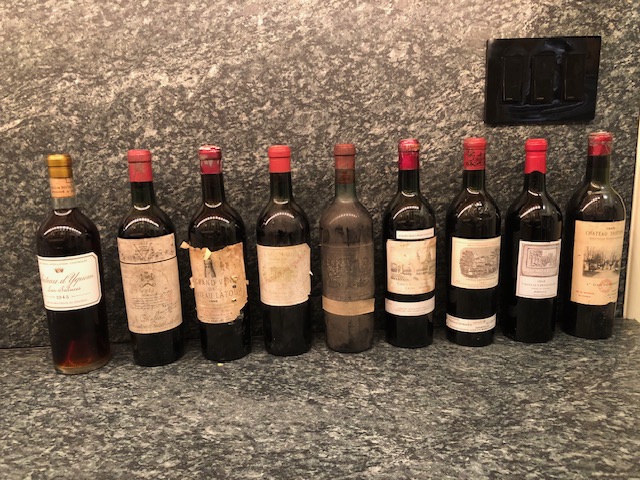
Bordeaux was in terrible shape at the end of the Second World War. It had been occupied by the Germans, and cellars were destroyed or looted. Vineyards were in poor condition: the women had done their best to maintain them and harvest grapes during the war. But the summer of 1945 was glorious and harvest occurred in close to perfect conditions. A frost early in May had reduced yields and increased concentration. The wines proved to be the best vintage of the twentieth century. Its only rival might be 1961. It’s generally agreed that the Médoc was the star of both vintages. The rivals for the best wine of the century divide between Mouton Rothschild 1945 and Latour 1961.

Before the tasting

At a retrospective in New York to celebrate the 80th anniversary, the vibrancy of the wines was still evident. Opening with Trotanoy, the wine still seemed fresh with lively fruits, well rounded, and just a touch of the tertiary character of old Merlot. It did not fade at all in the glass, even over an hour. Its elegance might be viewed as a contrast with the sheer power of today’s Pomerols.

The Berry Bros bottling of Cheval Blanc followed. It’s well known that Cheval had problems with over-heating in the vats in 1945, with ice thrown in to cool some, and volatile acidity sometimes developing. There was no trace of either problem with this bottle. Indeed, this is one of the rare instances in which I have usually found the Berry Bros bottling to be superior to the chateau bottling. The flavor spectrum of Cabernet Franc was marked, with that dry sense of tobacco dominating the finish. The wine held up well immediately after opening, but faded a bit after half an hour as the dryness of the finish took over.

The Berry Bros bottling of Cheval Blanc 1945

The next two flights were comparisons. Lafite Rothschild has been ethereal, with fragrant fruits floating in the atmosphere, but has begun to fade in the past couple of years. Although usually sturdier in most vintages, its neighbor Cos d’Estournel has sometimes shown something of the same fragrant elegance. On this occasion, the Cos started out if anything more fragrant and elegant than the Lafite, but first growth character showed as the wines developed in the glass and Cos developed an edge while Lafite floated along.

A similar development ensued with a comparison of Palmer and Chateau Margaux. Chateau Palmer started out with a touch more generosity, with rounder fruits, while Margaux seemed a little tight. Then as Palmer lost its sense of forward fruits, the structure of the Margaux loosened up and it become more elegant than the Palmer. The difference was a brilliant demonstration of the characters of their blends, heavily Cabernet Sauvignon for Margaux, more Merlot in Palmer.

Even after eighty years, Chateau Latour showed the power of Pauillac. Fruits are still relatively dense. Black fruit character and the pulling power of Cabernet Sauvignon remain evident. Some people preferred the Latour to the Mouton Rothschild, but I thought the Mouton pulled ahead for slightly livelier fruits, greater aromatics, and sense of freshness. It really is a timeless wine, or at least as timeless as wine can get.

The famous V for victory label of Mouton and a rather tattered label for Latour

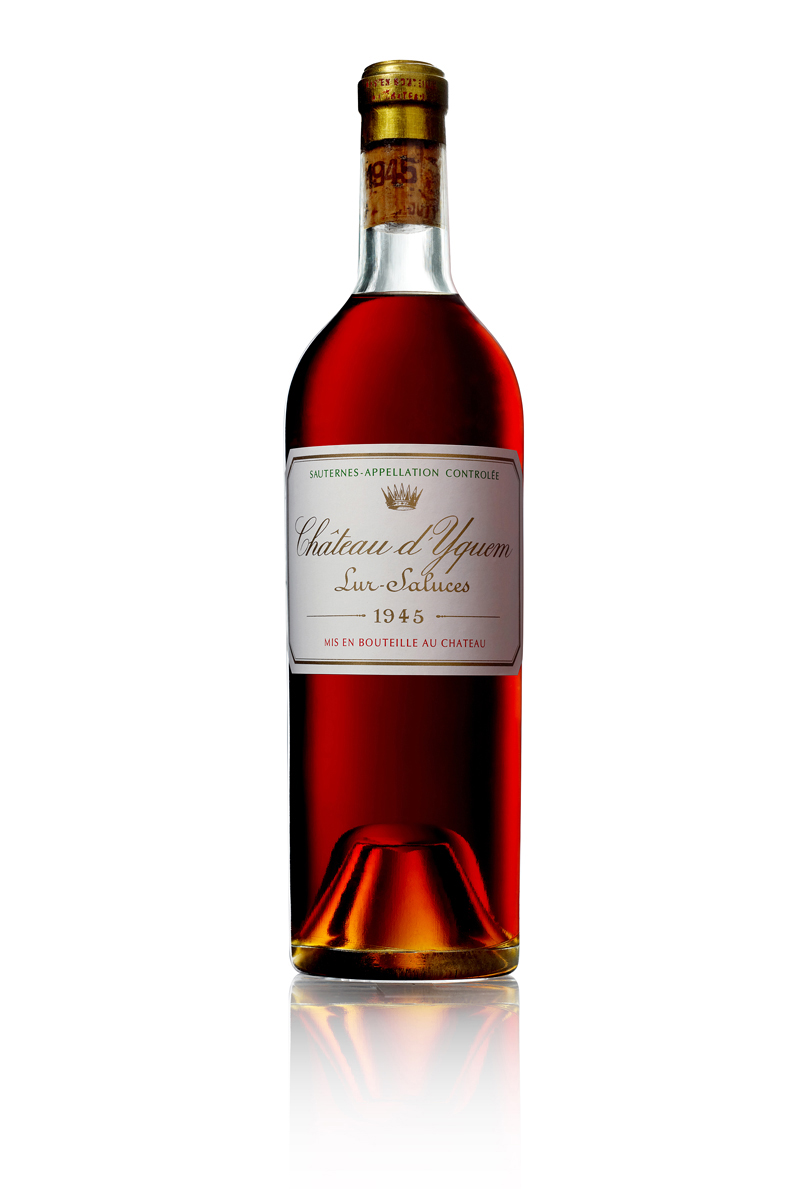
We finished with Chateau d’Yquem, so dark it seemed almost black. All Sauternes become darker with age, of course, but they say at Yquem that the 1945 is one of the darkest of the vintages of the century, having taken leaps into greater darkness every decade. It was even more intense than I remember it from my previous tasting, twenty years ago. The balance of sweetness to acidity is fantastic, with a palate that’s mature but not old, and a huge range of flavors.

Chateau d’Yquem 1945 in all its glory

I suppose it’s undeniable that these wines are no longer at their peak, which in most cases may have been several decades ago, but they are a living demonstration of the greatness of old Bordeaux.

Detailed Tasting Notes

Trotanoy

Pungent notes of old Merlot show through sweet ripe fruits, still in balance with acidity. Not at all tired although tannins are resolved. Keeps going in the glass and does not tire at all.

Cheval Blanc

Strongly dominated by mature Cabernet Franc with notes of tobacco and tea on the finish. Quite dry at the end. Feels more like the seventies than the forties in terms of age. Fading a little in the glass as fruits begin to dry out. A faint touch of tannin at the end becomes bitter as the fruits fade.

Cos d’Estournel

Just a little less weighty than the Lafite, but a very similar impression of elegance. Sweetens in the glass after opening, and then becomes a little bitter as it develops, losing elegance compared to the Lafite.

Lafite Rothschild

Not as fragrant or aromatically uplifted as previous bottles. A little sturdier than Cos when it opened, with a touch of bitterness at the end. But lightens up in the glass, developing that infinitely fragrant elegance.

Margaux

Very refined, greater sense of precision in its black fruits than Palmer, very much Cabernet Sauvignon in fine structure and texture. Great finesse Fruits begin to dry out very slowly in the glass.

Palmer

At first the Merlot carries this forward with a sense of generosity. A little fleshier than Chateau Margaux to begin with, but becomes a touch bitter as fruits fade in the glass.

Latour

Ripe and generous and quite nutty on the finish. A touch of bitterness as wine develops in glass. Certainly full bodied, you can definitely see the power of Pauillac and Latour, but it’s lost the sheer gloss, the plushness, that it showed when younger.

Mouton Rothschild

A little nutty, a little more elegant than Latour. Something of the same sense of those fragrant layers of flavor, that ethereal character, of the Lafite, but weightier. There is now a little bitterness on the finish.

Chateau d’Yquem

Rich, unctuous, figgy, very intense, very viscous. Notes of caramel. Sweet but not overwhelming. Very much its own wine, its own style. Vastly more complex than a modern Sauternes.

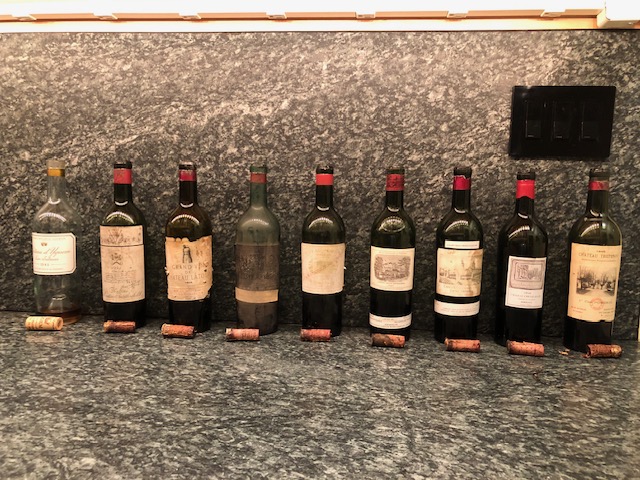
Not a drop left after the tasting. All the wines were in excellent condition, with levels varying from well into neck to very top shoulder. All the corks were original, except for Yquem, which was recorked recently. The wines were mostly sourced from old English country house cellars.

The Answer to Terroir Does Not Lie on the Skin

The most common descriptor associated with terroir is “undefinable”—it’s attributed to a mix of influences including soil, exposure, and climate that create distinctive character in the wine coming from different vineyard sites. At its simplest extreme, it is scarcely rocket science to accept that grapes (or for that matter any other crop) will be quite different if grown in a sunny, well drained spot at the top of a hill from those grown in a shady, waterlogged spot at the bottom of the same hill. That reductio ad absurdum disguises the fact that there can be vineyard sites which to all appearances are identical in all the parameters you might think distinguish them, but which nonetheless consistently produce different wines. No one to date has been able to explain this mystery in any rational way.

A large part of the mystique of wine would disappear if we could explain terroir on a scientific basis, but there is actually little threat from the latest attempt, a report in the Proceedings of the National Academy of Sciences from a group at the University of California, Davis headed by Dr. David Mills. The basic finding is that microorganisms on the skins of the grapes are different in various vineyards in California. These observations were made possible by the ability of rapid DNA sequencing to identify large numbers of microorganisms without the need actually to culture them.

So vineyards in different places have different sets of bacteria and fungi, very likely related to both region and climate. Wind, temperature, and humidity were identified as pertinent factors. This is scarcely a major surprise. But that’s a far cry from supporting the conclusion that “these differences may help explain regional patterns in wine chemicosensory properties,” which is quasi-scientific speak for arguing they might be involved in terroir.

For these microorganisms to be involved in determining wine character, they would most likely need to play some role during fermentation (their mass could scarcely be sufficient to provide any significant level of flavor components in themselves). Well, here is a problem. A significant proportion of the microorganisms that were detected are so-called spoilage organisms, which if allowed to act on the grapes in fact spoil the wine. Precautions are taken to prevent this (most typically the addition of sulfur to block bacterial or fungal action before fermentation).

In fact, wine producers divide into two groups on the issue of the role of yeasts in fermentation. Probably most producers in California are in the group who kill off all the indigenous yeasts before fermentation; cultured yeasts are then added. This provides control of the process and prevents spoilage organisms from acting, making it quite unlikely that any yeasts or bacteria on grape skins are involved in determining wine character.

Some producers allow fermentation to be catalyzed by indigenous yeasts. But here is an interesting point. In spite of a longstanding general belief that this is part of the properties of the vineyard (which makes the present article appear somewhat less than novel), it appears that the yeasts that actually catalyze fermentation are different every year. Eminent oenologist Ribereau-Gayon said, “In a given vineyard, spontaneous fermentation is not systematically carried out by the same strains each year; strain specificity does not exist and therefore does not participate in vineyard characteristics.” So it is hard for this to explain terroir. Curiously, the present paper finds that there is greater vintage variation between small vineyards than between wider areas (but this is based on a comparison of only two years). To make a case that microorganisms are involved in terroir, wouldn’t you need to show that there is some consistency in them over substantial periods of time?

The microorganisms also differ from regards to grape variety, again not a surprise, as grapes with thin skins (more easily damaged) are likely to attract different microorganisms from tougher grapes with thicker skins. This goes back to the point that many of the microorganisms are in the spoilage class, and the last thing you want is for them to affect wine character.

My bet would be that if microorganisms are involved in terroir, it would be more likely to be those in the soil that act on the roots of the grapevines, and which might therefore indirectly affect the properties of berries as they develop. Maybe the answer lies in the soil.

Reference: http://www.pnas.org/cgi/doi/10.1073/pnas.1317377110