Les Carmes Haut Brion is a tiny jewel of a property, the only chateau within the city limits of Bordeaux, and just at the very border of Pessac Léognan. It’s essentially surrounded by suburban housing. It was split off from Haut Brion as a present to the Carmelite monks who owned it from 1584 until the French Revolution. Since then it stayed with one family until it was sold in 2010 to Patrick Pichet of the Pichet Real Estate Group. The vineyard is not classified, but clearly there are plans to revive it and push to a higher level.
Surrounded by a high wall, it’s a single plot of 10 ha, with 7 ha planted to vines. It’s divided into a 4 ha block planted with Cabernet Franc and Merlot, and a 3 ha block planted with Cabernet Sauvignon. The microclimate is 3-5°C warmer than the countryside.
The chateau itself was not built until 1850 and is just at the border of the property. The old cells are at another border. The most strikign feature of the property today is a new cellar, designed by Philippe Starck and architect Luc Arsène-Henry, and completed for the 2015 harvest. A small stream runs through the property, and was extended to surround the new cellar, which has the shape of an upside down ship.
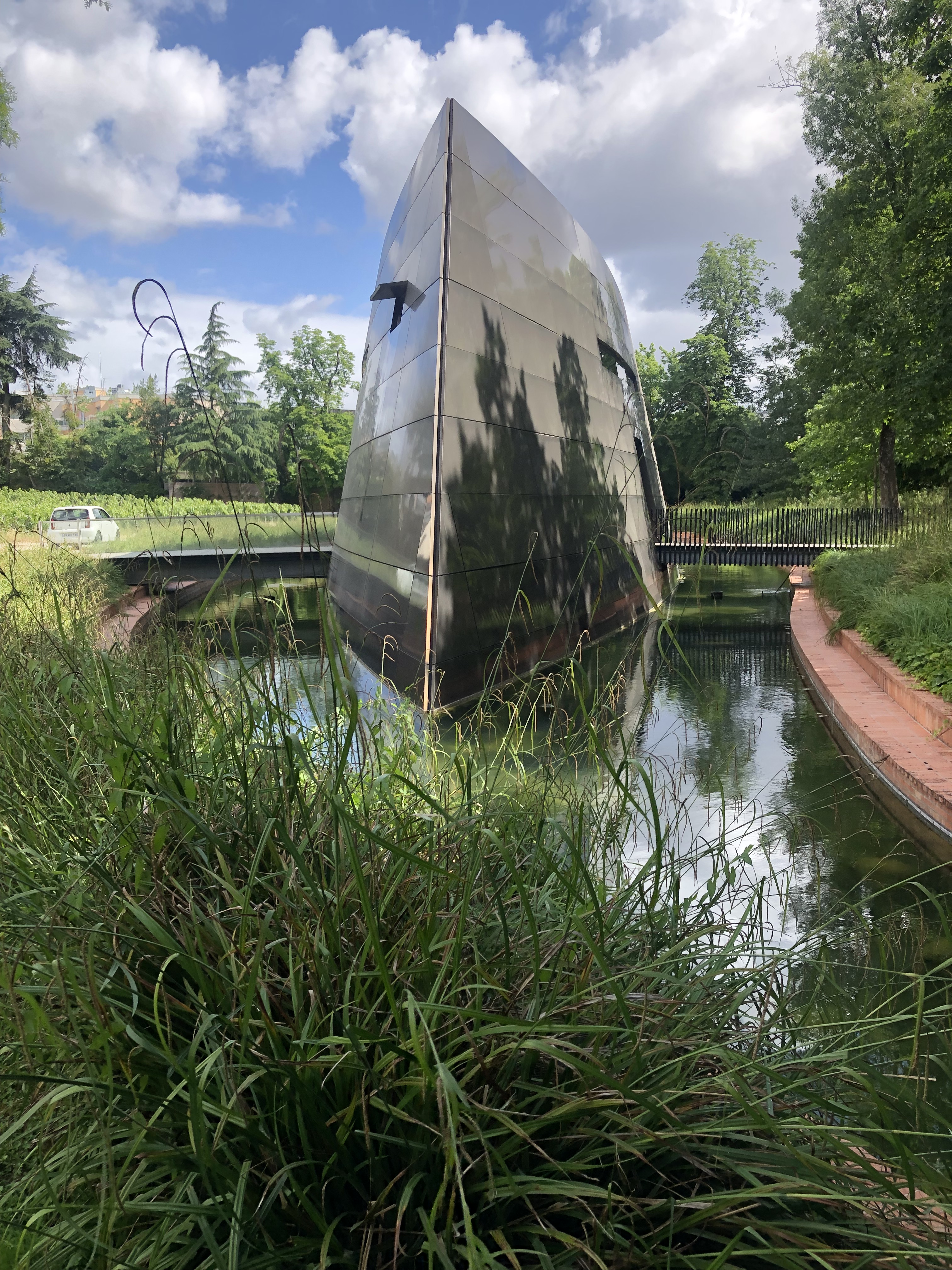
The new winery at Les Carmes Haut Brion
Winemaking focuses on the objective of making a wine that is drinkable early. “You don’t have to wait ten years, it’s well balanced and ready after 6 years.” Vinification uses a lasagna with alternating layers of berries and whole bunches. Submerged cap is used to achieve infusion rather than extraction. The wine ages for almost two years in barriques with 80% new barriques, some 18 hl foudres, and amphora (there are also some stainless steel barrels).
The Cabernet Franc can give the wine a more aromatic impression than is usual in Graves. The 2023 is smooth and elegant but a touch angular, while 2022 is lighter but elegant. The 2021 shows elegant fruits. The 2019 shows its Cabernet Franc in a distinctly mineral expression, the 2017 is also dominated by Cabernet Franc, 2016 has classic cigar-box impressions, and 2015 is on the lighter side.
There is a another wine, C des Carmes Haut Brion, but it’s definiotely not a second wine in the traditional sense, as it comes from 40 ha purchased in Martillac. “We don’t like to talk about second wines, we talk about wines from different places.” This is a more classic blend with two thirds Cabernet Sauvignon to one third Merlot. The first vintages aged for one year in barriques with 50% new oak followed by one year in concrete. Now a third year of aging in foudres has been added. It’s intended to be easy drinking. Although vinification of the C cuvée is similar to that of Carmes Haut Brion, the style is completely different, much softer and more forward.

