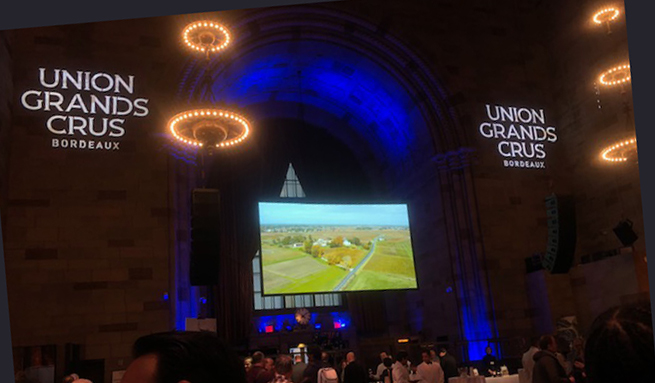
The 2023 vintage is widely described as ‘classic,’ which has become a euphemism in Bordeaux for ‘not overblown.’ This is really not a fair description. If classic means vintages of the era before global warming, say the 70s, then the mark of left bank Bordeaux would be herbaceous notes of Cabernet Sauvignon, and the mark of the right bank might be a slightly vegetal note if Merlot did not achieve full ripeness. Neither description would be at all fair to the wines as revealed by the annual UGBC tasting of the latest vintage upon release. Usually the UGCB tasting has around 120 chateaux, but this year was reduced to under 100, whether because of perceptions that the vintage will be a hard sell or because of other economic factors, so it’s not quite so representative.
After adjusting to the fruit-forward style of recent hot vintages, it can be difficult to recalibrate. The general style is restrained compared with the exuberance of some recent hot vintages. Alcohol levels have backed off from the excesses of some recent vintages. (Some people define a classic vintage in Bordeaux as having less than 13.5% alcohol on the left bank and less than 14.5% on the right bank: in that case, a ‘modern’ Bordeaux cannot have much resemblance to wines of the era before climate change, but that’s another story for another day.) The best wines in 2023 are smooth and elegant. Some are virtually ready to drink on release, some may need a year or so, but there are very few that will benefit from long aging. “Classic’ shows itself more as a lack of real concentration rather than any reversion to herbaceousness. It’s a very nice vintage to enjoy for lunch in restaurants.
Pessac-Léognan reds are quite consistent, showing a smooth elegance that’s been missing from some recent vintages. The best reds at the UGCB were Domaine de Chevalier (a slightly muted version of its usual crystalline brilliance), Larrivet Haut Brion (smooth elegance with a classic touch of cigar box), Smith Haut Lafitte (with the move to a more ‘international’ style toned down but showing slightly on its chocolaty finish) and Carbonnieux (getting away from the brutal extraction of some recent hot vintages). Tannins are really mastered in the top wines, but at a lower level, the wines show a more angular character that may come to the fore and restrict enjoyment to the mid term. The whites are lighter in style than usual, for drinking over the next 4 years or so, with Domaine de Chevalier maintaining its crystalline structure, Larrivet Haut Brion already ready but complex, and Smith Haut Lafitte showing a clean, pure style with a savory tang at the end.
Margaux is the least successful appellation in the Médoc. It’s relatively uniform, with most chateaux showing relatively light black fruits followed by a touch of tart acidity on the finish with hints of dryness from the structure. The wines are tight at the present, with a sense of asperity. It’s unclear if and when the fruits will come forward. Margaux certainly does not show a very generous style in 2023. Prieuré-Lichine stands out for a smoother, rounder balance than most. Rauzan-Ségla has beautifully delineated black fruits, giving a sense of precision, and is very approachable.
St. Julien shows a range from light and tight like Margaux to wines for which classic would be a fair description, in the sense that they show a more savory sense of balance. Beychevelle, Branaire Ducru, and St Pierre (which outclasses Gloria in this vintage) come over as virtually ready to start. This is not a vintage that shows off the forward international style, and both Lagrange and Léoville Poyferré have reverted to a more classic style with some overt evidence of structure. Talbot shows a clean, pure style that really speaks for St. Julien. Léoville Barton almost achieves its usual elegance, but still is a bit angular.
Pauillac is probably the most even and successful appellation in the Médoc, with a sense of smoothness, and is relatively full bodied for the vintage, if almost always stopping short of the usual plushness. There are few disappointments. D’Armailhac is one of the most refined (outshining Clerc Milon), and Duhart Milon shadows the style of Lafite, and is a standout for the vintage. Grand Puy Lacoste achieves its usual elegance, Lynch Bages achieves its usual smoothness, both in a lighter style. Pichon Baron and Pichon Lalande are both smooth and elegant.
Reduced numbers meant there weren’t really enough chateaux from St Estèphe to judge the appellation, but a certain hardness seems to come out in the wines.
St. Emilion is quite even, in spite of considerable problems with Merlot throughout the vintage, The wines are far from the caricature of forceful overblown forward fruits driven by high-alcohol Merlot. If there is not really a direct impression of Cabernet Franc, there is certainly an impression of greater restraint. The corollary is that the wines are (at least at this stage) a little monotonic in flavor spectrum. They should be nice restaurant wines over the next decade as they develop more flavor variety, although none is likely to achieve great longevity or complexity. The standout for its elegance is Valandraud, a far cry from its origins as a fruit-driven garage wine. Chateau Canon has made a very approachable wine. Canon La Gaffelière is very fine, with high Cabernet Franc making for a sense of precision, true to the usual sense of refinement of the chateau. Beauséjour-Bécot is smooth but nicely structured, and virtually ready now.
Reduced numbers made Pomerol hard to judge, but the wines are definitely much more restrained than has been usual in recent vintages. Some show a textured impression, perhaps because of lower fruit density, that seems a little rustic. On the limited showing at the UGCB, Pomerol was less successful than St. Emilion. One of the best is Chateau Beauregard, which shows a nicely restrained smooth style.
Sauternes and Barsac generally show mid-level botrytis, but two wines that stood out were Bastor-Lamontagne (unusually botrytic for the vintage) and Suduiraut (complex and varied on the palate with a relatively subtle impression).
2023 is an example of the progress made in viticulture and vinification. In the previous era, much of the crop, especially Merlot, would have been lost to mildew. Tannins would probably have been astringent. A relative success with Cabernet Franc explains why St. Emilion performed better than Pomerol. The left bank is less regular than the right bank.A lot depended on harvest date, as September started out rainy, and better wines were made by those who had the nerve to wait. At the end of the day, this may become a lovely vintage to drink in the relatively short term, but I view it as more in the modern style than ‘classic.’


 Lewin on Wine