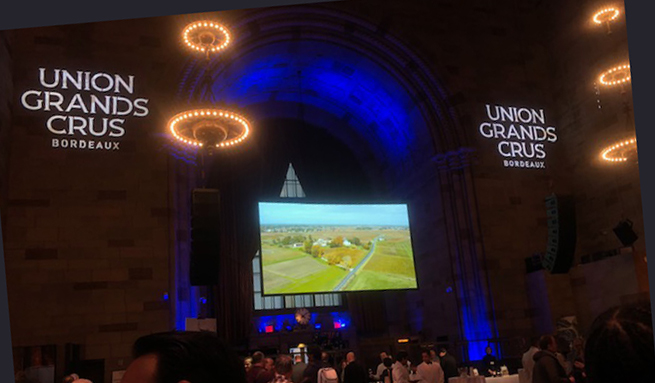
The 2023 vintage is widely described as ‘classic,’ which has become a euphemism in Bordeaux for ‘not overblown.’ This is really not a fair description. If classic means vintages of the era before global warming, say the 70s, then the mark of left bank Bordeaux would be herbaceous notes of Cabernet Sauvignon, and the mark of the right bank might be a slightly vegetal note if Merlot did not achieve full ripeness. Neither description would be at all fair to the wines as revealed by the annual UGBC tasting of the latest vintage upon release. Usually the UGCB tasting has around 120 chateaux, but this year was reduced to under 100, whether because of perceptions that the vintage will be a hard sell or because of other economic factors, so it’s not quite so representative.
After adjusting to the fruit-forward style of recent hot vintages, it can be difficult to recalibrate. The general style is restrained compared with the exuberance of some recent hot vintages. Alcohol levels have backed off from the excesses of some recent vintages. (Some people define a classic vintage in Bordeaux as having less than 13.5% alcohol on the left bank and less than 14.5% on the right bank: in that case, a ‘modern’ Bordeaux cannot have much resemblance to wines of the era before climate change, but that’s another story for another day.) The best wines in 2023 are smooth and elegant. Some are virtually ready to drink on release, some may need a year or so, but there are very few that will benefit from long aging. “Classic’ shows itself more as a lack of real concentration rather than any reversion to herbaceousness. It’s a very nice vintage to enjoy for lunch in restaurants.
Pessac-Léognan reds are quite consistent, showing a smooth elegance that’s been missing from some recent vintages. The best reds at the UGCB were Domaine de Chevalier (a slightly muted version of its usual crystalline brilliance), Larrivet Haut Brion (smooth elegance with a classic touch of cigar box), Smith Haut Lafitte (with the move to a more ‘international’ style toned down but showing slightly on its chocolaty finish) and Carbonnieux (getting away from the brutal extraction of some recent hot vintages). Tannins are really mastered in the top wines, but at a lower level, the wines show a more angular character that may come to the fore and restrict enjoyment to the mid term. The whites are lighter in style than usual, for drinking over the next 4 years or so, with Domaine de Chevalier maintaining its crystalline structure, Larrivet Haut Brion already ready but complex, and Smith Haut Lafitte showing a clean, pure style with a savory tang at the end.
Margaux is the least successful appellation in the Médoc. It’s relatively uniform, with most chateaux showing relatively light black fruits followed by a touch of tart acidity on the finish with hints of dryness from the structure. The wines are tight at the present, with a sense of asperity. It’s unclear if and when the fruits will come forward. Margaux certainly does not show a very generous style in 2023. Prieuré-Lichine stands out for a smoother, rounder balance than most. Rauzan-Ségla has beautifully delineated black fruits, giving a sense of precision, and is very approachable.
St. Julien shows a range from light and tight like Margaux to wines for which classic would be a fair description, in the sense that they show a more savory sense of balance. Beychevelle, Branaire Ducru, and St Pierre (which outclasses Gloria in this vintage) come over as virtually ready to start. This is not a vintage that shows off the forward international style, and both Lagrange and Léoville Poyferré have reverted to a more classic style with some overt evidence of structure. Talbot shows a clean, pure style that really speaks for St. Julien. Léoville Barton almost achieves its usual elegance, but still is a bit angular.
Pauillac is probably the most even and successful appellation in the Médoc, with a sense of smoothness, and is relatively full bodied for the vintage, if almost always stopping short of the usual plushness. There are few disappointments. D’Armailhac is one of the most refined (outshining Clerc Milon), and Duhart Milon shadows the style of Lafite, and is a standout for the vintage. Grand Puy Lacoste achieves its usual elegance, Lynch Bages achieves its usual smoothness, both in a lighter style. Pichon Baron and Pichon Lalande are both smooth and elegant.
Reduced numbers meant there weren’t really enough chateaux from St Estèphe to judge the appellation, but a certain hardness seems to come out in the wines.
St. Emilion is quite even, in spite of considerable problems with Merlot throughout the vintage, The wines are far from the caricature of forceful overblown forward fruits driven by high-alcohol Merlot. If there is not really a direct impression of Cabernet Franc, there is certainly an impression of greater restraint. The corollary is that the wines are (at least at this stage) a little monotonic in flavor spectrum. They should be nice restaurant wines over the next decade as they develop more flavor variety, although none is likely to achieve great longevity or complexity. The standout for its elegance is Valandraud, a far cry from its origins as a fruit-driven garage wine. Chateau Canon has made a very approachable wine. Canon La Gaffelière is very fine, with high Cabernet Franc making for a sense of precision, true to the usual sense of refinement of the chateau. Beauséjour-Bécot is smooth but nicely structured, and virtually ready now.
Reduced numbers made Pomerol hard to judge, but the wines are definitely much more restrained than has been usual in recent vintages. Some show a textured impression, perhaps because of lower fruit density, that seems a little rustic. On the limited showing at the UGCB, Pomerol was less successful than St. Emilion. One of the best is Chateau Beauregard, which shows a nicely restrained smooth style.
Sauternes and Barsac generally show mid-level botrytis, but two wines that stood out were Bastor-Lamontagne (unusually botrytic for the vintage) and Suduiraut (complex and varied on the palate with a relatively subtle impression).
2023 is an example of the progress made in viticulture and vinification. In the previous era, much of the crop, especially Merlot, would have been lost to mildew. Tannins would probably have been astringent. A relative success with Cabernet Franc explains why St. Emilion performed better than Pomerol. The left bank is less regular than the right bank.A lot depended on harvest date, as September started out rainy, and better wines were made by those who had the nerve to wait. At the end of the day, this may become a lovely vintage to drink in the relatively short term, but I view it as more in the modern style than ‘classic.’
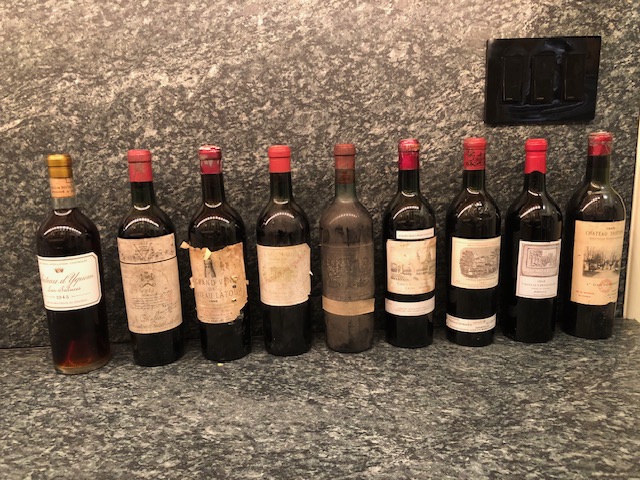
Bordeaux was in terrible shape at the end of the Second World War. It had been occupied by the Germans, and cellars were destroyed or looted. Vineyards were in poor condition: the women had done their best to maintain them and harvest grapes during the war. But the summer of 1945 was glorious and harvest occurred in close to perfect conditions. A frost early in May had reduced yields and increased concentration. The wines proved to be the best vintage of the twentieth century. Its only rival might be 1961. It’s generally agreed that the Médoc was the star of both vintages. The rivals for the best wine of the century divide between Mouton Rothschild 1945 and Latour 1961.
Before the tasting
At a retrospective in New York to celebrate the 80th anniversary, the vibrancy of the wines was still evident. Opening with Trotanoy, the wine still seemed fresh with lively fruits, well rounded, and just a touch of the tertiary character of old Merlot. It did not fade at all in the glass, even over an hour. Its elegance might be viewed as a contrast with the sheer power of today’s Pomerols.
The Berry Bros bottling of Cheval Blanc followed. It’s well known that Cheval had problems with over-heating in the vats in 1945, with ice thrown in to cool some, and volatile acidity sometimes developing. There was no trace of either problem with this bottle. Indeed, this is one of the rare instances in which I have usually found the Berry Bros bottling to be superior to the chateau bottling. The flavor spectrum of Cabernet Franc was marked, with that dry sense of tobacco dominating the finish. The wine held up well immediately after opening, but faded a bit after half an hour as the dryness of the finish took over.
The Berry Bros bottling of Cheval Blanc 1945
The next two flights were comparisons. Lafite Rothschild has been ethereal, with fragrant fruits floating in the atmosphere, but has begun to fade in the past couple of years. Although usually sturdier in most vintages, its neighbor Cos d’Estournel has sometimes shown something of the same fragrant elegance. On this occasion, the Cos started out if anything more fragrant and elegant than the Lafite, but first growth character showed as the wines developed in the glass and Cos developed an edge while Lafite floated along.
A similar development ensued with a comparison of Palmer and Chateau Margaux. Chateau Palmer started out with a touch more generosity, with rounder fruits, while Margaux seemed a little tight. Then as Palmer lost its sense of forward fruits, the structure of the Margaux loosened up and it become more elegant than the Palmer. The difference was a brilliant demonstration of the characters of their blends, heavily Cabernet Sauvignon for Margaux, more Merlot in Palmer.
Even after eighty years, Chateau Latour showed the power of Pauillac. Fruits are still relatively dense. Black fruit character and the pulling power of Cabernet Sauvignon remain evident. Some people preferred the Latour to the Mouton Rothschild, but I thought the Mouton pulled ahead for slightly livelier fruits, greater aromatics, and sense of freshness. It really is a timeless wine, or at least as timeless as wine can get.
The famous V for victory label of Mouton and a rather tattered label for Latour
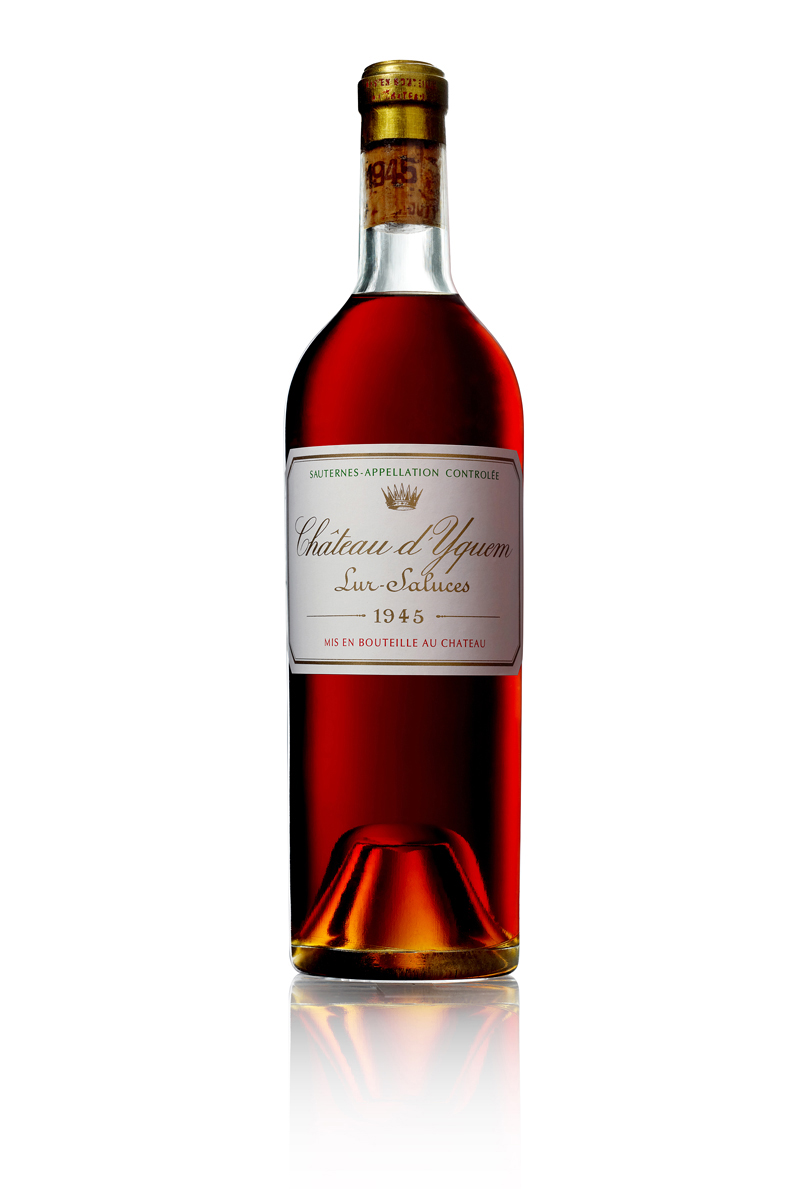
We finished with Chateau d’Yquem, so dark it seemed almost black. All Sauternes become darker with age, of course, but they say at Yquem that the 1945 is one of the darkest of the vintages of the century, having taken leaps into greater darkness every decade. It was even more intense than I remember it from my previous tasting, twenty years ago. The balance of sweetness to acidity is fantastic, with a palate that’s mature but not old, and a huge range of flavors.
Chateau d’Yquem 1945 in all its glory
I suppose it’s undeniable that these wines are no longer at their peak, which in most cases may have been several decades ago, but they are a living demonstration of the greatness of old Bordeaux.
Detailed Tasting Notes
Trotanoy
Pungent notes of old Merlot show through sweet ripe fruits, still in balance with acidity. Not at all tired although tannins are resolved. Keeps going in the glass and does not tire at all.
Cheval Blanc
Strongly dominated by mature Cabernet Franc with notes of tobacco and tea on the finish. Quite dry at the end. Feels more like the seventies than the forties in terms of age. Fading a little in the glass as fruits begin to dry out. A faint touch of tannin at the end becomes bitter as the fruits fade.
Cos d’Estournel
Just a little less weighty than the Lafite, but a very similar impression of elegance. Sweetens in the glass after opening, and then becomes a little bitter as it develops, losing elegance compared to the Lafite.
Lafite Rothschild
Not as fragrant or aromatically uplifted as previous bottles. A little sturdier than Cos when it opened, with a touch of bitterness at the end. But lightens up in the glass, developing that infinitely fragrant elegance.
Margaux
Very refined, greater sense of precision in its black fruits than Palmer, very much Cabernet Sauvignon in fine structure and texture. Great finesse Fruits begin to dry out very slowly in the glass.
Palmer
At first the Merlot carries this forward with a sense of generosity. A little fleshier than Chateau Margaux to begin with, but becomes a touch bitter as fruits fade in the glass.
Latour
Ripe and generous and quite nutty on the finish. A touch of bitterness as wine develops in glass. Certainly full bodied, you can definitely see the power of Pauillac and Latour, but it’s lost the sheer gloss, the plushness, that it showed when younger.
Mouton Rothschild
A little nutty, a little more elegant than Latour. Something of the same sense of those fragrant layers of flavor, that ethereal character, of the Lafite, but weightier. There is now a little bitterness on the finish.
Chateau d’Yquem
Rich, unctuous, figgy, very intense, very viscous. Notes of caramel. Sweet but not overwhelming. Very much its own wine, its own style. Vastly more complex than a modern Sauternes.
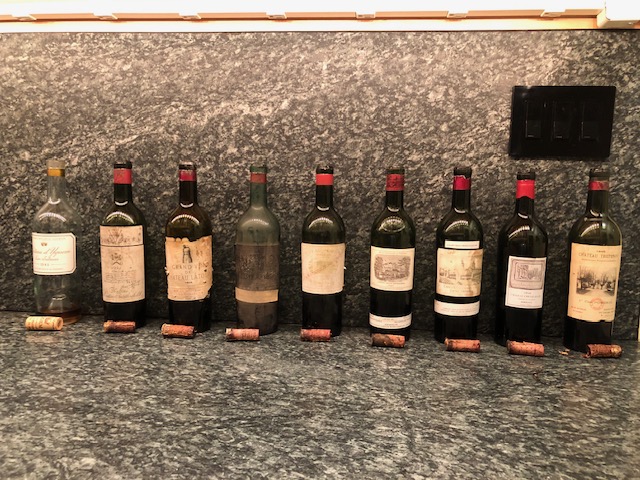
Not a drop left after the tasting. All the wines were in excellent condition, with levels varying from well into neck to very top shoulder. All the corks were original, except for Yquem, which was recorked recently. The wines were mostly sourced from old English country house cellars.
Based on this week’s annual UGCB tasting in New York, the vintage 2022 most reminds me of recently is 2016. Palates show smooth black fruits, tannins are there in background but rarely assertive, and the wines are at least approachable enough to assess. In terms of short to mid-term consumption, 2022 may offer as much pleasure as 2016. I am not so sure 2022 has quite the same intensity, and in the long term (say after 2040) I suspect it will show a lighter, less impressive style. While I wait to see if aging follows the expected pattern, my verdict is very good indeed, but perhaps not great if the criterion for great is extended longevity. Most of the wines will be ready to start within the next few years; it is a rare wine that will need waiting into the 2030s. The single descriptor that appears most often in my tasting notes is ‘smooth.’
This is certainly a vintage in which the individual appellations show their individual characters. There is greater homogeneity within each appellation than usual. It’s really a textbook year for seeing the differences between appellations on the left bank, with elegance in Margaux, precision in St. Julien, plushness in Pauillac, and hardness in St. Estèphe. It is not so obvious on the right bank, where a greater sense of restraint than usual has brought St. Emilion and Pomerol closer together. One general change is that those chateaux that had adopted an overtly ‘modernistic’ style during the Parker years have now reverted to a more restrained approach.
Pessac-Léognan divides between the top wines showing the intensity of a great year, and those wines in a slightly lighter style that may be ready to start within a couple of years. In the first powerful category are Haut Bailly (a standout this year, it really feels like a first growth), Domaine de Chevalier (with its usual great sense of precision, already turning silky
Smooth, inclined towards elegance), Pape Clément (more elegant than powerful this vintage, just a little short of the intensity of a top vintage), and maybe Smith Haut Lafitte (not as overtly modernistic as past years, but still the most ‘modern’ wine in Pessac-Léognan). In the second class are Carbonnieux, Carmes Haut Brion, de Fieuzal, Larrivet Haut Brion, Latour-Martillac, and Malartic Lagravière, all showing significant elegance. Pessac-Léognan is where I have the most concern whether the wines have enough stuffing for the long term.
In the Médoc there is an unusually clear demonstration of increasing structure as you move from south to north. The Haut-Médoc, Listrac and Moulis aren’t as fruity as, say, the wines of Margaux or St. Julien; Poujeaux and Chasse-Spleene show the most fruits in a relatively structured style. Cantemerle and Camensac are somewhat oarallel to them.
Margaux starts with more obvious structure than Pessac-Léognan. The wines tend to elegance, many are unmistakably Margaux with that impression of refined elegance, but these sense of tannins, shown by some dryness on the finish, is a bit more evident than usual. The standouts are Lascombes, where Axel Heinz is well on the way to placing the chateau in its proper place among the second growths, and has achieved a great combination of fullness and elegance, already giving a complete impression, and Rauzan-Ségla, where the extremely fine palate gives a great impression of the silkiness of Margaux. More structured than usual, Prieuré-Lichine achieves great elegance, Kirwan shows its typically lighter elegance with a great sense of fruit purity. Desmirail’s elegance is typical of Margaux. Brane-Cantenac, Cantenac-Brown, Dauzac, Giscours, and Malescot St-Exupéry all show that sense of structure against the palate of smooth black fruits.
In St. Julien, the fullness of the vintage plays off against the classic precision of the commune. Wines vary from those where precision is the dominant influence to those which show a broader, fuller palate. Fruits tend to be a little fuller here than in Margaux, so the tannins are sometimes a bit better hidden, but the wines are definitely well structured. As always, Léoville Barton typifies the precision of St. Julien, and Langoa Barton is in the same style but less intense. Léoville Poyferré has a more overt sense of black fruits, but has backed off from the full modernistic style of recent years. Saint Pierre is fuller and sweeter than its stable mate Gloria. Beychevelle shows its classic tightness, a coiled spring waiting to unwind, and Talbot is a bit rounder than usual for the chateau.
Pauillac shows a yet more structured impression than St. Julien, not quite a throwback to classicism, but certainly a counterpoint to the fruits, with the sense of structure pushing the usual plushness of Pauillac more into the background. The standouts in Pauillac are the two Pichons. When I came to Pichon Baron, I thought it showed the most obvious typicity of the appellation; and then I came to Pichon Lalande, which is even plusher and fuller. Both are outstanding, with black fruits coming well through the structure. Lynch Bages goes for elegance rather than power in this vintage. Grand Puy Lacoste shows a great combination of plushness and elegance. Grand Puy Ducasse shows a new level of precision. D’Armailhac is fuller and more concentrated than its stable mate Clerc Milon, Duhart Milon is very fine. Haut Batailley shows a distinct advance in finesse under its new management (from Lynch Bages); Batailley is not quite so refined. There scarcely seems to be any chateau in Pauillac that hasn’t produced a wine this year immediately identifiable as coming from the commune.
St. Estèphe is always difficult to assess at the UGCB because the tasting never includes the top wines, but that typical hardness of St. Estèphe is evident across the board.
I often find the wines of the right bank too overtly fruity, Pomerol more so than St. Emilion, but whether because of conditions of the vintage, or because producers have backed off from the Parkerized style, this year there is a greater sense of restraint. You would not mistake the wines for the left bank as they are evidently more open, but the fruits are nicely matched by structure in the background.
St Emilion shows wines with elegance (this is not a phrase I use so often on the right bank). The standouts are Canon-La-Gaffelière, which has simply became more refined every year, and in 2022 shows a great sense of precision, and Valandraud, which shows a level of refinement that’s unusual for St. Emilion and is all but the antithesis of the in-your-face character of the garage wines. Pavie Macquin has a slightly fuller style, with a great foreboding of savory development to come. La Dominique really typifies the vintage with round black fruits making a smooth palate backed by supple tannins. Beau-Séjour Bécot, Dassault, Clos Fourtet, Grand Mayne, La Tour Figeac, Trottevielle all follow suit.
Pomerol is not as forward and obviously fruity as I associate with its usual state. Tannins are quite firm in the background, although never obtrusive, brining a greater sense of structure than usual, but without showing that sense of dryness on the finish displayed by the wines of the Médoc. Some Pomerols feel more like St. Emilion. With that sense of structure, they probably will not be ready much before the wines of the left bank. Le Gay comes closest to my image of Pomerol for its rich, forward black fruits. Petit Village is fuller and more typically Pomerol than its (new) stable mate, Beauregard, which offers more restraint and structure and seems backward. Clinet and Gazin are mid weight and firm, more restrained than the style I usually associate with the chateaux.
There are years when the whites of Bordeaux are so rich and oaky that they seem reminiscent of Burgundy, but 2022 tends towards crispness and even sometimes a touch of herbaceousness from Sauvignon Blanc. One of the more intense whites of the vintage, Pape Clément is the standout for richness, with no trace of herbaceousness. Domaine de Chevalier shows its usual great sense of precision. Moving more towards herbaceousness, Smith Haut Lafitte is just a little less refined. De Fieuzal, Larrivet Haut-Brion, Latour Martillac, and Malartic-Lagravière show palates of stewed citrus with that typical hint of herbaceousness in the background.
Sauternes did well this year, with wines showing nicely botrytized noses and palate following into marmalade, caramel, honey, and nuts. Suduiraut is the standout for its intensity, followed by Doisy-Védrines. Guiraud and La Tour Blanche are full on the palate but don’t show those savory overtones.
2022 is a more even vintage than usual, making it hard to go wrong.
Tasting Notes
Pessac-Léognan Blanc
Château Carbonnieux Nose mingles nuttiness with herbaceousness. Palate veers towards refreshing herbaceousness, quite noticeable retronasally. 89/100
Château Les Carmes Haut Brion Slightly lighter style, elegant but does it have enough stuffing for the long term? 90/100
Domaine de Chevalier Blanc Whiff of herbaceousness on nose is offset by sweet ripeness of fruits on palate. Very fine representation of the precision of the chateau and the style of Pessac-Léognan. 93/100
Château de Fieuzal Smooth and black, inclined to elegance. Questions is whether it has enough stuffing. It will be ready to drink quite soon. 90/100
Château Haut-Bailly Intensity of palate reminiscent of old vines cuvées. Tannins are supple, fruits are black, the intensity feels like a first growth. Tannins are not at all obtrusive, the fruits are much in front. Could almost start now. 94/100
Château Larrivet-Haut-Brion Smooth, inclined towards elegance, but the question is whether it has stuffing for longevity. Generally a modernistic impression. 90/100
Château Latour-Martillac Slightly attenuated impression. Smooth black fruits but not a lot of stuffing behind. Needs more presence on the palate. 90/100
Château Malartic Lagravière Smooth, elegant, black, not quite a lighter style, but not full force. Black fruits are supported by relatively light tannins. 90/100
Château Pape Clément Mid weight palate is well balanced between black fruits and supple tannins but possibly not the intensity of the very top vintages. Perhaps it’s just going for elegance. Not so overtly modern as in the past. 92/100
Château Smith Haut Lafitte Smooth and modern with faintly nutty notes and traces of vanillin. Supple tannins in the background. Somehow the modern style is not persuasive. This may be the most modernistic wine of the year. Very nice for short time, but what about longevity? 92/100
Pessac-Léognan
Château Carbonnieux Smooth palate with just a rasp from structure at the end. Very much Graves, cigar box showing on top of black fruits, Reminiscent of 2016, very promising. 91/100
Domaine de Chevalier Smooth and elegant, very typical. Black fruit palate supported by tannins that are already turning silky. Long finish shows black fruit s tending to blackcurrants. 93/100
Château de Fieuzal Sense of citrus fruits and herbaceousness on palate, but not as intense as I expected from the year. Nice balance with refreshing style of citrus fruits. 90/100
Château Larrivet-Haut-Brion Restrained, faint herbaceousness offsets citrus palate. Nice sense of balance and completeness. 91/100
Château Latour-Martillac Slightly herbaceous stewed citrus impressions but not as much concentration on palate as I would like. 90/100
Château Malartic Lagravière Stewed citrus fruits with sweet ripe impressions. Faint hints of nuttiness at end. 90/100
Château Pape Clément One of the more intense whites of the vintage. Sweet ripe stewed citrus, no trace of herbaceousness. Smooth and silky. 92/100
Château Smith Haut Lafitte Banc Smooth, fine, stewed citrus fruits on palate with no trace of herbaceousness. This is just a little less refined than Pape Clement. Smooth and silky on the finish. 92/100
Moulis
Château Chasse-Spleen Softer than Poujeaux but perhaps fruits are not quite as concentrated, although there is greater tannic structure with more dryness on the finish. There is just a touch of hardness on the finish. 90/100
Château Poujeaux Very typical result for chateau. Opens with black fruits that then become more restrained as firm tannins kick in. Touch of dryness at end indicates structure. Origin outside the great communes betrayed by just a touch of hardness. 90/100
Haut-Médoc
Château Cantemerle Nice sense of restraint against black fruit palate. Tannins are smooth in background. This is all but ready to drink. 90/100
Château de Camensac Faint hints of herbal character on nose. Nice balance on palate but not as concentrated as I expected for year. 90/100
Château Citran Black fruits subsumed by flatness of finish. Not much pizzazz. 89/100
Margaux
Château Brane Cantenac Faint sense of asperity to nose. Not quite barnyard but some herbal impressions faintly in background. Slightly attenuated quality. Tannins quite tight. 90/100
Château Cantenac Brown Mid weight palate, some dryness from tannins at end. The elegance of Margaux is pushed into the background. Structure needs to resolve a bit. 90/100
Château Dauzac Slightly herbal sense of austerity to nose. Sweet ripe fruits on palate, fruitiness quite overt. Wine a little fuller than usual for Margaux. 90/100
Château Desmirail Classic nose of black fruits, spices, and herbs. Restrained black fruits on palate. Very typical of Margaux with lovely herbal impressions on finish. Should be ready soon. 91/100
Château Giscours A little fuller as always, but nicely restrained on palate. Structure indicated by dryness on finish. Palate shows fruits in background but tannins not too overt either. Hard to judge. 90/100
Château Kirwan Here is the typical elegance of Margaux and the light touch of Kirwan. Great sense of fruit purity. Structure indicated by dryness on finish. 91/100
Château Lascombes Full force elegance if that’s not an oxymoron. Palate is relatively full for Margaux, with smooth black fruits and supple tannins. Already there is an impression of completeness. 94/100
Château Malescot St. Exupéry Smooth and very Margaux-ish. Structure shows non finish. Indeed this gives impression of well-structured wine. Black fruits show liquorish impressions with faint aromatics. Feels relatively modernistic. 92/100
Château Prieuré Lichine Smooth, elegant, very Margaux-ish, structure indicated by dryness at end. Elegant black fruits with tannins really drying finish. More structured than usual. 91/100
Château Rauzan-Ségla Very fine, very elegant, really epitomizes Margaux. Smooth and silkier than most Margaux chateaux this year. Classic representation of chateau and appellation. 93/100
Château du Tertre Smooth, elegant, tannins well in background, some hints of smoke. Very nice, but not as intense as some chateaux this year. 90/100
St. Julien
Château Beychevelle This shows the classic tightness of young Beychevelle, with elegant fruits feeling very Cabernet Sauvignon-ish and a sense of taut structure on the finish. Dryness on the finish shows significant structural support. This is a very fine result in the traditional style of the chateau. 92/100
Château Branaire Ducru Smooth palate shows good sense of precision of St. Julien. Lovely black fruits fill the palate with just a touch of overt fruitiness at the end. 91/100
Château Gloria Nice sense of the precision of St. Julien. Fruits are a little tight, quite elegant, but I wonder if there is quite enough stuffing for longevity. 90/100
Château Gruaud Larose A little flat on the nose. Fine granular impression on palate, black fruits just a little muted at present. Should become a classic representation of the chateau showing the drier side of St. Julien. 92/100
Château Lagrange Smooth, elegant, good sense of St. Julien. The overly modernistic impression of recent years has all but gone. Just a faint touch of vanillin to remind of recent history. Tannins quite firm but not obtrusive. 91/100
Château Langoa Barton The usual fine impression of the Barton wines, but less presence on the palate than I expected in this vintage. Black fruits are supported by fine tannins, I would have liked just a little more intensity. 90/100
Château Léoville Barton As usual more intensity than Langoa. Smooth, elegant, greater sense of structure. Very fine tannins scarcely obtrude on the palate. Very much the Barton style. 92/100
Château Léoville Poyferré Overt sense of black fruits to nose and palate. Firm tannins with touch of dryness on finish. The modernistic style is not so evident as previously, but the palate is relatively full, you fill the vintage has filled it out more than usual. 92/100
Château Saint Pierre Fuller and sweeter than Gloria and also more sense of structure showing with the dryness of the finish. Less precise but broader than Gloria. 91/100
Château Talbot Relatively round impression for Talbot. Just a hint of tannic dryness at end. Firm impression on palate. Developing in a savory direction. 92/100
Pauillac
Château Batailley The fullness of Pauillac shows, not quite plush on the palate. The texture is not quite as fine as I would like. Structure needs to soften. 90/100
Château Clerc Milon Just a touch tight and restrained. Tannic structure shows as dryness on finish. A bit of a throwback considering the vintage. 91/100
Château d’Armailhac Fuller than Clerc Milon, greater fruit concentration, smooth tannic structure showing more as restraining influence than dryness on finish. 92/100
Château Duhart Milon A very fine impression, showing finesse over plushness, tannic structure just detectable by dryness on finish. Will mature to elegance rather than power. 92/100
Château Grand-Puy Ducasse Here is something of the plushness of Pauillac offset by a well structured character. This is very Pauillac and represents a distinct advance over previous years for the chateau. 92/100
Château Grand-Puy-Lacoste Smooth and elegant, very much the elegant style of the chateau, fine black fruits, supple tannins in background. Perhaps not as forceful as 2016. 92/100
Château Haut Batailley A distinct advance in finesse over the old style.. Fine black fruits supported by tannins that dry the finish. Quite structured in the classic tradition but the fruits behind the structure are evident. The closest to a vin de garde this vintage comes. 92/100
Château Lynch Bages Very fine, very elegant, smooth rather than plush. Finely textured palate will move in savory direction as it ages. 94/100
Château Lynch Moussas Fine structure feels more like St Julien. Quite an elegant impression. Structure imposes restraint rather than dryness on finish. Very good for the chateau. 90/100
Château Pichon Baron Perhaps the most classic representation of Pauillac in the vintage. Round black fruits are almost plush with very smooth supple tannins. A top result for the chateau and the vintage. May become chocolaty as it ages. 94/100
Château Pichon Longueville Comtesse de Lalande Plusher and fuller even than Baron. Tannins show firmness on finish. Lovely black fruits just coming through the structure. Very typical Pauillac. 95/100
St. Estèphe
Château Cos Labory Here is the hardness of St Estèphe, not really dryness on the finish, just a little hard, flattening the impression of the underlying black fruits. Just needs time. 90/100
Château Phélan Ségur Quite smooth for the chateau and for St Estèphe. Structure shows at the end but I expect this to soften in 4-6 years. 90/100
St. Emilion
Château Beau-Séjour Bécot Smooth, round, and fruity. Tannins well in the background are supple. Touch of overt fruitiness reveals Merlot. Close to approachable. 90/100
Château Canon La Gaffelière Really shows breed because it not only has the round black fruits of the vintage with supple tannins but also an impression of precision and elegance. This is very fine. 94/100
Château Dassault Smooth, round, soft black fruits, supple tannins, quite an elegant impression for St. Emilion. Maybe I would like a touch more presence on the palate. Very approachable. 92/100
Château La Dominique This wine really typifies the style of Grand Cru Classés this vintage. Soft, round, black fruits are relatively forward, but there is a touch more tannic presence, although supple, than some. Very good result, 91/100
Clos Fourtet A little more restrained than most this year. Good balance between black fruits and unobtrusive structure. Hints of coffee. 91/100
Château Grand Mayne Typical for year, black fruits at front, supple structure behind, but not quite enough pizzazz on palate. 90/100
Château Pavie Macquin Right on form. Palate shows firm black fruits, slightly nutty in the background. Nice sense of savory development to come. Very well balanced. A proper wine. 92/100
Château La Tour Figeac Typical if not at the top rank. Not exactly attenuated, but not as much presence as I would like on palate. Just a touch of firmness from structure at end. 90/100
Château Trottevieille Slightly flat on the palate compared with the more obviously fruity chateaux of this vintage. Tannic structure is not obtrusive but seems to be responsible for flattening the palate a bit. 90/100
Château Valandraud Very fine result showing a level of refinement that’s unusual for St. Emilion. Palate has finely textured black fruits, tannins in background. I don’t often say this in St. Emilion, but the overall impression is elegance. It is a complete contrast with the reputation of garage wines. 93/100
Pomerol
Château Beauregard Seems restrained for Pomerol. Black fruits segue into firm finish with some elegance. Feels more like St Emilion or even left bank compared to usual lushness of Pomerol. Structured enough to need time. 91/100
Château La Cabanne Soft, a bit forward, quite Pomerol-ish, but firm tannins in background. 90/100
Château Clinet Mid weight black fruits. More restrained than I usually associate with the chateau. Firm tannins in background. 90/100
Château Le Gay This is one of the few wines of the vintage that taste like my image of Pomerol. Forward, fruity, and black on palate, although tannins are firm in background. 90/100
Château Gazin Quite a firm impression on the palate. Black fruits more in the background than most, tannins quite firm. Feels surprisingly like St. Emilion. 90/100
Château Petit Village Fuller and more typically Pomerol than Beauregard, but even so there is more sense of structure than I usually associate with Pomerol. Black fruit palate has firm tannins in background. 92/100
Sauternes
Château Doisy-Védrines Botrytis on nose, sweet on palate, but not too sweet, you can see the flavor variety coming through with citrus, marmalade, and nuts. Lingers on the finish. 93/100
Château Guiraud Full on the palate, botrytis showing on nose and palate, with honey, nuts, and marmalade. Sweetness is just a touch overt. 93/100
Château Suduiraut Nose is redolent with botrytis, honey, marmalade, stewed citrus. Viscous palate has great concentration, long finish with hints of bitterness. This is a top result. 95/100
Château La Tour Blanche Sweet palate with notes of botrytis but some bitterness on top of honey, nuts, and marmalade, but no savory contrast. 91/100
2017 is a great year for defining differences between appellations on both left and right banks, even if those differences do not always conform to the common historical definitions. The general character of the year is surprisingly classical, although without the herbaceous or bitter background that young Bordeaux used to have: you might call it a modern take on the classical character. Many wines will be ready relatively soon (think about starting mostly about four years from now and drinking for about eight years). This will be a fine year for restaurant wines, with the best retaining their typicity in a more approachable style; there’s just enough stuffing to support mid-term development without any dilution. Wines that have moved towards an international character are less obvious this year; the effect of vintage has been to damp down the style into a smoothness from which black fruit aromatics just poke out.
The UGCB presents the vintage in London in October, and in the USA in January.
The UGCB tasting held in New York this week showed most of the great chateaux (excepting the first growths). I started with Pessac-Léognan, where most reds are relatively subdued, but show good sense of texture on the palate, although that classic impression is reinforced by bitterness often running ahead of the fruits. They should mature to a smooth elegance for drinking in the mid term. In top châteaux, Pape-Clément just shows its international character with black fruit aromatics poking out through the tannins, while Smith Haut Lafitte shows as one of the most obviously international wines in Bordeaux this year, with a soft, almost opulent impression just cut by the tannins of youth. Haut Bailly shows classicism with structure presently outrunning the fruits but suggesting good aging potential, Domaine de Chevalier is perhaps not quite as smooth as usual but has good aging potential, and Les Carmes Haut-Brion really shows its 55% Cabernet Franc. Whites tend to show a grassy herbaceous character, sometimes verging on sweaty, but with sweet citrus fruits, as typified by the attractive Carbonnieux. In top wines, Domaine de Chevalier gives a classy impression of subtle citrus, if not quite at its usual level of crystalline brilliance, and Pape-Clément and Smith Haut Lafitte reverse the relationship of their reds, with Pape-Clément full, rich, and almost opulent, while Smith Haut Lafitte is not quite as overt.
Moving from Graves to Margaux, the first impression is the increased finesse of the structure, with tannins still evident, but showing a finer-grained character. In terms of historical comparisons, this is a lighter vintage for Margaux. Going in deeper, Margaux seems to split into two parts: the top wines have the structure and balance to age at least through the mid-term, and may require longer than the wines from Pessac-Léognan; but most wines are somewhat lighter, and fall into the category of what you might call restaurant wines, lovely for the mid-term but without potential for real longevity. The general character should be to age towards delicacy, with the best wines showing a savory character. In the first group, I would place Chateaux du Tertre, Rauzan-Ségla, perhaps Rauzan-Gassies; in the second group come Kirwan, Durfort-Vivens, Desmirail, Cantenac-Brown, Brane-Cantenac, Prieuré-Lichine, Malescot-St.-Exupéry. Dauzac, Ferrière, and Marquis de Terme are rather tight, while Giscours as always is a little on the full side for Margaux, but the vintage makes it a little short. Lascombes is more classical and less international than preceding vintages. I’m less convinced about the potential of Margaux, compared with other appellations, to stay on the right side of the line between delicacy and dilution.
The Crus of the Haut-Médoc more or less follow Margaux, although texture is generally not quite so fine. La Lagune stands out for elegant aromatics; and the smooth aromatics with hints of blackcurrants mark out La Tour Carnet as part of the international movement. In Moulis, Clarke has just a touch more elegance than Fourcas-Hosten, while in Listrac, Poujeaux approaches Margaux in style this vintage.
Graves and Margaux are all black fruits, and red fruits first appear in my notes when I arrived in St. Julien. But the main difference is the contrast between the clarity of the palate in Margaux and a tendency towards a fine chocolaty texture in St. Julien, strong in Beychevelle, just evident in Gruaud Larose, and almost imperceptibly in the background in Branaire-Ducru. Chocolate is the unmistakable mark of St. Julien in this vintage. Its soft, almost furry, tannins may make the wines seem more approachable sooner. As always, Langoa and Léoville Barton are the wines that stay closest to the historical roots of St. Julien, with Langoa very fine and Léoville showing more presence through a translucent palate. Léoville Poyferré and Lagrange show the smoothness of the international style, making them among the softer wines of the appellation. Gloria is elegant but not as fine as St. Pierre, which is moving in a savory direction. Talbot’s round, ripe character is a far cry from the old dry style of the Cordier house, and an indication of the change in Bordeaux.
Pauillac stands out in this vintage for that characteristic combination of finesse and firmness in the tannins, which are more obviously tamed than in St. Julien, Margaux, or Graves. The wines show lovely firm structure, sometimes with the plushness of Pauillac just poking through. Three chateaux in the two Rothschild groups illustrate the range. Armailhac shows the restrained power of Pauillac, but there is something of a reversal of the usual hierarchy with Clerc Milon showing more elegant black fruit aromatics; Duhart Milon is rounder and finer, and moves in the direction of Lafite. Grand Puy Ducasse has increased in refinement and moved closer to Grand Puy Lacoste, both showing a certain roundness and plushness to indicate they are in Pauillac and not St. Julien. Lynch Moussas offers the Pauillac version of a restaurant wine. Lynch Bages is lovely and firm, Pichon Baron is a little brighter than most Pauillacs and seems less dense then usual, while Pichon Lalande is quite typical of itself and the appellation, although again just short of the density of a great year. St. Estèphe is always difficult to assess at the UGCB because few chateaux are represented, but there seems to be a tendency to show the hardness that can characterize the appellation. Phélan Ségur seems more successful than Chateau de Pez or Ormes de Pez.
There is something of a reversal between St. Emilion and Pomerol, with the top wines of St. Emilion showing an opulence and richness driven by Merlot, while Pomerol tends to show something of the relatively greater restraint of St. Emilion. But the range here extends from overtly lush wines to those where the dryness of the finish attests to an underlying structure needing time to resolve, to those that verge on herbaceous, giving the impression that the grapes may not have been uniformly ripe. At the lush end of St. Emilion come Beau-Séjour Bécot, where soft, opulent fruits bury the tannins and give an impression half way to Pomerol, Canon-La-Gaffelière with a chocolaty impression, and the even finer Canon with its hints of blueberries, raisins, and chocolate. There’s more impression of Cabernet Franc in La Couspade and La Dominique, while Clos Fourtet, La Gaffelière, Larcis Ducasse, and Pavie Macquin are relatively restrained. Perhaps the surprise is Valandraud, which in a turn-up for the book shows this year as the most classical representation of St. Emilion, slightly nutty, nicely ripe, but not too overtly Merlot-driven.
In Pomerol, the finesse of Bon Pasteur gives the lie to Michel Rolland’s reputation as the architect of excess, Beauregard is clearly driven by Merlot but stops a touch short of opulence, and Clinet gives an impression almost of belonging to St. Emilion rather than Pomerol. The general impression is more restrained than usual.
Conditions late in October favored botrytis, but in a limited tasting—some of the Sauternes ran out before I got to them at the end—the wines seemed more inclined towards elegance than towards the luscious power some reports have suggested. Again showing the capacity of the vintage to reverse historical trends, Chateau de Fargues is elegant and subtle as always, but not as evidently botrytized as usual, Rieussec has good density with impressions of botrytis, and Suduiraut has the greatest botrytic influence.
Pricing so far often seems too close to the great 2016 vintage for comfort, but wines that could be found at, say, under two-thirds of the price of the 2016, would offer a good opportunity to appreciate the styles of many chateaux in the relatively short term.
“I’m finding it hard to see a lot of love in these wines,” one taster said at the tasting of 2016 St. Emilion Grand Cru Classé in New York. Indeed the wines are quite tight at present, but although elegant is not the first word I usually use to describe St. Emilion, it was often the most appropriate description in my notes.
The general impression of the vintage is fine, structured, and still a little tight. In a blind tasting it might be difficult to identify most of these wines as being predominantly Merlot because their texture has a finesse you might not usually associate with the variety. Most need at least 3-4 years, not so much for the tannins to resolve, as they are generally fine and tend towards silky, but to let flavor variety come out from under. They remind me more of the Left Bank than of the usually plusher character of the Right Bank.
The style of 2016 is a great compromise between the extremities of earlier years. At the same tasting of the 2010 vintage six years ago, my problem was in distinguishing wines from one another (Oenologues Triumph in St. Emilion) because they all showed much the same character of furry tannins behind soft black fruits. And then four years ago at the tasting of the 2012 vintage, the wines were tight and alcoholic, often verging on tough, with quite sharp tannins (Alcohol and Tannins in St. Emilion: Cheshire Cat Years?)
By contrast with the earlier years, 2016 has a great sense of balance between fruits and structure. Of course they vary in their stages of development. A few are really still tight, but in most, flavor variety is just beginning to poke out from the palate, with some wines now moving in a savory direction. They should become increasingly fine as they age over the next couple of years, and then show increasing generosity and delicious refinement for at least the next decade.
I hesitate to project beyond that, but there were a few older wines on display to give some indication of aging potential, among which Dassault 2000 was quite mature and really at its peak with signs of tertiary development, Grand Pontet 1995 was flavorful but quite dry at the end, and Grand Corbin Despagne 1989 is à point although not showing tertiary development. (I had the 1988 at the château a year ago, and it was even better, making the point that Grand Corbin-Despagne really makes 30-year wines.) The best wines of 2016 may therefore well last for two decades or more.
The 2016 Vintage
Bellefont Belcier: Very smooth on palate, with structure just holding the fruits back, but very fine impression promising elegant future.
Chauvin: Very fine impression with smooth, silky tannins, flavor variety just coming out, moving in a savory direction with a tang on the finish. Fine result for vintage.
Clos des Jacobin: Fine elegant impression to nose, elegant structure and fruits on palate against silky background, flavor coming out and moving in savory direction.
Corbin: Firm palate with hints of chocolate on finish, nice flavor variety already beginning to show with the finesse of the vintage. Flavorful palate is moving in a savory direction.
Dassault: Firm palate moving in chocolatey direction, underlying texture with savory flavors, a touch of tannins at end on long finish.
de Pressac: Minty impression to nose, nice solid impression with good flavor variety showing on palate, moving in savory direction, with hints of mint coloring the palate.
Faurie de Souchard: Very smooth indeed, very fine texture to palate, with tannins just showing on dryness of finish, with hints of mint and chocolate. Very fine indeed.
Fonplégade: The most approachable wine in the 2016 tasting. Quite a rich nose tends to buttery impressions, with good structure and elegant balance on palate. Fine silky tannins evident only by faint bitterness on finish. Touch of heat at end but otherwise very sophisticated for St. Emilion. Tannins moving in chocolatey direction.
Fonroque: Restrained nose, fine palate shows rather fresh acidity considering vintage and appellation, quite tight and backward. Might be difficult to identify this as 90% Merlot in blind tasting. Needs time to release flavor variety.
Grand Corbin: Tight and backward, almost fresh acidity, tannins tight on finish with touch of bitterness, somewhat of an old school impression with reflections of the left bank.
Grand Corbin-Despagne: Very faint buttery impressions to nose. Fine texture in background on palate, structure shown by a little bitterness at end but is very fine. Long finish promises goof future development.
Grand Pontet: Elegant impressions to nose, fine and tight, follow to palate. Fine texture should turn silky with age. Flavor variety is just beginning to show. Should mature to real elegance.
Jean Fauré: Very restrained nose, really quite dumb. Palate shows a little more texture than most, but not so lively (yet). Quite structured and a bit uncertain how long it might take for fruit to come out.
La Tour Figeac: Some flavor variety beginning to show against background structure evidenced by almost-phenolic bitterness at end. This needs time to come around. A savory impression on the finish is promising.
Ripeau: Fine structure supports savory notes on palate, somewhat backward in being gripped by acidity, and a little uncertain as to future supply of generosity.
Yon Figeac: Generosity is hiding behind the structure. Smooth palate shows flavor variety just coming out, structure in nice balance with fruits, which will emerge more clearly in next year or so.
Older Wines
Dassault (2000): Mature impression with nose showing some tertiary notes and some high-toned aromatics with oxidative notes. Shows some development on palate with touch of sous bois contrasting with the high-toned aromatics. Around its peak, with the risk of oxidation taking over with further aging.
Grand Pontet (1995): Faintly minty, faintly herbal impressions to nose, following to lovely palate on edge of showing mature development. Quite dry on the finish but good flavor variety. Some people might find this a little dry.
Grand Corbin-Despagne (1989): Surprisingly youthful with no signs of tertiary development. Nose is a little dumb but palate is à point. Smooth palate with tannins almost resolved, moving a little towards minty herbal impressions. May be on verge of fruits beginning to dry out.
Judging from this week’s UGCB tasting of 2015 Bordeaux in New York, the vintage is very good, although lacking the sheer wow factor of 2009 or 2005. I see it as a modern take on classic tradition, by which I mean that the wines tend towards elegance and freshness, but without the heavy tannins or herbaceousness of the past, and are relatively approachable.
After a day tasting around 100 chateaux, I had a 1978 Léoville Lascases for dinner: the difference in style is most marked in the delicious tang of herbaceousness marking the 1978. Needless to say, there was not a trace of herbaceousness in any of the wines of 2015. I miss it.
2015 is a relatively homogeneous vintage: there is more or less even success across the board. It is even true that the difference between modernist and more traditional châteaux is much less marked than in some past vintages. In previous vintages the modernists–among which I include Pape-Clément, Smith Haut Lafitte, Lascombes, Lagrange, Léoville-Poyferré, Pichon Baron, Cos d’Estournel–have stood out for forward fruits, very ripe and round, sometimes approaching New World in style: in 2015, modernism takes the form of a smooth sheen to the palate, with tannins tamed and very fine. But it’s a general mark of the vintage that tannins are rarely really obtrusive, and the taming of the tannins is likely to mean that, unless it closes up unexpectedly, the vintage will be ready to start relatively soon,.
Appellation character is clear this year.
Margaux is very fine and elegant, although there is a tendency for the lighter fruits of the appellation to let the tannins show more obviously than in other appellations. The appellation generally gives somewhat the impression of a lighter year. Durfort Vivens has really revived, with a fine effort that speaks to Margaux, Kirwan has more finesse due to its new cellar, Lascombes is more elegant and less modern than usual, Rauzan-Ségla is quintessential Margaux, and Siran presents a great view of Margaux from the class of Cru Bourgeois.
The same sense of elegance carries to St. Julien, except that here the tannins universally seem exceptionally fine in the background, making many wines more immediately attractive; St. Julien is closer in style to Margaux than to neighboring Pauillac. Beychevelle as a very convincing expression of the appellation, Gruaud Larose is very much on form this year, Lagrange seems lighter compared to its usual modern style, Léoville Barton is stylish and elegant, the quintessential St. Julien, while Léoville Poyferré is distinctly more modern.
Moving into Pauillac, there is more power in the background, with wines somewhat rounder, but there’s a range from almost rustic to utterly sophisticated. Tannins are held in check by density of fruits, making wines seem relatively approachable. A fine effort from d’Armailhac is almost plush, it’s a good year for Grand Puy Ducasse but it doesn’t have the breed of Grand Puy Lacoste, which is structured and built to last, Lynch Bages is a solid representation of the appellation, Pichon Baron shows the smoothness of its modern style, but this year Pichon Lalande gives an even more modern impression and seems quite approachable.
It’s always hard to get a bead on S. Estèphe at the UGCB because so few châteaux are represented, and the top châteaux are missing, but if I got any sense that the vintage was less successful in any one appellation, it would be here. Tannins are well in front of fruits and less tamed than in other appellations: the classic tightness of St. Estèphe tends to show through. None of the wines can be called generous, although Lafon-Rochet gets half way to Pauillac with a smooth palate, Cos Labory shows the tightness of St. Estèphe, and Phélan Ségur seems on the light side for the appellation.
Outside of the great communes, La Lagune will be a classic, La Tour Carnet is more modern but not as obvious than usual, Cantemerle is quite smooth.
Cru Bourgeois show in similar style to the grand cru classés, but with less refinement and roundness; there isn’t the difference between the classic approach and the luxury wine approach of rich years such as 2009, although the advantage of the grand cru classés remains obvious.
Graves has many lovely restaurant wines, that is, well balanced for drinking immediately.
In Pessac-Léognan, I did not get much sense of the classic cigar-box in the reds, but the wines did seem a little more granular than the Médoc. Domaine de Chevalier is lovely with its usual crystalline brilliance, Haut Bailly is more granular, Larrivet-Haut Brion is smooth, Malartic-Lagravière is just a touch more tannic, Pape-Clément is not quite as modern in its aromatics as Smith Haut Lafitte.
It’s a very good year in St. Emilion, with wines showing the generosity of the right bank, but nicely restrained rather than lush. In fact, restrained is the phrase that occurs most often in my tasting notes. Beauséjour-Bécot is smooth, Canon is beautifully refined, Canon La Gaffelière is a top result for the appellation with layers of flavor, La Gaffelière is true to the structured tradition of the château. Making its first appearance at the UGCB, Valandraud no longer makes the outrageous impression of a garage wine, but seems in the mainstream.
Pomerol does not show full force lushness, and is only a little more fruit-forward than St. Emilion, with many wines showing more obvious evidence of structure than usual. The restrained black fruits of Clinet tend to elegance, even Michel Rolland’s Bon Pasteur shows evident structure.
Whites are decent but nothing really stood out for me: Graves produced lovely restaurant wines in whites as in red. Pessac-Léognan seems less concentrated than usual, and wines tend to be soft and attractive. Particular successes: Châteaux de France, Malartic-Lagravière, Pape-Clément, Smith Haut Lafittte.
Sauternes are delicious, with Château de Fargues as a standout. A sense of purity makes the wines refreshing.
Overall a very good year, with wines tending to be restrained rather than obvious, most needing only a few years before starting, and probably best enjoyed in the decade after that.
I went to this year’s tasting of the Union of Grand Cru Bordeaux in the slightly surreal surroundings of Miami. Outside people were playing in the pool; inside we were tasting the first showing in the States of the 2014 vintage. Ten or twenty years ago, if I had said this was a restaurant year, it would have been taken as meaning that the wines were relatively light and enjoyable to drink in the mid term without having the potential to age longer term. That is a reasonable description of Bordeaux in 2014 except for a big difference: most of the wines are virtually ready to drink now because of the refinement of the tannins; in the past they would still have needed several years to come around.
Few of the 2014 vintage need more than another year or so, and even for those it’s more a matter of preference than a necessity. Because the wines do not have punishing levels of extract, and the wines are more restrained than usual, this is a great year for seeing the differences between appellations. Typicities are especially clear on the Left Bank, although the restrained style of the vintage makes the Right Bank seem less rich and powerful than usual.
This is not a great year for whites, although there is more variety in the character of Pessac-Léognan than usual, from Domaine de Chevalier’s usual crystalline precision, to Smith Haut Lafite’s crisp Sauvignon edge to a rich palate, and Pape Clément’s exotic opulence. Most others show a tendency to display Sauvignon Blanc’s herbaceous side, sometimes with an exotic overlay.
The relatively light character of the vintage shows through in Pessac-Léognan, where the wines tend to elegant black fruits rather than power. They are well balanced for current drinking; some give the impression that it may be important to enjoy before dilution begins to set in. The extremes of precision versus breadth show as usual in Domaine de Chevalier (one of the few that really does need some time) and Pape Clément (less international than usual). Haut Bailly is definitely top flight Left Bank, but seems more Médocian this year. It’s a relatively crisp vintage in the Graves, some might even say tending towards mineral. I think Malartic-Lagravière have upped their game in recent years, and the 2014 is a very good representation of the vintage in Pessac: sweet ripe black fruits show a smooth palate with refined tannins in the background, and just a faint hint of herbal impressions.
The characteristic velvety core with a sense of lightness of being that marks the Margaux appellation is evident in this vintage. The difference from the more direct structure of St. Julien is clear. Marquis de Terme, Kirwan and Prieuré-Lichine show the velvet, Durfort Vivens and Rauzan-Ségla capture the elegance of Margaux, and Lascombes seems less international than usual. With light, refined tannins, most are almost ready to drink now, will be fully ready in a couple of years, and should improve over a few years. Margaux is more homogeneous than usual in this vintage.
St. Julien shows its usual elegant structure. As so often for me, Léoville Barton is the benchmark of the appellation: elegant palate, refined structure, complexity underneath. Langoa Barton is not so complex; Léoville Poyferré shows signs of its more international style in a faintly chocolaty finish to a smooth palate, as does Lagrange. Chateau Gloria is ironically the quintessence of a grand cru with a very fine sense of structure, while St. Pierre is less subtle and more forceful. Gruaud Larose has that typically tight impression of youth; Beychevelle as always is dryly elegant. Most need another couple of years and should be good for more or less a decade.
Moving from St. Julien to Pauillac, there’s an immediate sense of smooth black fruits, an overlay that is quite velvety and rich. Chateau d’Armailhac is the quintessence of Pauillac this year, with that characteristic plushness of the appellation. As always, Grand Puy Lacoste shows the refined side of Pauillac, with the vintage expressing itself by a slightly overt touch of structure at the end. Lynch Bages is a bit on the tight side, but the structure is just protected by the fruits and should support longevity.
St. Estèphe is always hard to judge at the UGCB because so few chateaux are represented, but my general impression is that the typical hardness of the appellation shows rather obviously on the palate. Yet the approachability of Ormes de Pez is a vivid demonstration of the change in style of Bordeaux over the past twenty years.
Listrac-Moulis and the Haut Médoc generally make a more traditional impression than the great communes, perhaps showing more resemblance to the Cru Bourgeois than to the grand crus. Sometimes the bare bones of the structure shows past the fruits. Showing the lightness of the year, Chasse-Spleen is quite classic, Cantemerle flirts with traditional herbaceousness, La Lagune is a bit fuller than its neighbors in Margaux, and La Tour Carnet shows the 2014 version of the international style.
The one word that describes this vintage in St. Emilion is unusual in the context of the appellation: restrained. The wines show their usual flavor spectrum, but are toned down from their customary exuberance. Canon and Canon la Gaffelière show great purity of fruits, Beauséjour Bécot is a marker for the appellation in this vintage, Clos Fourtet and La Gaffelière are attractive but without a great deal of complexity.
Pomerol also merits an unusual description: elegant. Most wines display their usual flavor spectrum, without enough stuffing for longevity, but with the restrained nature of the vintage letting purity of fruits show through. Perhaps the succulence of Beauregard is the most Pomerol-ish, Bon Pasteur is the most elegant, and Clinet, La Pointe, and La Cabanne really represent the character of Pomerol in this vintage with a balance between softness and freshness.
This is not a great vintage for Sauternes. Even so, “I’ve stopped spitting,” announced my companion, the Anima Figure, when we reached Sauternes. The wines are sweet and citric, a little honeyed and piquant, but mostly without the intensity of botrytis. Chateau de Fargues stood out for me for its higher level of botrytis and classic balance.
While this is a lesser vintage, there are some lovely wines, with the style representing a move back to classicism in its freshness, yet staying in the modern idiom by its approachability. There is much less difference in approachability than usual between the Left and Right Banks: St Emilion and Pomerol are absolutely ready, and the Left Bank is virtually ready. If nothing stood out as superlative, none failed to represent their appellation. They will give a taste of the authentic Bordeaux for the next few years.
My question does not reflect concern as to whether 1990 Bordeaux is ready to drink, as the vintage has been drinking well for quite some years now (and to my mind is distinctly more reliable than 1989, with which it is often compared). It addresses the deeper question of whether this vintage will end up true to the old traditions of Bordeaux or will more reflect the modern era.
The driving force for this question in my mind is the history of the 1982 vintage, which showed an unprecedented drinkability on release. For the first two decades, the wines were lovely, but with a distinctly richer and more overtly fruit-driven spectrum than previous top vintages. Then around year 2000, they began to revert to type, with the left bank wines beginning to show traces of delicious herbaceousness to offset the fruits. Since then they have developed along the lines of classic Bordeaux.
My question is whether vintages that have been successively richer than 1982, such as 1990, 2000, 2005, and others, will show that same quality of reversion to type or whether they are so much richer, with higher tannins, greater dry extract, and greater alcohol, that they will follow a different path, more New World-ish you might say. Until now I have been concerned that they might fail to develop that delicious savory counterpart to the fruits that to me is the quintessence of Bordeaux as it ages. At a splendid gala dinner held by the Commanderie de Bordeaux of New York, which focused on the 1990 vintage, I got my first sense that these wines may now be moving in a savory direction.
Chateau Figeac now shows its structural bones more clearly than a few years back. Herbaceousness is evident to the point at which it seems much more dominated by Cabernet Sauvignon than its actual one third, and I might well have placed it on the left bank in a blind tasting. This now seems classic to the point at which I am worried whether herbaceousness will overtake the fruits as they decline.
Lynch Bages is at its peak, and little altered from two or three years ago. Here Cabernet Sauvignon shows more as a subtle touch of cigar box than herbaceousness; this is completely classic in offering a faint counterpoise to the black fruit spectrum of the palate. That refreshing uplift is what I love about Bordeaux. (I see a direct line from the 1985, where cigar box dominates the fruits, delicious but not as subtle as the perfection of the 1990.)
Chateaux Palmer and Latour are still dominated by the richness of the vintage; in fact they seem to have put on weight and to be richer than they were three or four years ago. Palmer has gone from the traditional delicacy of Margaux with violets on the palate three years ago to a palate that is now dominated by rich, round black fruits. This is rather plump for a traditional Margaux, although as refined as always, but the signs of potential reversion to type were there in the past, and I expect them to return .
It’s not exactly vinicide to drink the Latour now, but it would be missing the point. The wine shows impressive richness and power, with deep black fruits where the first faint signs of development are beginning to show. There are plenty of precedents for Latour requiring decades to come around—the 1928 wasn’t drinkable until the late 1970s—but this wine is certainly enjoyable now. It’s not unready because of a tannic presence, but because the fruits have yet to develop the flavor variety and complexity that will come over the next decade. In the context of my basic question, this is classic.
So there is good news and bad news. The good news is that the 1990 Bordeaux is now beginning to develop in a way that I think of as reverting to type. The bad news is that it has taken 25 years. The 1982s took 18 years to reach a comparable point. If we fast forward and try to predict the path for the 2005s or 2009s, we may be looking at 30 years.
Austerity is not a word that often comes to mind in the context of St. Emilion, but it did at this year’s New York tasting of Grand Cru Classés, which compared the 2010 and 2012 vintages. This gave me much pause for thought by comparison with the tasting two years ago of the 2009 and 2010 vintages (Oenologues Triumph in St. Emilion). Last time round, the main impression (driven by 2009 but not that much different in 2010) was the softness of the palate, with fruits supported by furry tannins. This time the impression was of much tighter wines; the 2010s have tightened up, and the 2012s can verge on tough. These were not the lush, approachable wines for which St. Emilion is reputed; words like fleshy or opulent never appeared in my tasting notes.
Alcohol levels were punishing, often around 15% for 2010, and a half percent or percent lower in 2012. Now that the fruits of 2010 have lost their initial youthful enthusiasm, alcohol and tannin are driving the palate. What showed as a structural backbone to the fruits two years ago now seems more skeletal. It’s fair to say that alcohol is not directly obtrusive in many wines, but it has an indirect effect in enhancing the bitterness of tannins on the finish. Some wines have an almost tart quality at the end, which clashes with the fruits rather than refreshing. The traditional generosity of Merlot in St. Emilion is largely missing, and I often get an impression biased more towards Cabernet Franc than the dominant Merlot.
It wouldn’t be unfair to say that the 2012s are starting out where the 2010s leave off, with an almost sharp tannic finish often dominating the fruits. This makes me quite concerned as to how they will show in another two years’ time. I don’t often get the impression that the fruits will really emerge when the tannins resolve. Most chateaux have managed to achieve decent ripeness in the tannins, but occasionally you get suspicions of green. The 2012 wines have less alcohol than the 2010s, but they also have less fruit concentration, so the problem of maintaining balance as the fruits thin out is more or less equivalent. The fruits make them seem like wines for the mid-term, but I’m not sure the tannins will resolve in time; and they don’t have the stuffing for the long term. You might expect the greater fruit concentration to let the 2010s resist better, and I’m not so much worried about whether the fruits will outlast the tannins, which are mostly quite fine, but I have a concern that 2010 may be the year of the Cheshire Cat: what will dominate when the tannins resolve is the grin of the alcohol.
Very few of these wines, from either 2010 or 2012, are ready to drink: most need from two to four years more. Of course, this situation would scarcely be a surprise to any survivors who remember Bordeaux of the pre-1982 era. I will say that I saw more evidence of character in these wines than in the 2009s (and the 2010s two years ago) when there seemed to be a sort of interdenominational quality to them: the present question is whether you can handle the character of a bitter tang at the end. There’s evidently quite a lot of extract in today’s wines, and it’s hard to say whether that will give them the stuffing to develop well as tannins resolve, or whether it will remain awkward. In most cases, I preferred the 2010 to the 2012, but in those instances where I preferred the 2012, it was usually due to lower alcohol letting the fruits speak more freely.
My favorite wines were Chateau Fombrauge and Grand Corbin-Despagne in 2010 and Chateau Yon Figeac in 2012.
Chateau Fombrauge, 2010
Slightly nutty, soft impression from nose. Palate well balanced between black fruits and refreshing acidity; still something of a tannic bite at the end. The structure is there but not obtrusive, and the overall impression is refined, showing precision in the fruits. 91 points, drink 2016-2027.
Chateau Grand Corbin-Despagne, 2010
Some black fruits poking through restrained nose, leading into good balance on palate between refined black fruits and tannins with chocolaty overtones. A little tight at the end but should soften in next year or so. Refined impression avoids the bitter tang at the end of many wines. 90 points, drink 2016-2027.
Chateau Yon Figeac, 2012
More sense of black fruits and spices than in the 2010. Refined palate makes an elegant impression, with a touch of tannin at the end. I like the sense of precision in the fruits and the balance. Fine structure should offer some support for aging. 90 points, drink 2017-2026.
The Wine Society’s tasting of wines from Ducru Beaucaillou with Bruno Borie was an eye opener into the changing nature of Bordeaux, although the grand vin of Ducru continued to demonstrate its supreme elegance.
Croix de Beaucaillou was introduced as a second wine in 1995 (displacing Lalande Borie to the position of third wine). It’s now not so much a second wine as a separate brand, Bruno explained, coming from vineyards plots farther from the Gironde. This may explain why I could not see much of an obvious relationship between La Croix de Beaucaillou and Ducru Beaucaillou itself. Both come only from Cabernet Sauvignon and Merlot, but La Croix tends to have 10-20% more Merlot, and its style is more superficial. It’s round and attractive, but it’s the grand vin of Ducru Beaucaillou that shows the precision that typifies St. Julien. I was surprised by the closeness of style of the 2010 and 2009 La Croix; the difference seems due more to the extra year’s age of the 2009 than to vintage character, as both show fruits before structure.
The youngest Ducru was the 2009, smooth and silky, and just about drinkable now as the tannins are coming into balance with the fruits. “The drinkability of 2009 is evident,” Bruno says. Young Bordeaux from great vintages no longer has punishing tannins, but all the same, the tannins still have grip, and to drink it now is to miss the point, as those subtle, elegant, flavors won’t come out from under for several years. Judging from comments around me about deliciousness, and seeing the empty glasses, it strikes me that there is a willingness on the part of the consumer to accept wines with more tannins and extract then used to be the case. Yes, it’s a plumper version of Ducru’s usual style, but please don’t drink it yet.
I almost never like 2006 left bank wines as I find it hard to get past the flat character of the year, but both La Croix and Ducru showed more aromatics than I usually see in this vintage. Very good results for the year, but all the same, hard to see that they are going anywhere.
The biggest surprise of the tasting for me was the 1999: traditional claret with a light fruit impression that’s as much red as black. It’s very drinkable, what I would call a luncheon claret, and it strikes me that it’s very much what claret used to be, before the grand cru classés started going for more extraction and a deeper, richer, international style.
The next surprise was the 1996 which is simply glorious. I’ve always regarded this as one of the standouts of the vintage, but the last time I tasted it, a delicious counterbalance of herbaceousness was developing to offset the fruits. This bottle (fresh from the Ducru cellars) by contrast did not have any trace of herbaceousness, but tended more to chocolate and sweet tobacco and cedar overtones. It’s not often that I see Bordeaux losing herbaceousness with age and showing clearer fruit character.
Ducru remains the quintessential St. Julien for me, with a terrific ability to pinpoint the character of each vintage, although I tend to prefer “classic” vintages to more “modern” ones..




 Lewin on Wine