Southwest Diary Part 2 – Cahors: Cosse Maisonneuve, Clos Triguedina, Chateau du Cèdre and a nonVisit to Lagrezette

The old description of the “black wine of Cahors” tells you pretty much all you need to know: the wine was dense and tough. It was Malbec, which fell out of favor in Bordeaux when it did not graft well after phylloxera, began more slowly to be replaced by Merlot in Cahors, and then came back after its rediscovery in Argentina. Now most labels of Cahors also state Malbec in large letters. “The image of Cahors in the 1980s was rather rustic,” says Jean Luc Baldès at Clos Triguedina. “Argentinean Malbec is a different wine, it has different terroir and climate, but now people realize because of Argentinean Malbec that things can be different, Argentina’s success opened the door for us.”

I visit three top producers in Cahors and am impressed with the increased precision of the wines. At Cosse Maisonneuve, Catherine Maisonneuve is exploring her terroir with 100% Malbecs. Why does she make only monovarietals? “It’s the noble cepage, it’s perfectly adapted to climate. Merlot has only been here since the sixties; because they had planted a poor Malbec that was too productive, they authorized Merlot, but it’s the Malbec that really expresses the terroir.”

Tuesday morning: Cosse Maisonneuve occupies a sort of amphitheater rising up to the surrounding woods. Three 100% Malbecs come from different positions on the slope: Le Combal from the bottom (the most gravelly terroir) is fruit-driven with firm tannins, Lafage from the middle (more calcareous) is a bit softer, and Les Laquets from the top (clay on a limestone base) is fine and perfumed. From a nearby site with yet more clay and limestone comes La Marguerite, the finest of all.

MaissoneuveTW

The wines become increasingly fine going up the slope at Cosse Maisonneuve

Tuesday afernoon: Jean Luc Baldès has built up Clos Triguedina into one of the largest producers in the area. “There is no negociant in Cahors, so we are obliged to do everything, to work out techniques for viticulture and vinification, and to commercialize the wine,” he explains. He views his wines in terms of the terraces of Cahors. Rising up from the valley of the Dordogne, as you go progressively higher you come into different geological eras. His box of three wines, labeled Trilogie, has one each from the second, third, and fourth terrace. “The second terrace has clay on calcareous subsoil, which gives fruity notes; the third is at about 100 m and has round calcareous pebbles, giving a ripe richer, wine; and the third of clay and limestone, gives finesse and elegance,” he says. The eponymous Clos Triguedina is the classic assemblage from all terraces. His philosophy is that “Malbec can bring finesse and elegance, it does not need to be massive, it’s fresh and mineral.” His Probus bottling from Vieilles Vignes is the Vosne Romanée of Cahors. Jean Luc’s grandfather had a nursery as well as being a vigneron, so Triguedina now has some very old Malbec, around a hundred years.
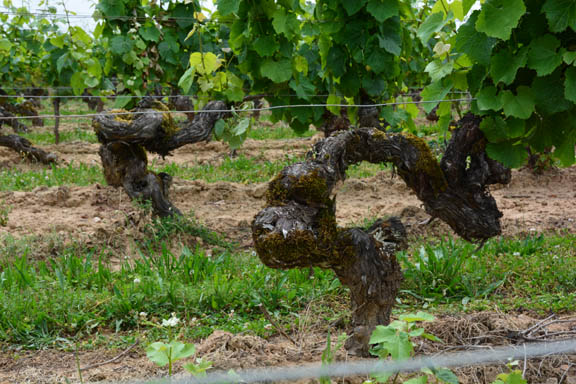
TriguedinaTW The oldest Malbec vines in France are at Clos Triguedina

Pascal Verhaege at Chateau de Cèdre has a different philosophy, and believes that assemblage gives a more complex wine. “I came from Burgundy and I wanted to make cuvées from each terrace, but we get more complexity by making an assemblage from all three.” The wines range from entry level to GC, a Vieilles Vignes that’s made by barrel fermentation (the ends of the barrels are left off, and then the cooper comes to install them after fermentation has finished.) We compare current vintages of Chateau de Cèdre and GC with the 2000 vintage for Pascal to make his point that the difference between the wines increases with time: the effects of barrel fermentation are not a flash in the pan, he believes.

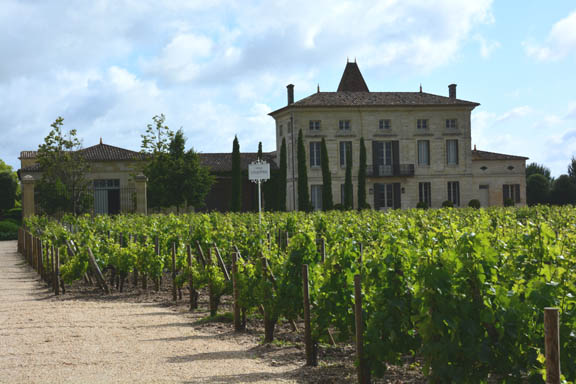
Tuesday evening: The strangest visit of the week comes at the end of the day at Chateau Lagrezette. I had emailed to make an arrangement to visit, and received a reply from Marine Grison, which seemed friendly enough: “contact me for all information so we can best prepare for your visit, we’ll arrange to visits the chais and have a tasting.” We arrived on schedule to find the tasting room deserted: should we just help ourselves and organize a tasting, we wondered? There was no way to summons help, but Lagrezette’s phone number was on the boxes that were lying all around so I called. I explained the predicament: no one to organize a tasting. “Ah, you have to have an appointment,” the voice said. I have an appointment, I explained, citing the email exchange. There was a pause. “Ah, you have the wrong sort of appointment,” the voice said. “Anyway, there is no one here and I am going home in ten minutes.” Bienvenue à la Belle France!
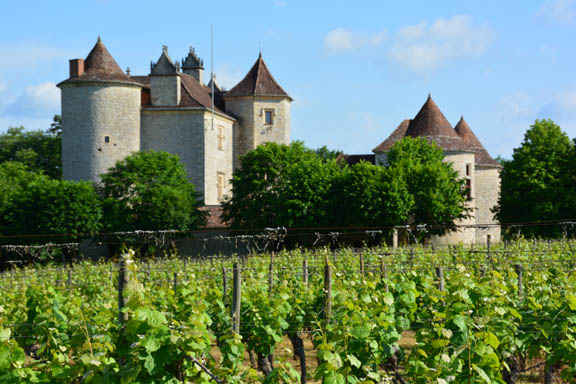
LagrezetteTW

Lagrezette has a grand chateau but appears to be run by fonctionaires
Southwest Diary part 1: Monbazillac, Bergerac, and a terrible mistake with the Côtes

Very impressed with commitment to quality of three producers: Tirecul La Gravière, l’Ancienne Cure, and Vignoble Verdots. Vineyards for Bergerac form a big circle south of town of Bergerac: Bergerac can make red or (more recently) dry white. “We used Vin de Pays Perigord for white wine until recently, because there was no consensus among the producers what Bergerac Sec should be,” explains Bruno Bilancini at Tirecul la Gravière. Most producers have wines from all appellations, meaning Bergerac (red), Bergerac Sec (dry white), Bergerac Rosé and Moelleux (half sweet) and Monbazillac (botrytized sweet wine, which can come only from a small area in the center).

Tirecul la Gravière’s production is almost entirely Monbazillac, divided between Les Pins (young vines, which here means less than 25 years), the chateau wine, and Cuvée Madame, made only in exceptional years. The blend of grapes in the AOP is similar to Sauternes, but Bruno uses only Semillon and Muscadelle. “I’m not a fan of Sauvignon,” he says. With younger wines, the initial impression focus on marmalade; once again, I was put to shame by my companion, the Anima Figure, who could identify origins more precisely than I could, as bitter oranges of Seville. But she is an afficionado of English marmalade.

“With time the wine depends less and less on sugar and becomes more elegant,” Bruno says. With older wines, comparing the 2005 and 1994 Chateau wines, or the 2004 and 2001 Cuvée Madame, it seemed immediately obviously that in each case the older wine is less sweet and more complex: but being an oenologue Bruno has measured the sugar levels, which are in fact the same. The tasting completely refutes the idea that Monbazillac is a poor man’s Sauternes: it’s more savory than Sauternes, with herbal influences, which Bruno describes as saffron and anise, and I’d be inclined to describe as tarragon. At Ancienne Cure, the Monbazillac develops delicate notes of black truffles to counterpoise the sweet apricots.

MonbazillacTWThe Chateau de Monbazillac is now owned by the cooperative

Curiously the Bergerac Sec goes in the opposite direction. Again there is the same general mix of grape varieties as white Bordeaux: Sauvignon Blanc, Semillon, and Muscadelle vary in proportions (with a tendency to more Muscadelle in Bergerac), but the first impression of the wines is all stone fruits, peaches and apricots, sometimes quite perfumed, a real contrast with the grassier notes of Bordeaux. Then with time the wine turns in a more savory direction.

Terroirs differ to the extent that at l’Ancienne Cure—which takes its name from a thirteenth century church on the property—in Colombier, Christian Roche makes two thirds white wine, where across the road in Conne-de-Labarde, Vignobles de Verdot produces mostly red. At Vignobles de Verdot, I meet the whirlwind that is David Fourtout. We tour the chais to find all sorts of new equipment, from custom designed conical cuves to a special sorting machine. All this is intended to produce more precision in the fruits, with softer tannins: you might say the wine is becoming increasingly sophisticated. Both Christian and David produce a range of wines from entry level to top of the line, with the top reds labeled as Côtes de Bergerac.

Producers are conscious that Bergerac has an image problem. “We are not a famous appellation. Bergerac is close to Bordeaux is how we have to describe it,” says David. “This means we have to work harder in the vines.” The decision by the Syndicat to introduce a top level appellation called Côtes de Bergerac was a terrible mistake. Not the principle of higher quality, which is that chaptalization is forbidden, and longer aging is required, but the name: everywhere in France Côtes de Quelquechose indicates a wine that is inferior to Quelquechose. No one from outside could know that Côtes de Bergerac is intended to be a higher level than Bergerac “We are considering calling it Grand Cru instead,” David says, but it isn’t presently obvious that INAO will allow this.

The best wines in Côtes de Bergerac – which is only 4% of all red production – strike me as close in quality to the Côtes de Castillon, an outpost of Bordeaux just a bit to the west of Bergerac. Côtes is equally a problem there; the appellation should have been called just Castillon. I would say to INAO and the Syndicat in both cases: don’t undercut the efforts of the best producers, who are really committed to quality, by imposing a name that implies inferiority to consumers.

Bordeaux Diary Part 4: Movers and Shakers in St. Emilion & Pomerol

Jean-Pierre Moueix established Pomerol on the map almost single-handedly after the second world war. Having become the aristocrat of Pomerol, today Moueix is turning somewhat away from the negociant business, has sold off some of the minor chateaus in its holdings, and is focusing more clearly on a group of 9 top chateaus, mostly in Pomerol. Virtually adjacent to Pétrus, Vieux Chateau Certan is owned by 44 members of the Thienpont family. Thienponts seem to be all over Pomerol and St. Emilion, from Jacques at Le Pin to Nicolas and his son Cyrille who manage a group of chateaux in St. Emilion.

Tuesday: the peak of Pomerol. No visit to Pomerol would be compete without seeing Pétrus, of course, where the former shabby buildings have been replaced by a spanking new facility. Ironically, because Pétrus was in the forefront of the movement to green harvesting, and Christian Moueix was supposedly rebuked in the local church for wasting God’s bounty, “we no longer do green harvest because we are not looking for concentration of sugar, we are looking for concentration of flavor… In spite of all our efforts, wines are over 14% alcohol. We are thinking of bring back Cabernet Franc.”

PetrusTWPétrus is no longer shabby, in fact it is quite snazzy

Wednesday: variations in clay. With 9 chateaus, Moueix dominates the top end of wine in Pomerol. At the very peak are Chateau Hosanna (the most delicate in style) carved out from the breakup of Chateau Certan Guiraud, Fleur Pétrus (distinctly feminine and elegant), then a complete contrast with Trotanoy (the most masculine and weightiest), and of course Pétrus stands alone. It’s all determined by the type of clay. We met at Fleur Pétrus, which recently moved production from the old chateau just by Pétrus to a building opposite the church in Pomerol. It’s the only one of the Moueix properties a visitor has any hope of finding: the others are all extremely discreet, with no signposts.

FleurPetrusTW2 Fleur Pétrus has moved to a new chateau in downtown Pomerol (it and the church are downtown Pomerol)

I reproach export manager Frédéric Lospied for the disappearance of Chateau Magdelaine, a Moueix property in St. Emilion, which has always been one of my favorites for its discrete style. “Other people have been telling me that,” he says, but the explanation that combining it with Belair-Monange gives a more reliable, larger scale of production doesn’t really add up given Moueix holdings of tiny properties such as Hosanna and Fleur Pétrus.

We drive past Petit Village and I take a picture of the extraordinary new structure, a suspended box connecting two buildings, but we do not visit, because my last visit there, two years ago, was cancelled by owner AXA when they learned I wanted to discuss the strange case of the disappearing Cabernet Sauvignon. Petit Village was supposed to have one of the largest plantings of Cabernet Sauvignon on the right bank, but it turned out to be a mistake: it was really Cabernet Franc. In the context of my book, Claret & Cabs, I thought this block might be interesting, but AXA said sniffily, “we do not think it is constructive to talk about Cabernet Sauvignon at Petit Village.”

PetitVillageTWWhat are these vines? Chateau Petit Village is not receptive to discussing Cabernet Sauvignon and Cabernet Franc.

Friday: Thienpont Day. Managing nine chateaux in St. Emilion and on the Cotes, Nicolas Thienpont is a busy fellow. Over lunch with Nicolas, his son Cyrille, and vineyard manager David Suire, I gingerly broach the controversial subject of the recent reclassification in St. Emilion. “There are things you can say, and things you can’t say,” says Nicolas, “which do you want to hear?”. Obviously I want to hear what can’t be said. Nicolas is evidently happy with the recognition of his work with the promotions of chateaux he manages, but says flatly that he’s not really satisfied with the basis for classification. This is a common theme, even among chateau owners who are classified in Premier Grand cru Classé A. The heart of the matter is how much the classification should depend on the quality of the terroir and the wine, and how much on other factors. If there’s any common view, it’s that terroir and quality should count for much more than the present half. Will things change for the next classification, I ask. Nicolas shrugs. “You’ll have to ask INAO,” he says, “it’s all up to them.”

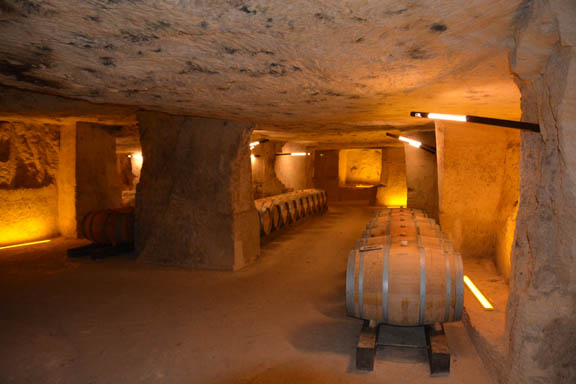
BeausejourDufauTWChateau Beausejour Duffau Lagarosse has caves worthy of Champagne, dug deep into the limestone plateau

After meeting at Chateau Pavie Macquin in the morning, we had made a tour with David of the properties in St. Emilion: Beauséjour Duffau Lagarrosse, Larcis-Ducasse, Berliquet, and back to Pavie Macquin for a tasting. The approach in the vineyards and vinification isn’t terribly different among the chateaux, and Stéphane Derenoncourt is the consulting oenologist for the group, but a tasting of the 2011 vintage shows the distinctive character of each of the chateaus. Larcis Ducasse is a little reserved, but you can see the increase in smoothness from the past, and why it was promoted to Premier Grand Cru Classé. It would be difficult to draw a line in terms of quality between Pavie Macquin (promoted to Premier Grand Cru Classé in 2006) and Beauséjour-Duffau (a Premier Grand Cru since the initial classification in 1955), but Pavie Macquin has the edge for overt elegance—“it plays between the power of clay and the minerality of calcareous terroir” says Cyrille Thienpont–whereas Beauséjour is more structured. The ringer is Château Berliquet: with vineyards just above Angelus and below Beauséjour and Canon, it occupies prime terroir but has never risen above Grand Cru Classé. I ask Cyrille why this is, but the answer is enigmatic. I remember that under Nicolas Thienpont’s management both Larcis Ducasse and Pavie Macquin have been promoted in prior classifications.

PavieMacquinTWChateau Pavie Macquin has a new tasting room

Final visit of the week is off to something completely different, to see Stéphane Derenoncourt in the Cotes de Castillon, just to the east of St Emilion. Stéphane is a consulting oenologist with many chateaus in St. Emilion, and also started his own vineyard, Domaine de l’A in the Cotes de Castillon. Headquarters is a small modern building in the hamlet of Fillot, where everything seems to run on espresso. Stéphane is an enthusiast for Castillon. “Effectively Castillon is an extension of the limestone plateau. The different (with St Emilion) for me is the price.” We agree that in blind tastings the best wines from Castillon would be hard to distinguish blind from St Emilion, “not from the very best Premier Grand Cru Classés, which are truly exceptional, but from the others,” is Stéphane’s caveat. He’s disappointed, even angry about, the recent turn of events in Bordeaux. “we have a big problem here with the arrogance of Bordeaux and the enormous increase in price. People think that the Bordelais are arrogant, that they are only businessmen. It is a feature of the Grand Cru Classé, but it reflects on all Bordeaux. I think Bordeaux has the best price:quality ratio in the world, but people don’t recognize this.”

Bordeaux Diary Part 3: Outsiders on the Right Bank – From Garage Wines to Single Vineyards and Respectability

Through the 1980s, it was outsiders, such as Jacques Thienpont from Belgium, or Jean Luc Thunevin from Algeria, who made the running in putting St. Emilion in the forefront of the news by upsetting the traditional order.

Tuesday: the heights of Pomerol. The tiny property of Le Pin is overshadowed by the huge pine tree that gave it its name. Jacques Thienpont, who comes here from his native Belgium, admits Le Pin may have been confused with (and have become a model for) the garage wines, but says that “we knew this was special terroir, wine was always made at the cellar here. It’s 100% Merlot, but I don’t have the power and richness of Pétrus, Le Pin is more elegant.” Then we go over to L’If in St. Emilion, where Jacques aims to repeat the experience of le Pin in another appellation. After lunch with Jacques and his nephew Cyrille, who manages L’If, on to another Thienpont family property, Vieux Chateau Certan, managed by Alexandre, who believes that the high proportion of Cabernet Franc is important in the character. “Instead of a monodimensional wine that is pure Merlot, the Cabernet Franc gives complexity… People are coming back to complexity.”

Dinner with Jonathan and Lynn Maltus at Chateau Teyssier. Since coming from Britain 20 years ago, Jonathan has built Chateau Teyssier into one of the larger properties in St. Emilion, but is now equally well known for his four single vineyard wines, which fall into two pairs. Le Carré and Les Astéries are 200 yards apart, but Le Carré is plush whereas Les Astéries is all tension. “This is the least Maltus-like wine I make; our other wines are accused of being North American in style.” In the other pair, Le Dôme actually used to be part of Vieux Chateau Mazerat, but “this is one of three garage wines that have become proper wines (the others are Valandraud and La Mondotte).”

Wednesday: Finished the day at Jean Luc Thunevin’s cramped offices in St. Emilion. The self-named bad boy of St. Emilion was inclined to philosophize on this occasion. The first garagiste has been very canny in turning Valandraud into a real chateau, with some vineyards in the eastern part of St. Emilion, but not surprisingly doesn’t bow to the god of terroir. “There are many cases where terroir hasn’t changed but people have variously made poor wine or great wine.”

Bordeaux is fairly regarded as closed: not very receptive to outsiders (at least not unless they come with very deep pockets) but here are three who have more than bucked the trend, in fact they have created a new trend towards expression of special sites and methods for achieving ultimate quality.

Bordeaux Diary Part 2: Insiders in St. Emilion – The Stately Pleasure Domes of Xanadu

The 2012 reclassification in St. Emilion was a sea change in promoting Angelus and Pavie to join Cheval Blanc and Ausone in the hallowed ranks of Premier Grand Cru Classé A. While the wines are admired, there are many reservations about procedures and criteria in the classification. Certainly this might be regarded as a Parker classification that has rewarded the rich and opulent style, while ignoring that long time contender for promotion, Chateau Figeac, which with a high Cabernet content has a more reserved style.

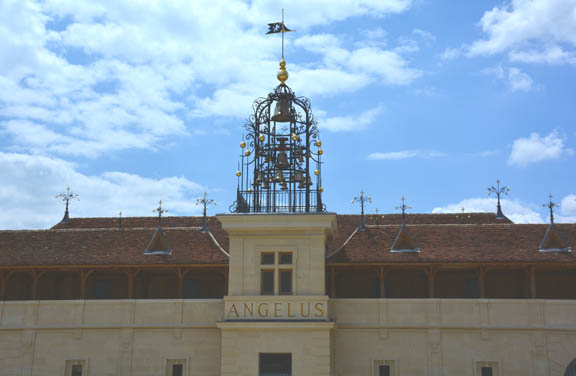
Monday: the first palace. After lunch to Chateau Angelus, with its massive new building crowned by a modern bell tower. They played the national anthems of both the U.K. and U.S. on the bells when we arrived. The entrance goes into what looks like a modern take on a massive mediaeval banqueting hall with a vaulted wooden roof that must be a contender for the longest in France. Offices are squeezed in along the side. The atmosphere screams nouveau riche, but there is no dispute about the quality of the wine. This is very much a family-run operation as we meet Hubert de Bouard as well as his daughter and cousin, all involved in the business. This is one of the largest estates in St. Emilion, with 39 ha used for Angelus, and another 12 ha used for the second wine, Carillon d’Angelus. Hubert consults for 60 chateaus as well as managing his own properties—which include Fleur de Bouard in Lalande de Pomerol—so he’s an influential fellow in the region.AngelusTW

The bells of Angelus can be seen (and heard) for miles around

Thursday: modernism in St. Emilion. Managed to take the back road to Pavie, so instead of coming in to the grand entrance at the front like a civilized person, followed a tortuous path down from the hills, winding up in the parking lot. But it really showed what the limestone plateau above is like and how the terroir differs from lower down. Pavie had better keep its promotion into Premier Grand Cru Classé “A” because the “A” is engraved in stone above the entrance to the new limestone palace.

There’s no mistaking the level of investment here. When Chateau Pavie and adjacent Pavie Decesse came on the market in 1997, supermarket magnate Gérard Perse, who had previously bought Chateau Monbousquet, acquired Pavie Decesse. When Pavie had not sold a year later, “he decided to change his life, he sold the supermarkets and left Paris to build up Chateau Pavie,” says Gerard’s son in law, Henrique da Costa. Since then, it’s been a steady upward path, with high praise from Parker, culminating in the promotion.

PavieTWChateau Pavie is constructed from local limestone

Tasted the 2006, which isn’t at all the popular image of an overblown wine. It’s only 70% Merlot and includes some Cabernet. “We love the Cabernet Sauvignon, when it’s ripe you produce fantastic wine,” says Henrique. “We are working to increase the Cabernet.” In addition to Pavie and its second wine, Arômes de Pavie, there is Esprit de Pavie, a generic Bordeaux that comes largely from Castillon. “Esprit de Pavie was introduced in 2008. We have three properties in Castillon, but Castillon isn’t well known, we decided to make it a generic Bordeaux,” says Henrique.

With the massive palaces of Angelus and Pavie dominating their neighborhoods, St. Emilion, known previously for its modest chateaus and small vineyards, can look the grand chateaux of the Medoc in the face.

Bordeaux Diary Part 1: Families – Survival of the Threatened in St. Emilion and Pomerol

This has been a whirlwind week, with visits to 20 chateaux. My next book, the Wines of Modern France, profiles the 500 leading producers, including about 100 from Bordeaux, of whom 40 are on the right bank. Trends on the right bank are a bit different from developments on the left bank, and the most disturbing is how clearly the old family estates feel themselves threatened.

Monday: the extremes of St. Emilion. Stephan von Neipperg at Château Canon La Gaffelière is as dapper as ever, proud of its promotion into Premier Grand Cru Classé together with La Mondotte. This is all the more striking because when he originally purchased La Mondotte, he was denied permission to include it into Canon La Gaffelière because of reservations about the terroir. Production is tiny. Is it a garage wine? “I never understood why they called it a garage wine, it’s come from completely distinct terroir since 1996… It’s now a Premier Grand Cru Classé, you cannot talk about a first growth being a garage wine. Stephan is a little ironic about La Mondotte’s rise to fame: “Originally they said to me, yes, it’s good but you have to see if you can age it 15 years. Well, now we have shown it can age well, but this is Bordeaux, it’s always taken a long time to integrate new wine.”

He was also at the forefront of the move to expand into the Côtes de Castillon where Château d’Aiguilhe is one of the most successful properties. “No one knew about Castillon 20 years ago, we were the first to invest in 1995… I can grow in Castillon, here in St. Emilion I would have to buy my neighbors. In another 10 or 15 years it will be possible for Castillon to make wine of quality similar to the best areas of St. Emilion.” But he concedes that quality is variable now. “The problem is that they can only survive by quantity.” With a powerful common identifying mark for his chateaux of the coat of arms, Stephan has expanded his way out of the threat to family businesses.

On to Beauséjour-Bécot, a small property right on the top of the limestone plateau which is the best terroir in St. Emilion. Juliette Bécot is very much conscious of the recent change in atmosphere: “We are a family estate, it’s belonged to my family since the Revolution, we earn money only from viticulture, but we have to compete with owners who can invest lots of money from other sources.” Unable to expand in St. Emilion, Juliet bought another estate in Castillon from which Joanin Bécot comes.

Juliet is not happy with the classification system in St. Emilion. This goes back to 1986 when Beausejour-Becot was demoted to Grand cru Classé because bought some additional vineyards. Her father, Gérard, thought this was extremely superior terroir, so the problem was unanticipated. “When you compare this with the present classification, it’s just a joke… I think we are very far from the first classificatioin and we are going in the wrong direction. Maybe we should come back to a more classical view, based on terroir.”

Tuesday: expansion in Pomerol. Hard to know whether to regard Chateau Clinet as an old family property or new money, as it was bought by Ronan Laborde’s father in 1999 to satisfy Ronan’s interest in winemaking. There’s been a program of investment in both vineyards and chai, with Merlot increased to 90% by a mixture of plantings and acquisition of a new all-Merlot vineyard. Chateau Clinet is the major part of production. This is an operation in plain expansion. “Fleur de Clinet is not strictly a second wine, it has some declassified lots from Clinet but is mostly juice and berries purchased from other growers in Pomerol. In addition, Ronan is a Bordeaux AOC blended from five different appellations, which will shortly be moved to a new facility just near by.

Thursday: ten generations in St. Emilion. After lunch we meet Alexandre Malet Roquefort, who now manages Chateau Gaffelière together with his father. I explain that I remember drinking my way through a case of La Gaffelière 1971 in the late seventies; this was my introduction to right bank wines. In due course Alexandre’s father, Comte Malet Roquefort, appears to say that he wants to meet someone who’s been drinking La Gaffelière for almost fifty years. Aged 81, the Comte is a veritable tribute to the benefits of red wine. La Gaffelière’s reputation was suffering a few years back, but now there seems to be constructive engagement between modernism and tradition. The facility is workmanlike: “we didn’t want to impress visitors, it’s not Disneyland here,” says Alexandre. “The DNA of La Gaffelière is classic wine, it’s one of a small group in St. Emilion that didn’t change its style in recent years. We like a wine that is fruity and not too extracted.” Perhaps that’s why I still like it.

GaffeliereTWThe residence and winery at La Gaffelière

From one family property to another, we moved over to La Conseillante in Pomerol, owned by the Nicolas family since 1871 (they are not related to the Nicolas wine shops). The vineyards have been the same 12 ha for three centuries, but here the facility has been completely modernized. Actually a third of the vineyards are in St. Emilion, running into Cheval Blanc, which you can see from the windows of the tasting room. As a result, “La Conseillante is not entirely typical of Pomerol; if Pomerol is known for power and richness, we are known for elegance and silky tannins,” says winemaker Jean-Michel Laporte. I realize that the right bank wines I like most are all exceptions to the most common styles of their appellations.

ConseillanteTWLa Conseillante has constructed a modern extension

A Visit to Jean Luc Thunevin: the Bad Boy of St. Emilion Explains his Philosophy

My visit to Jean Luc got off to an interesting start when I explained that I was writing a book called The Wines of Modern France: A Guide to 500 Leading Producers. He looked slightly quizzical. “You don’t believe that France can be modern,” I asked, as that’s a wry response that has been made by other producers in France. “The title of your book seems curious to me because even the classic are modern now,” he explained. “I give you an example,” he continued. “Le Pin: is it a modern wine or a classic? It’s not a garage wine but it inspired me.” Then another example: “It’s not so easy to find a classic wine: Léoville Barton? But it’s also a modern wine.” Then a little more argumentative: “the image of modern wine is new oak. But then Mouton 1947 was a modern wine.”

True to the French tradition, Jean Luc then asked what is the philosophy of modernity. “The success of modernity is to be able to have a product that pleases the clients,” he concluded. “What’s a wine that’s a has-been? It’s one that doesn’t please the clients.” I argued that Valandraud was a modern wine that altered the paradigm by introducing changes that many others followed, first in St. Emilion and then elsewhere. Jean Luc agreed at least that he is a modernist. “I’m modern, I was the first garagiste. We protected the fruits, took precautions against oxidation, introduced green harvest, leaf pulling. Everyone does it now.”

“The first wine that I loved was Pétrus. Then Le Pin was my inspiration,” he explained, “I wanted to make a wine like Le Pin, hedonistic and sexy, soft and chic.” This seemed to be an argument for instant gratification, so I asked about the importance of ageability. “Ageability is a big obligation of Bordeaux,” he agreed, “everyone wants wine that can age because of Bordeaux. But happily we can now make wines that are good now and age well. When I started people said Valandraud would not last more than ten years, but now it has lasted thirty years.” Later he proved his point by pulling out a 2002 Valandraud for tasting. “I give you this because it’s easy to make a sexy wine in a good year, but this was a difficult year.” The wine was delicious, just on the tipping point into tertiary development. I asked how long Jean Luc thinks it will last. “It’s a baby, it’s just beginning to develop,” he said. “The 1992 is still good and we didn’t have the same techniques then, for example, sorting,” he explained.

I thought I might provoke an interesting response by asking whether garage wines are finished. “As a phenomenon, that’s sure. But not as a niche. And there are garagistes in other places, Spain for example. But anyway, it’s not the phenomenon of garage wines, it’s the phenomenon of expensive wines.” Of course, Valandraud has now come a long way from its origins as a garage wine: it’s now a St. Emilion Premier Grand Cru Classé. Doesn’t the latest reclassification in St. Emilion show a big change in attitude, I asked. “You have a point,” Jean Luc agreed. “It’s hard for people to accept that success can depend on a person and (just) on the terroir. But it’s only fifty years since the first classification. At that time it was incredible to believe that St. Emilion would be ready for reclassification in ten years…Angelus’s promotion is due to Hubert de Bouard’s talent… If Cheval Blanc hadn’t had good proprietors, it wouldn’t have become a Premier Grand Cru Classé.”

As you might expect from the first garagiste, Jen Luc has some reservations about terroir. “People don’t understand what is good terroir. They confuse aesthetics with reality. I give you the example of Chateau Rayas—the soil is sandy… It’s (only) necessary that the soil isn’t bad, not too dry, not too wet. You have to have good berries.”

Jean Luc has a strong sense of independence, but for all his success, no pretension. We met above the l’Essential wine shop in his tiny office, where Jean Luc has a desk at one end and his assistants are grouped at the other end. “There’s a glass ceiling in the Médoc, he said, “I could get nowhere, but in St. Emilion the door was open. I sell my wine in my boutique, I don’t need negociants, I don’t need to export, I have autonomy.” Then we went down to the wine shop and tasted the 2011 Valandraud—“this was an austere year in Bordeaux, the problem for me was to make a sexy wine”—followed by the 2002. Jean Luc sent the shop manager up to the office to collect the staff, who came down to try the 2002. It was a good end to the day, with appreciative murmurs all round.

Will L’If Become the Le Pin of St. Emilion: Jacques Thienpont Strikes Again?

When Jacques Thienpont started Le Pin in 1979, he had no idea it was going to become one of the most famous—and at one time the most expensive—wine of Pomerol. Owned by the Laubie family since 1924, this tiny vineyard of 1.2 ha was located between Vieux Chateau Certan (also owned by the Thienpont family) and Trotanoy (one of Moueix’s leading properties). The Thienponts knew it was special terroir, and the original plan was to buy it to add to Vieux Chateau Certan, but the family did not want to pay the price, so Jacques bought it himself, paying a million francs for it (equivalent to 150,000 euros or $200,000).

The small scale of production, high price, character of 100% Merlot, and concentrated character of the wine led it to be grouped with the garage wines, although this has never really been an appropriate description, since it comes from prime terroir, and winemaking does not use any extreme methods. Subsequently some more small plots, contiguous with the original holding, were added to bring the total size up to 2.7 ha. There is no second wine at Le Pin, but there is another label called Trilogie, which is a blend across three successive vintages.LePin-original

The original house at Le Pin.

LepinS

The new winery

The property takes its name from the massive pine tree that stands just in front of the winery. Jacques now seems to be repeating history with the recent purchase of a property in St. Emilion, originally Chateau Haut-Plantey, but now renamed L’If (the French for yew tree).

My visit to Le Pin this week started out at the new winery, a contemporary jewel that replaced the old building in 2012, more than thirty years after the original purchase. Then we visited L’If, where the building is pretty dilapidated, but modern equipment has been installed inside. The old large fermentation tanks have been replaced with a variety of tanks to allow fermentation of individual plots. The original purchase included 5 ha in single block around the building, and another 2 ha close by; another hectare has since been added, bringing the total to 8 ha. This is good terroir, a nice slope just under Chateau Troplong Mondot, with a view across to the church at St. Emilion. There’s lots of limestone, which will be planted with Cabernet Franc; Merlot will be retained or planted on the plots with more clay. “It’s good terroir, but we will have to start from scratch, because they used weed killer,” Jacques says.

Almost half of the property has been pulled out for replanting. 1 ha is about to be replanted, and another 2 ha will be uprooted shortly; the land will be left fallow for four years before replanting, and then it will be three years till the first grapes are ready to use, so for the next 7 years production will be down. Cabernet Sauvignon has been removed—this is not a good spot for it, says Cyrille Thienpont, who is managing the property (and we will meet again at other Thienpont properties). Replanting will bring the varieties to a mix of about 60% Merlot and 40% Cabernet Franc. The big debate of the moment is how much to increase the density of planting from the present 6,500 vines/ha. With any significant increase come additional costs such as the need for different tractors that can handle narrower rows. I asked Jacques whether he was going to be frantically busy at harvest with two properties, but he explained that, even though the distance between the properties is only about five miles, L’If always harvests about three weeks later than Le Pin. “When we are putting wine into the barrels at Le Pin, we know it’s time to go and do the harvest at L’If,” he says. The first vintage to be released under the L’If name is 2011.

Coming from Pomerol, where there is no classification, Jacques does not intend L’If to become part of the St. Emilion classification. It may join Chateau Tertre Rôteboeuf as one of the most significant unclassified properties in the appellation. No one could have forecast Le Pin’s rise to fame, but it’s much easier to prophesy that we’re going to hear a good deal about L’If once the project really gets under way: Jacques hopes it will take less than the thirty years he’s been at Le Pin to fructify. Whether it will rise to the dizzy heights of challenging the top wines of the appellation remains to be seen.


St. Emilion Proprietors are Revolutionizing The Satellite Areas: Bargains from Castillon and Lalande de Pomerol

Today I visited three Premier Grand Cru Classés in St. Emilion: Chateaux Angelus, Beauséjour Bécot, and Canon la Gaffelière. The feel of the visits could not be more different, the wines all have their own distinct styles, but all three share the fact that they have expanded out of St. Emilion into neighboring areas, the first into Lalande de Pomerol to the west, the other two into Côtes de Castillon, just on the northeast border of St. Emilion.

Don’t be put off by the name. Côtes de Quelquechose almost always indicates an appellation of secondary importance to Quelquechose. “It would have been much better simply to call the appellation Castillon,” argues Stephan von Neipperg at Chateau Canon La Gaffelière. But the best part of the Côtes de Castillon, at St. Philippe d’Aiguille, has a limestone plateau that isn’t dissimilar to the far more famous limestone plateau where most of the Premier Grand Cru Classés of St. Emilion are located. Granted this doesn’t extend all over Côtes de Castillon—but the famous limestone plateau doesn’t extend over all St. Emilion either.

The cost of land in St. Emilion is now prohibitive: proprietors say that it’s but impossible to extend their vineyards. That’s part of the driving force for going out to Côtes de Castillon. Stephan von Neipperg was one of the first. “When I took over Chateau d’Aiguilhe in 1999,” he recollects, “we preserved 27 ha of old vines, and we replaced 15 ha of poor plantings of Cabernet Franc and Cabernet Sauvignon. The problem was economics, people went for quantity, but now they are recognizing the potential of the limestone plateau.” It’s no coincidence that the best wines in Castillon are made by people from St. Emilion: with a keen eye based on their experience in St. Emilion, they have bought vineyards on the best terroir. Juliette Bécot is extremely conscious of running a family estate—“it used to be very common, but now it’s more and more rare” —she says, but felt when she started out that she wanted to have her own voice, so established Joanin Bécot in Castillon in 2001.

Now famous for the renovation of Chateau Angelus, with its famous modern bell tower—both God Save the Queen and The Star Spangled Banner were played on the bells when we arrived, as I am British but came from New York—Hubert de Boüard consults for around 60 chateaux as well as running Angelus. He also created Fleur de Boüard, in Lalande de Pomerol, where in addition to the eponymous wine he produces a super-cuvée, Le Plus de Boüard, by selection of the best lots. Even from a single trie in the vineyard, some grapes are selected for Plus rather than Fleur. Plus spends 33 months maturing in oak—longer even than Angelus.

The common feature of all these—let’s call them the satellite wines—is that they are made with the same care and attention as the grand vin in St. Emilion, relying on similar expertise, but are available at lower price. Sound familiar? That’s the old argument for second wines. But whereas the second wines are always marked by that feeling that they weren’t good enough to make it into the grand vin, the satellite wines represent the best their terroir can produce. It’s an interesting trade off, that can pay off handsomely when the terroir is right.

The satellite wines come from different chateaus from their proprietors’ main chateaus, but show an interesting stylistic relationship with the grand chateaus.  Fleur de Bouard is the plushest; Chateau d’Aiguilhes is the most structured (Domaine de l’A, from oenologist Stéphane Derenoncourt, where I have a visit planned for later in the week, shows similar character but is more aggressive), Joanin Becot is the lightest and most approachable. In a blind tasting, they would be difficult to distinguish from St. Emilion at the level of the Grand Cru Classé. Perhaps Fleur de Boüard has more of the richness of Pomerol. These are all very good wines by any measure, and by and large, I prefer them to the second wines from the corresponding chateau in St. Emilion. The only thing these wines can’t compete on with St. Emilion is price.

Will people please stop trying to prove terroir exists. It’s more useful to look for gold at the end of the rainbow

Grow one plot of grapevines on the top of a hill in a really sunny, exposed, windy spot. Grow another plot at the bottom of the hill in a shady waterlogged spot. It is really not rocket science to understand that the grapes are likely to be quite different, as will wine made from them. That’s terroir, stupid.

Pushing the argument to these extremes doesn’t really resolve the issue of whether terroir effects exist that produce wines with subtle but consistent differences from adjacent vineyards where there is a little perceptible difference in growing conditions. Burgundians will argue, for example, that the adjacent vineyards of Cazetiers and Combes aux Moines in Gevrey Chambertin produce different wines. Faiveley have adjacent vineyards with vines of the same age, tended the same way. “The tractor doesn’t stop,” says Jérôme Flous of Maison Faiveley. But as I describe in my book, In Search of Pinot Noir, the wines are consistently different.

Well, yes, but maybe in such cases, producers, consciously or unconsciously, are treating the wines just a little bit differently to produce results that conform with their expectations for each vineyard. You might almost call it the Holy Grail of Terroir to demonstrate that the wines from different vineyards are intrinsically different. A group of scientists have just reported an attempt to prove this.

They took Pinot Noir berries from two vineyards managed by the same producer in Burgundy, one in Flagey-Echézeaux and one in Vosne Romanée. They don’t give exact locations, but the vineyards appear to be within a mile of one another. They report that soils types are similar in each vineyard: they don’t comment on the age of the vines or planting density, but let’s give the benefit of the doubt and assume that all extraneous parameters are the same.

They took two samples of 100 berries from each vineyard in 2010, 2011, 2012 and compared the berries and wine made from them by microvinification. Well, here’s the first problem. ONE HUNDRED BERRIES! How many berries do you suppose there are in a vineyard? Let’s try to estimate this. Suppose the vineyard is 1 ha and has 8,000 vines, each with 6 bunches, and each bunch has 50 grapes. I make that 2.5 million berries. I do not think you need to be an expert in statistics to see that 100 berries is not going to be representative of the vineyard. (For the more geekishly minded, you’d need a few hundred to achieve a 5% statistical significance level.)

I won’t go into the details of the analysis, which uses formidably complicated equipment, but comes down to the ability to measure small amounts of phenolic compounds. The authors conclude that  differences between vintages are more significant than differences between vineyards. This is not a surprise. But they go on to say they can find  differences between the vineyards, for both grapes and wine. This I do not believe. It’s definitely fair to say that when you compare the samples in one vintage, all four are different. But I’m not at all convinced that the two samples from each vineyard identify any distinct character. The results look  higgledy-piggledy, and the two samples from each vineyard seem just as different from one another as from the other vineyard. Misquoting Monty Python, Every berry is sacred, every berry is great.

I believe in terroir, but I don’t believe this study proves any more than that each sample of one hundred berries is a different from every other sample of one hundred berries. (Gives a whole new meaning to micro-cuvées.) Anyway, do we want to see a scientific basis established for terroir, wouldn’t that spoil the fun?