Visit to Porto and Douro: Day 2 Tasting at Ramos Pinto

One of my objectives in visiting the Douro is to define the style of each Port House. Some are more distinct than others, of course. At Taylor Fladgate yesterday morning, Croft seemed to have the most overt style, Fonseca was generous as always, and Taylor was the most refined and precise. Then in the afternoon, Churchill showed a characteristic thread of acidity, sometimes verging on minerality, always precise, through both tawnies and rubies. Today I spent the morning at Ramos Pinto with Ana Rosas, the fifth generation of the family to be involved in winemaking, who has recently taken over as their master blender.

Ramos Pinto has long been known for the quality of their tawny ports. “Tawny really is the soul of Port, it’s what the house is about, it’s how we have learned to age the wines, it’s the style of the house,” says Ana.

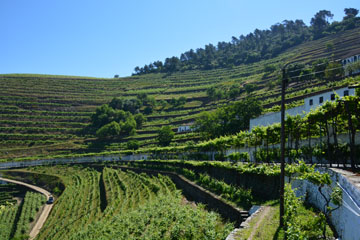
Defining style was a challenge as the ten year aged tawny comes from their vineyard in Douro Superior, Quinta de Ervamoira (near Foz Coa), while the twenty year tawny comes from Bom Retiro in Cima Corgo. The ten year shows all the power of the Douro Superior, the hottest and driest part of the region; in fact, the average age is between 12 and 13 years because the wines are initially so intensely colored that they take longer then ten years for the color to attenuate to the point at which the wine can be approved for tawny port. It’s still quite dark for a tawny.

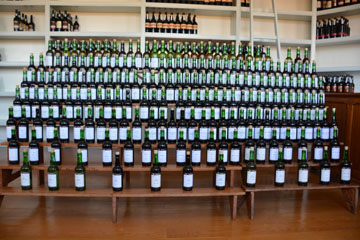
The twenty year was my favorite in the tasting, expressing the full delicacy and nuance of the aged tawny style. We are also tasted some of the wines that are blended into it, some very old and concentrated (like the 1924 and 1964) so that only very small amounts are used. How many different lots are blended, I asked Ana. “I really don’t know,” she said, “it’s too many to count and the amounts that are used vary widely.” In the tasting room, there’s a large array of small bottles with samples of wines for blending. Ana calls this her piano.

RamosPinto1The “piano” of samples for blending

The 30-year tawny shows more concentration and intensity than the 10-year or 20-year, with a style that’s between them in terms of the balance between power and elegance, as it’s a blend from both Ervamoira and Bom Retiro and other vineyards (all owned by Ramos Pinto, who use only estate grapes). Ramos Pinto do not usually produce a 40-year tawny (you might certainly feel that the 30-year takes the style as far as it can go) but exceptionally there is presently a 40-year tawny, made in tiny amounts as a celebration, which shows the style of the 20-year taken to an even higher level of concentration.

So I may have failed in my basic objective of defining style, but I’m happy to say that in effect there’s a style for everyone here: 10-year or perhaps 30-year if you like some forcefulness, and 20-year if you prize delicacy.

20-year Aged Tawny

Light elegant color is a marked contrast with the depth of the 10-year. Very fine elegant impression to nose in quite distinct style. Refined on the palate with a delicate nutty impression, with a lovely balance supported by lacy acidity. Overall an impression of beautiful delicacy.

30-year Aged Tawny

Fine impression to nose, with more intensity but less delicacy than the 20-year. Lots of concentration and flavor, but maintains freshness, with a lingering, sweet, nutty aftertaste.

We also tasted some old vintage Ports, going back from 2000 to 1924. My favorite was the 1963.

Vintage 1963

Very soft on palate, lightening in color and aroma, you might say the spectrum is part way to tawny. Very fine and just a touch spirity as it develops.


RP2The Ramos Pinto Lodge on the waterfront at Gaia.

Visit to Porto and Douro: Day 1 Tastings at Taylors and Churchill

At the start of a research visit to Porto, my first impression is how distinctly the styles of the individual houses come through their old tawnies and vintage Ports (even though some of the houses fall under the same management in large groups). More detailed reports of visits to each house will follow, but in the meantime, here is the most interesting Port (or table wine) tasted from each house today.

Taylors 30 Year Tawny

I always see a significant jump in interest going from ten year to twenty year tawny, but sometimes the next increment of increased concentration going to thirty year is outbalanced by increased oxidative character. Tasting Taylors 10, 20, 30, 40, and the Single Harvest 1966 (effectively a 50 year tawny), for me the thirty year beat out the twenty year by a whisker. There’s a great sense of precision to the nose, the palate is sweet and infinitely smooth, and there’s just a touch more sense of the supporting acidity to bring crispness at the end. (The 1966 is closer in style to the 30-year than to the 40-year, and is infinitely refined.)

Fonseca Guimaraens 2013

This is a blend from all three vineyards that would go into Fonseca when a vintage is declared, so in a sense it’s a second wine representing the best lots in a year that’s not declared as a vintage. It’s sweet, ripe, full and approachable on the palate with chocolaty tannins at the end. A very nice opportunity to get the full style of vintage Port in a young wine.

Churchill Vintage 1997

The first impression is just how refined this is for vintage port, with a lovely sense of precision to the fruits, almost a sense of minerality demonstrating the good bones of the structure. Fine elegant black fruits are beautifully delineated, showing a seamless surface with layers of flavor underneath. This is certainly ready to drink but it will surely age another couple of decades becoming if anything even more sharply focused.

Douro Red Table Wine

Quinta de Gricha, Churchill, 2007
This comes from a field blend of 60-year-old vines in the Quinta de Gricha, that is, it’s a single vineyard red wine from the same vineyard that contributes to Churchill’s vintage Port. A warm fruit impression is softer and more aromatic than the Gran Reserva (which comes partly from Gricha and partly from other locations), with furry tannins giving a chocolaty finish. Black cherry aromatics are backed up by some spice notes. This shows a more savory direction than the 2005, which is more perfumed. It’s a very fine demonstration of the potential for table wine in the Douro.

A Perspective on Canadian Wine

Most people probably know Canadian wine only through the prism of its famous ice wine, but actually Canada has around 12,000 ha of vineyards (mostly in British Columbia’s Okanagan Valley and Ontario’s Niagara Peninsula) roughly equivalent in total to Burgundy’s Côte d’Or. Most production is dry wine, with sparkling wine and ice wine a small proportion. A tasting at Canada House in London offered a rare opportunity to get a bead on whether this is a successful endeavor.

The wines were almost all VQA (Canada’s appellation system), so this is a look at the high end. I do think they’ve made a mistake in defining the VQAs in great detail at this stage, with ten sub-appellations in Niagara, for example, confusing rather than enlightening.

Living on the East coast of the United States, I am inclined to regard Canada as the frozen North, or anyway, distinctly cool climate, so I am frankly confused by the somewhat optimistic descriptions of climate by the Wine Council of Ontario. An amusing chart of annual temperatures in various wine growing regions appears to show that Bordeaux is warmer than the Languedoc and that Niagara is warmer than Bordeaux, which leaves me feeling somewhat sceptical.

Looking at weather station data, I place Niagara between Alsace and the Mosel. It is a little bit warmer in British Columbia, and there is certainly significant variation between the ends of Okanagan Valley as it extends for more than a hundred miles from north to south, but I am surprised to see the southern part described as warmer than Napa on the basis of degree days, as weather station data in the midpoint of the southern part suggest to me that temperatures are quite close to Alsace. Perhaps I am not paying sufficient attention to variations between microclimates.

Tasting the wines, the climate that most often comes to mind for comparison would be the Loire. With Riesling and Chardonnay as the main focus, but also a fair proportion of Pinot Gris, Gewurztraminer, and Viognier, the impression is distinctly cool climate.

Most Chardonnays at the tasting had too much oak for my taste, even though the stated usage of new oak was usually quite moderate. Even allowing for youthful character, I’m not certain there’s enough fruit to carry the oak. My impression of the Chardonnays from Niagara is that the citrus palate can be a bit too much driven by lemon. It’s fair to say that the style is European rather than New World, but given the cool climate character of the wines, I would suggest that Chablis would be a better model than the Côte d’Or, and the question should be how much (old) oak to use together with stainless steel, rather than what proportion of the oak (with many wines barrel fermented) should be new. With prices often around or above $35, competitiveness seems an issue.

Curiously given the cool climate impression, I was not generally impressed with the Rieslings. My main complaint is the style: Riesling character is often obscured by a significant level of residual sugar. I did not find a single dry Riesling. I’m inclined to wonder whether, if you can’t successfully make a dry wine, you should plant a different variety, but I suppose you might say that the best Canadian Rieslings do show a nice aperitif style.

Given the cool climate impression made by the whites, the successful production of reds is quite surprising, especially the focus on Bordeaux varieties rather than those more usually associated with cooler climates. Among them, Cabernet Franc appears to be the variety of choice for single varietal wines, and although there are certainly some creditable wines showing good varietal typicity, I find many to be on the edge for ripeness. Certainly the style is much more European than New World­—the Loire would be the obvious comparison. The best Merlots or Bordeaux blends seem more like the Médoc than the Right Bank of Bordeaux in style.

To my surprise, Syrah outshines Cabernet Franc in Okanagan Valley. The Syrahs are evidently cool climate in character, definitely Syrah not Shiraz, in a fresh style with some elegance, which should mature in a savory direction; nothing with the full force impression of the New World. They remind me of the Northern Rhone in a cool year.

There are some successful Pinot Noirs in both British Columbia and Ontario, presenting somewhat along the lines of Sancerre or Germany. The difficulty is to bring out classic typicity in these cool climates, but the best are Pinot-ish in a light style.

Some producers are now making single vineyard wines. Is it worth it? It’s an interesting question whether at this stage of development the best terroirs have been well enough defined to produce reliably better wine every year or whether a better model would be to make cuvées from the best lots. There’s also the question of whether they are competitive at price points pushing beyond those of the estate bottlings.

Favorites at the tasting

Sparkling wine, Gaspereau Valley, Nova Scotia: Benjamin Bridge, 2008

This is called the Methode Classique Brut Reserve to emphasize the connection with Champagne: it comes from 61% Chardonnay and 39% Pinot Noir. It follows the tradition of Champagne with a faintly toasty nose showing some hints of citrus. Nice balance on palate with an appley impression. Flavors are relatively forceful.   11.5% 89

Syrah, Okanagan Valley, British Columbia: Painted Rocks Winery, 2013

Lovely fruits in a restrained style, fresh and elegant with beautiful balance, a touch of pepper at the end. A textbook Syrah in a slightly tight style.   14.9% 89

Syrah, Okanagan Valley, British Columbia: Burrowing Owl Vineyards, 2013

Black fruit impression on nose with hints of blueberries. Light style is quite Rhone-like on palate, nice clean fruits with faint buttery hints at end, more successful than the Bordeaux varieties. 14.5% 89

Pinot Noir, Beamsville Bench, Niagara Peninsula: Hidden Bench, Felseck Vineyard, 2013

Nicely rounded red fruits with faintly minty overtones bringing a slight herbal impression to the nose. Quite a sweet ripe impression on palate with touch of spice at the end. Slight viscosity on palate brings to mind the style of Pinot Noir in Germany.   12.7% 88

Cabernet Franc, Creek Shores, Niagara Peninsula: Tawse Family Winery, Van Bers Vineyard, 2012

Nose shows some faint tobacco and chocolate, with palate following with typically herbal notes of Cabernet Franc. Dry tobacco-ish finish. Does it have enough fruit to stand up when the tannins resolve?   13.0% 88

Chardonnay, Niagara: Norman Hardie Winery, Cuvee L, 2012

More restrained nose than Hardie’s other Chardonnay cuvees but some oak does show through. Nice balance on palate between oak and slightly lemony fruits. Follows Chablis in style.   12.4% 88

Viognier, Okanagan Valley, British Columbia: Blasted Church Vineyards, 2014

Barrel fermented with some new oak. Faintly perfumed nose with the perfume somewhat clearer on palate. Fry impression to finish short of phenolic. Nice long finish on which you can just see the oak.   13.0% 89
The Tipping Point in Bordeaux

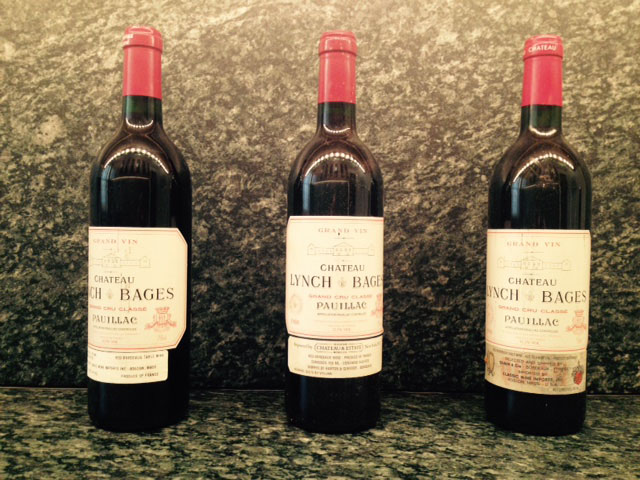
I’ve always thought that the tipping point when Bordeaux changed from its traditional herbaceous style to the modern fruit-driven style was 1982. A series of vintages of Lynch Bages has caused me to revise that conclusion and move the tipping point forward at least to 1990.

Considered by many at the time to have an unprecedented richness that would preclude aging, the 1982 was certainly the first vintage to be instantly delicious on release. It continued to be eminently drinkable in the same style for twenty years, but around 2000 showed the first signs of reversion to type, which is to say showing a delicious touch of herbaceousness to counterpoise the fruits.

My recent experiences with Lynch Bages 1982 show significant bottle variation, with the best bottles showing a generous softness that recalls the original character of the vintage, but others showing an extreme cigar-box like dryness that more resembles the 1975 vintage and suggests the fruits are drying out. At least for the last ten years, it’s been reverting to type, which is say to the pre-1982 tradition, so the change in character was more a matter of style for the first decade than a permanent tipping point.

The lush, rich character of the 1990 far out shadows the 1982, although it also now shows significant bottle variation. The range recently has varied from a bottle showing a touch of classic cigar box to cut the fruit to one that was completely undeveloped, rich and aromatic to the point at which first thoughts might turn to the New World. The latter seems to be the more common experience, and the sheer power of the aromatics makes me feel this may be a Cheshire Cat wine, with nothing left behind as the structure resolves. It seems so completely different in character from traditional Bordeaux as to represent a permanent break with tradition.

In terms of pinning down a tipping point, the 1988 is definitely old school; pleasant enough, losing some fruit now, but in the tradition of restraint rather than extroversion. By comparison with the 1990, the 1989 seems to offer reminiscences of traditional Bordeaux; faintly animal notes might suggest a touch of Brett (a big problem in Bordeaux at the time), making it difficult to judge the force of the fruits, but although they are deep and black, in the end the sense of tannic structure brings a restraint that is lacking from the 1990.LB

Along with these recent vintages, I have also had the 1961. To my palate, this is unmistakably the real thing: elegant fruits, lacy acidity, a touch of cigar box. A tribute to Bordeaux’s traditional longevity, it seems hardly to have changed in character since I first tasted it in 1982. For all the technical advances in viticulture and vinification, I don’t think any vintage since 1961 has produced its equal. I will accept that there have been great advances, especially in turning vintages that would have been write-offs into good wines, but why can’t we produce anything of the like of 1961 any more?

First Ever Tasting of All Dom Pérignon P2 Plenitudes

Dom Pérignon’s cellarmaster, Richard Geoffrey, introduced the P2 Plenitude range in London today with the first-ever tasting of all available vintages. Plenitude takes the concept of late disgorgement to a logical extreme.

DPTastingRichard Geoffroy explaining the wines

Late disgorgement has been used by many vintage super-cuvées as a means of bringing out Champagne’s maximum aging potential. Vintage Champagne ages in the bottle, of course, but its evolution is oxidative, replacing the initial freshness with notes of nuts, toast, and brioche. The same Champagne kept on the lees ages quite differently.

“The beauty of lees aging is that it is not passive, there is an active aging. The lees feed the wine – or I could say that the wine eats the lees, they are swallowed up to give more viscosity, more intensity. It’s all possible because yeast lees fight off oxidation, there is no better anti-oxidative agent than the lees. We believe that this element of active maturation is part of winemaking as much as terroir,” says Richard Geoffroy.DomPerignon

Four P2 Plenitudes in the typical bottles

Lees aging is a few years for most vintage Champagne, but is extended for top cuvées, where the dissolution of the lees into the wine becomes an important part of their character. Dom Pérignon is first released a minimum 8 years after the vintage. The same wine, released after some years additional lees’ aging, was originally called the Oenothèque, but has now been renamed Plenitude, to reflect the belief that aging is not a linear process, that there are certain discontinuous points in time where the wine reaches a stage of additional complexity that merits disgorgement.

For the P2 Plenitude, this happens around 12 years after the vintage, and we tasted the 1998, 1996, 1995, and 1993 vintages, all disgorged around that point. A second Plenitude occurs at least 18 years after the vintage, and there are P3 Plentitudes from vintages of the seventies and eighties. This takes the wine to its ultimate complexity, says Richard Geoffroy: “The energy of time in a P3 brings all the elements into place to make the wine as elongated as it can be.”

Vintage character comes out as clearly in the Plenitudes as it did in the original releases. 1998 is full, ripe, and generous; 1996 is taut and mineral, with more pronounced salinity than the first release; 1995 is refined and precise; 1993 offers the faintest suggestion of blowsiness. “I keep explaining that we are on a mission to recognize the Champagne years for what they are,” Richard Geoffroy explains. “Many people making vintage Champagne are too shy, they make it like a sort of super nonvintage.” If the aim is to reflect vintage character, even perhaps to intensify it given the nature of late disgorgement, it’s certainly been achieved.

There’s some concern in the trade that wines that have been disgorged late won’t age as long in the bottle as those disgorged previously, but the P2 Plenitudes seem to me both to have similar aging potential to the original releases (I would say the original 1996 release is just about reaching a limit now, and I think the P2 1996 will last about the same twenty years) and to reflect vintage character (1996 will have the greatest longevity, 1993 or perhaps 1998 will have the shortest).

Do all vintages justify re-release as P2 or P3 Plenitudes? “All vintages are meant to give P2 and P3, it’s built into the criteria… And success with P2 feeds back to P1. It puts the whole thing into perspective. Dom Pérignon has sometimes been criticized for being too tight at first release. I’m very happy now that P1 can be appreciated for what it is, knowing that P2 is to come,” is Richard’s final word.

Tasting Notes

1998: Disgorged 2009/2010. Full ripe impression to nose. Ripe and powerful on palate, good flavor variety and intensity, yet still showing fresh notes of citrus and apple at the end. Some more mature notes of chocolate and coffee come out faintly in the glass. 93 Drink now-2028.

1996: Disgorged 2008. Taut impression of vintage comes straight off nose, following to palate. The most mineral of all the Plenitudes, citric with overtones of salinity. Wide flavor variety but very fresh. The most structured of all, yet also the smoothest texture. Wonderful contradictions. 95 Drink now-2028.

1995: Disgorged 2007. Very pale color. Some sense of development just beginning with touch of toast and brioche. Very finely textured on palate, with great sense of precision to the acidity. Palate less developed than nose suggests, with general impression of citric minerality, and just a hint of toast and brioche at very end. 94 Drink now-2028.

1993: Relatively developed impression increases in glass; disgorged in 2006, this is the oldest of the Plenitudes in the flight, but it feels disproportionately older than the 1995 disgorged a year earlier. Granular impression to palate with greater sense of viscosity than other vintages. Impression of maturity enhanced by hints of coffee and roast on finish. 92 Drink now-2025

Is Global Warming Changing the Hierarchy of Premier and Grand Crus?

With premox and other problems shortening the longevity of white Burgundy, I have been drinking up my last 2005s, a bit earlier than I would have done previously, and in the past year I have noticed a surprising change in the relationship between premier and grand crus in Chablis.

Take the example of Louis Michel’s grand cru Les Clos and premier cru Montée de Tonnerre. As Louis Michel is the benchmark for Chablis matured in stainless steel, the difference is a pure view of the effect of terroir on fruits, with no complications from different regimes of oak exposure.

Les Clos is always magnificent. For every producer it is the most reserved, steely, and mineral of any of his premier and grand crus. Just beyond Les Clos, separated from the band of grand crus by a small hollow, comes Montée de Tonnerre, always the best of the premier crus, and for some producers often pretty much up to grand cru standard.

I started drinking Louis Michel’s 2005s in 2009. Les Clos showed the house’s typical deeply textured structure, reflecting long maturation on the lees. Reflecting the warm vintage, it was a little richer than usual from the start, with stone fruits mingling with citrus.

Montée de Tonnerre was also a little richer than usual, but with the balance more in the direction of citrus, nicely textured under the fruits, with layers of flavor. Absolutely top notch for premier cru, but less depth than the grand cru.

Today things are different. Les Clos has become quite phenolic in the past year, and the sense of minerality has declined; it’s beginning to seem a little tired, and in a blind tasting I might place it farther south than Chablis. By contrast, Montée de Tonnerre is the absolute quintessence of Chablis: one sniff, and that cool, steely minerality shows that you are in Chablis. Fruits remain in the citrus spectrum, and there’s still some reserve on the finish. In a blind tasting I would place this as grand cru Chablis, and its steeliness might even make me think about Les Clos.

While the relationship between Les Clos and Montée de Tonnerre may have reversed, another grand cru, Vaudésir, has stayed truer to type. The textbook spiciness is overlaid by Louis Michel’s granular texture, stony rather than mineral, but with age the fruit spectrum is turning towards peaches and cream; phenolic hints intensify in the glass, following the path of Les Clos more slowly.

When the Crus were defined, the main distinction between them was reliability of ripening. But this was in a much cooler era: what ripened best in the 1930s may go over the top sooner in warm vintages in the new millenium. I suppose it all depends on what you mean by Chablis. If you want a rich white Burgundy, grand crus from warm vintages may fit the bill. If you want the historic saline minerality, premier crus may show more typicity.

The hierarchy of crus has always been defined, I think, in terms of wines tasted shortly after the vintage; it happens that the best age longer. That also may be changing with warmer vintages, with some of the grand crus richer and more delicious at first, but more likely to decline into blowsiness before the premier crus. How will the market react to this change, and will it be necessary to revise the classification of premier and grand crus?

LouisMichelThe best cru of 2005?

Have Mondavi and Opus One Lost their Way?

It may be unfair to link Mondavi and Opus One together at this point, since although Opus One started as a joint operation between Robert Mondavi and Philippe de Rothschild, they went separate ways after Constellation purchased Mondavi, but I was struck at a dinner with wines from both producers by the similarity in their development. Current vintages of Mondavi’s Fumé Blanc and Reserve Chardonnay were followed by three vintages of Opus One, and it would be fait to say that power is triumphing over elegance all along the line.

In the early years of Napa Valley’s development, Mondavi was a benchmark for Cabernet Sauvignon (the 1974 Reserve was a defining wine for the vintage), the Chardonnay was one of the more French-oriented, and the Fumé Blanc was a master stroke that tamed Sauvignon Blanc with subtle oak impressions. But today the 2012 Fumé Blanc gives an impression of sharp acidity with indistinct fruit impressions, while the 2013 Reserve Chardonnay gives an impression of raw oak in front of fruits. In fact, you might say that the Fumé Blanc is too much Sauvignon and not enough Fumé, while the Chardonnay is too much oak and not enough fruit.

I can’t trace the change in character of the whites historically, but a change in the reds goes back to the early 2000s. There was a long-running difference of opinion between Mondavi and the Wine Spectator over style. The Spectator’s lead critic on California, James Laube, commented in July 2001, “At a time when California’s best winemakers are aiming for ripe, richer, more expressive wines, Mondavi appears headed in the opposite direction… [Winemaker] Tim Mondavi and I have different taste preferences… He has never concealed his distaste for big, ultra rich plush or tannic red wines. I know he can make rich, compelling wines, yet he prefers structured wines with elegance and finesse.” Tim Mondavi replied, “I am concerned… that there appears to be a current trend toward aggressively over-ripe, high in alcohol, over oaked wines that are designed to stand out at a huge tasting rather than fulfill the more appropriate purpose of enhancing a meal.” There you have the whole debate about style in Napa in a nutshell. Yet after this was all said and done, the style at Mondavi changed in the direction of greater richness.

I’ve always found Opus One easy to underrate in the early years, when it tends to be somewhat dumb, and to retain a touch of austerity, but in vertical tastings I’ve found it to age well. Tasted at the winery five years ago, the 2005 was showing beautifully, the 1995 showed the elegance of a decade’s extra aging, and the first vintage (1979) was still vibrant. My impression at the dinner this week was different. The 2005 shows powerful primary fruits, with not much evidence of development, and a touch of oxidation, showing in the form of raisons on the finish. If it hadn’t seemed the most complete wine of that vertical at the winery, I would say that it must have been brutal when it was young. As this is an unexpected turn of events, I wondered whether perhaps the bottle might be out of condition, whether perhaps the oxidative impressions were due to poor storage, but I think this question was answered by the 2009, which showed a similar, but less evident, impression of oxidation. Again this is a turn-up for the book, as the last time I had the 2009 was at the winery just after it had been bottled: tannins were subsumed by dense, black, and aromatic fruits, and my impression was that the fruit concentration offered great potential for development. But today, aside from taming the tannins with time, I really don’t see much development in flavor variety, and I suspect this is going in the same direction as the 2005. The 2012 is certainly a very big wine, yet identifiably Cabernet-based, with that sense of restraint and hints of tobacco, but I’m concerned that the massive fruits may turn in the same oxidative direction as the earlier vintages. How long, Oh Lord, how long, will it be before the wines develop interesting flavor variety?

I wonder how much alcohol has to do with these impressions? The first vintage of Opus One had 12.9% alcohol, the level stayed under 13% through the 1980s, under 14% through the 1990s, and now alternates between 14.0 and 14.5 according to the labels. Although alcohol isn’t obtrusive on the palate–in the current parlance that winemakers use to explain or apologize for high alcohol, it is balanced—it’s the very high extract and fruit concentration that achieve the sense of equilibrium. This makes it hard for the wine not to over-power a meal. I know that there’s a school of thought that alcohol levels aren’t relevant or interesting, and that no one really cares, but I do: not just because the wine is too heady, but because I don’t like the corollary that there’s simply too much flavor . Or more precisely, too much quantity of flavor and not enough variety. There comes a point where levels of extraction are so high that varietal typicity disappears and everything is just fruit, fruit, fruit. My plea to Napa winemakers is to back off: you don’t have to extract absolutely everything you can from the grapes. It might be a better compromise to harvest under 14% alcohol than to go that last step to super-ripeness.

What is Modern Wine?

I was going to call my latest book The Wines of Modern France, to emphasize that it’s a new approach to looking at what French wines are like today, but in the end I settled for simply the Wines of France, because so many wine producers in France questioned the inclusion of  “Modern.” Perhaps this is not so surprising in a country where tradition is so valued, but it gives me pause for thought as to what we mean by “modern wine.”

Everywhere in the world of wine, there is a continuing debate between tradition and modernity. But it is a bit different in France: I don’t think I have met a single vigneron who would admit to being modern. When I told producers my book was about the wines of modern France, many were quizzical, and asked if you could truly put “France” and “Modern” in the same sentence. This is a common view among artisan producers: modernity means mass production using industrial methods, and rejecting them defines you as a traditionalist. Perhaps this is why no one wants to admit they are a modernist in France: the important thing is to redefine tradition so that your wine fits in.

I had an interesting disagreement about modernity with Christophe Perrot-Minot, who makes clean, bright, flavorful wines that, for me, express the quintessence of modern Burgundy. When I asked whether he regards himself as a modernist, he was almost insulted. “For me this is traditional, not modern. It’s not that I’m looking for drinking young, I’m looking for balance, and they will age well. For me, a modern wine is made by thermoregulation and long cold maceration. Wines that are too tannic, I call them rustic, not modern or traditional.”

The very concept of modernism is viewed with suspicion. Jean-Luc Colombo all but created a scandal when he introduced new oak into Cornas thirty years ago. When I asked his daughter Laure whether she regards her father as a modernist, she responded with a question: “What is tradition—is it twenty years or fifty years or a hundred years?”–a fair point as Jean-Luc’s approach now has been widely followed.

Mounir Saouma, at micro-negociant Lucien Le Moine in Beaune, sees the “young tradition” as the last thirty or forty years, and the “old tradition” as the preceding period. He views the essential difference as the level of intervention. “So I saw the need for a place where we would make wine in the old tradition. There was a window for a policy of ‘I don’t do.’ Many people were saying ‘I do so and so.’ The objective was to be as classic as possible. I don’t like the word old-fashioned, it’s pretentious. Hundreds of years ago there was a simple way of making wine: if it’s red, put it in a tank, push down the cap, press, wait, bottle. I tried experiments in making wine very simply, putting it in tank and leaving it.” Today Mounir makes his wines pretty much that way, and they have a wonderful bright elegance, very pure and precise. I would call them modern by comparison with the muddier flavor profiles of the past.

My book is certainly about modern wines in the sense that it tries to relate the wines being produced today to the objectives of the people who are making them. I would describe many of the producers as artisanal: small scale rather than bulk production, manual work rather than automated equipment, individuality rather than homogeneity. But why shouldn’t a producer who believes in minimal intervention be considered to be modern? It would be difficult without modern methods and hygiene to make natural wines, for example. Is it necessary to equate modernity with industrial methods? And aren’t you entitled to feel some skepticism if a producer says that he makes wine exactly like his father and grandfather?

The best wines today for me are those that do represent the traditions of the region, but which avoid the problems and flaws of the past. Nostalgia is all very well, but whether you call them modern or not, today’s wines are more a reflection of the producers’ objectives than when they were limited by technical problems.

This is an extract from the conclusions of Wines of France: A Guide to 500 Leading Producers.


Is Bordeaux 1990 Finally Starting to Come Around?

My question does not reflect concern as to whether 1990 Bordeaux is ready to drink, as the vintage has been drinking well for quite some years now (and to my mind is distinctly more reliable than 1989, with which it is often compared). It addresses the deeper question of whether this vintage will end up true to the old traditions of Bordeaux or will more reflect the modern era.

The driving force for this question in my mind is the history of the 1982 vintage, which showed an unprecedented drinkability on release. For the first two decades, the wines were lovely, but with a distinctly richer and more overtly fruit-driven spectrum than previous top vintages. Then around year 2000, they began to revert to type, with the left bank wines beginning to show traces of delicious herbaceousness to offset the fruits. Since then they have developed along the lines of classic Bordeaux.

My question is whether vintages that have been successively richer than 1982, such as 1990, 2000, 2005, and others, will show that same quality of reversion to type or whether they are so much richer, with higher tannins, greater dry extract, and greater alcohol, that they will follow a different path, more New World-ish you might say. Until now I have been concerned that they might fail to develop that delicious savory counterpart to the fruits that to me is the quintessence of Bordeaux as it ages. At a splendid gala dinner held by the Commanderie de Bordeaux of New York, which focused on the 1990 vintage, I got my first sense that these wines may now be moving in a savory direction.

Chateau  Figeac now shows its structural bones more clearly than a few years back. Herbaceousness is evident to the point at which it seems much more dominated by Cabernet Sauvignon than its actual one third, and I might well have placed it on the left bank in a blind tasting. This now seems classic to the point at which I am worried whether herbaceousness will overtake the fruits as they decline.

Lynch Bages is at its peak, and little altered from two or three years ago. Here Cabernet Sauvignon shows more as a subtle touch of cigar box than herbaceousness; this is completely classic in offering a faint counterpoise to the black fruit spectrum of the palate. That refreshing uplift is what I love about Bordeaux. (I see a direct line from the 1985, where cigar box dominates the fruits, delicious but not as subtle as the perfection of the 1990.)

Chateaux Palmer and Latour are still dominated by the richness of the vintage; in fact they seem to have put on weight and to be richer than they were three or four years ago. Palmer has gone from the traditional delicacy of Margaux with violets on the palate three years ago to a palate that is now dominated by rich, round black fruits. This is rather plump for a traditional Margaux, although as refined as always, but the signs of potential reversion to type were there in the past, and I expect them to return .

It’s not exactly vinicide to drink the Latour now, but it would be missing the point. The wine shows impressive richness and power, with deep black fruits where the first faint signs of development are beginning to show. There are plenty of precedents for Latour requiring decades to come around—the 1928 wasn’t drinkable until the late 1970s—but this wine is certainly enjoyable now. It’s not unready because of a tannic presence, but because the fruits have yet to develop the flavor variety and complexity that will come over the next decade. In the context of my basic question, this is classic.

So there is good news and bad news. The good news is that the 1990 Bordeaux is now beginning to develop in a way that I think of as reverting to type. The bad news is that it has taken 25 years. The 1982s took 18 years to reach a comparable point. If we fast forward and try to predict the path for the 2005s or 2009s, we may be looking at 30 years.


What’s the problem with 1996 Red Burgundy?

The Burgundians are not so prone as the Bordelais to call any good year the vintage of the century, but 1996 was widely acclaimed at the time as a great vintage in Burgundy for both red and white. Twenty years later, it is abundantly clear that it is anything but a great vintage. My particular peeve is that I was so pleased at the time to acquire a really good selection of Crus and producers for reds, in fact this was the first time I had been able to get grand crus from the likes of Rousseau and so on. Now this seems more like hubris.

Coincidentally or not, this was also the first year in which premox really took hold for white Burgundy. (Some people date it from 1995, but 1996 was the first year I saw the effect in any quantity of wines). This is a bit odd because my experience since then has been that premox is magnified in the richer years – which 1996 now is turning out not to be. Because of premox, I have finished up my 1996 white Burgundies, but I am still mulling over how the reds could have been so deceptive as I continue to explore them.

This is scarcely the first vintage in which everything seemed fair set at the time of harvest and a problem emerged later. 1983 comes to mind as the most striking precedent: the wines seemed lovely on release, but two or three years later, many showed unmistakable signs of grape rot, and to all intents and purposes rapidly became undrinkable.

I would love to have a proper scientific explanation of the problem with 1996. On the palate the wines universally show a medicinal acidity, sometimes verging on bitter. It’s not just that the wines have too much acidity – we have seen that in plenty of older vintages from Burgundy – but it’s the character of the acidity, more than a bit medicinal, sometimes even a touch metallic. What is responsible for this universal character?

It’s most noticeable at village level, but remains prominent at premier cru; grand crus have a better weight of fruit and richness to balance it, but it’s a rare grand cru that does not show it in the background. It is not entirely predictable: it’s less obvious in Jadot’s Ruchottes Chambertin than in Le Chambertin, for example.

It wasn’t evident at the time of vintage. My tastings of barrel samples identified strong tannins and good acidity, but these did not seem out of kilter, and over the first few years, the wines seemed to have a promising richness. For almost the first ten years after the vintage, acidity seemed high but reasonably in character. By 2006 it began to seem doubtful if and when the wines would come around, and by 2009 or 2010 the acidity seemed to be pushing the tannins on the finish. Tannins aren’t obviously punishing today, but must be contributing to the character that has become so evident over the past five years; virtually all my tasting notes since 2010 include the word “medicinal”.

While the vintage now lacks generosity, I’d be hard put to describe it as mean, since the underlying fruits often show a sweet ripeness – but they can’t get out from under that medicinal character. The puzzle for me is how this developed so uniformly several years after the vintage. Could it have been there all along but has been revealed only as the fruits lightened up? At all events, I don’t accept the school of thought that the wines need more time to come around: they are what they are, and this won’t change.