A Perspective on Canadian Wine

Most people probably know Canadian wine only through the prism of its famous ice wine, but actually Canada has around 12,000 ha of vineyards (mostly in British Columbia’s Okanagan Valley and Ontario’s Niagara Peninsula) roughly equivalent in total to Burgundy’s Côte d’Or. Most production is dry wine, with sparkling wine and ice wine a small proportion. A tasting at Canada House in London offered a rare opportunity to get a bead on whether this is a successful endeavor.

The wines were almost all VQA (Canada’s appellation system), so this is a look at the high end. I do think they’ve made a mistake in defining the VQAs in great detail at this stage, with ten sub-appellations in Niagara, for example, confusing rather than enlightening.

Living on the East coast of the United States, I am inclined to regard Canada as the frozen North, or anyway, distinctly cool climate, so I am frankly confused by the somewhat optimistic descriptions of climate by the Wine Council of Ontario. An amusing chart of annual temperatures in various wine growing regions appears to show that Bordeaux is warmer than the Languedoc and that Niagara is warmer than Bordeaux, which leaves me feeling somewhat sceptical.

Looking at weather station data, I place Niagara between Alsace and the Mosel. It is a little bit warmer in British Columbia, and there is certainly significant variation between the ends of Okanagan Valley as it extends for more than a hundred miles from north to south, but I am surprised to see the southern part described as warmer than Napa on the basis of degree days, as weather station data in the midpoint of the southern part suggest to me that temperatures are quite close to Alsace. Perhaps I am not paying sufficient attention to variations between microclimates.

Tasting the wines, the climate that most often comes to mind for comparison would be the Loire. With Riesling and Chardonnay as the main focus, but also a fair proportion of Pinot Gris, Gewurztraminer, and Viognier, the impression is distinctly cool climate.

Most Chardonnays at the tasting had too much oak for my taste, even though the stated usage of new oak was usually quite moderate. Even allowing for youthful character, I’m not certain there’s enough fruit to carry the oak. My impression of the Chardonnays from Niagara is that the citrus palate can be a bit too much driven by lemon. It’s fair to say that the style is European rather than New World, but given the cool climate character of the wines, I would suggest that Chablis would be a better model than the Côte d’Or, and the question should be how much (old) oak to use together with stainless steel, rather than what proportion of the oak (with many wines barrel fermented) should be new. With prices often around or above $35, competitiveness seems an issue.

Curiously given the cool climate impression, I was not generally impressed with the Rieslings. My main complaint is the style: Riesling character is often obscured by a significant level of residual sugar. I did not find a single dry Riesling. I’m inclined to wonder whether, if you can’t successfully make a dry wine, you should plant a different variety, but I suppose you might say that the best Canadian Rieslings do show a nice aperitif style.

Given the cool climate impression made by the whites, the successful production of reds is quite surprising, especially the focus on Bordeaux varieties rather than those more usually associated with cooler climates. Among them, Cabernet Franc appears to be the variety of choice for single varietal wines, and although there are certainly some creditable wines showing good varietal typicity, I find many to be on the edge for ripeness. Certainly the style is much more European than New World­—the Loire would be the obvious comparison. The best Merlots or Bordeaux blends seem more like the Médoc than the Right Bank of Bordeaux in style.

To my surprise, Syrah outshines Cabernet Franc in Okanagan Valley. The Syrahs are evidently cool climate in character, definitely Syrah not Shiraz, in a fresh style with some elegance, which should mature in a savory direction; nothing with the full force impression of the New World. They remind me of the Northern Rhone in a cool year.

There are some successful Pinot Noirs in both British Columbia and Ontario, presenting somewhat along the lines of Sancerre or Germany. The difficulty is to bring out classic typicity in these cool climates, but the best are Pinot-ish in a light style.

Some producers are now making single vineyard wines. Is it worth it? It’s an interesting question whether at this stage of development the best terroirs have been well enough defined to produce reliably better wine every year or whether a better model would be to make cuvées from the best lots. There’s also the question of whether they are competitive at price points pushing beyond those of the estate bottlings.

Favorites at the tasting

Sparkling wine, Gaspereau Valley, Nova Scotia: Benjamin Bridge, 2008

This is called the Methode Classique Brut Reserve to emphasize the connection with Champagne: it comes from 61% Chardonnay and 39% Pinot Noir. It follows the tradition of Champagne with a faintly toasty nose showing some hints of citrus. Nice balance on palate with an appley impression. Flavors are relatively forceful.   11.5% 89

Syrah, Okanagan Valley, British Columbia: Painted Rocks Winery, 2013

Lovely fruits in a restrained style, fresh and elegant with beautiful balance, a touch of pepper at the end. A textbook Syrah in a slightly tight style.   14.9% 89

Syrah, Okanagan Valley, British Columbia: Burrowing Owl Vineyards, 2013

Black fruit impression on nose with hints of blueberries. Light style is quite Rhone-like on palate, nice clean fruits with faint buttery hints at end, more successful than the Bordeaux varieties. 14.5% 89

Pinot Noir, Beamsville Bench, Niagara Peninsula: Hidden Bench, Felseck Vineyard, 2013

Nicely rounded red fruits with faintly minty overtones bringing a slight herbal impression to the nose. Quite a sweet ripe impression on palate with touch of spice at the end. Slight viscosity on palate brings to mind the style of Pinot Noir in Germany.   12.7% 88

Cabernet Franc, Creek Shores, Niagara Peninsula: Tawse Family Winery, Van Bers Vineyard, 2012

Nose shows some faint tobacco and chocolate, with palate following with typically herbal notes of Cabernet Franc. Dry tobacco-ish finish. Does it have enough fruit to stand up when the tannins resolve?   13.0% 88

Chardonnay, Niagara: Norman Hardie Winery, Cuvee L, 2012

More restrained nose than Hardie’s other Chardonnay cuvees but some oak does show through. Nice balance on palate between oak and slightly lemony fruits. Follows Chablis in style.   12.4% 88

Viognier, Okanagan Valley, British Columbia: Blasted Church Vineyards, 2014

Barrel fermented with some new oak. Faintly perfumed nose with the perfume somewhat clearer on palate. Fry impression to finish short of phenolic. Nice long finish on which you can just see the oak.   13.0% 89
Is Global Warming Changing the Hierarchy of Premier and Grand Crus?

With premox and other problems shortening the longevity of white Burgundy, I have been drinking up my last 2005s, a bit earlier than I would have done previously, and in the past year I have noticed a surprising change in the relationship between premier and grand crus in Chablis.

Take the example of Louis Michel’s grand cru Les Clos and premier cru Montée de Tonnerre. As Louis Michel is the benchmark for Chablis matured in stainless steel, the difference is a pure view of the effect of terroir on fruits, with no complications from different regimes of oak exposure.

Les Clos is always magnificent. For every producer it is the most reserved, steely, and mineral of any of his premier and grand crus. Just beyond Les Clos, separated from the band of grand crus by a small hollow, comes Montée de Tonnerre, always the best of the premier crus, and for some producers often pretty much up to grand cru standard.

I started drinking Louis Michel’s 2005s in 2009. Les Clos showed the house’s typical deeply textured structure, reflecting long maturation on the lees. Reflecting the warm vintage, it was a little richer than usual from the start, with stone fruits mingling with citrus.

Montée de Tonnerre was also a little richer than usual, but with the balance more in the direction of citrus, nicely textured under the fruits, with layers of flavor. Absolutely top notch for premier cru, but less depth than the grand cru.

Today things are different. Les Clos has become quite phenolic in the past year, and the sense of minerality has declined; it’s beginning to seem a little tired, and in a blind tasting I might place it farther south than Chablis. By contrast, Montée de Tonnerre is the absolute quintessence of Chablis: one sniff, and that cool, steely minerality shows that you are in Chablis. Fruits remain in the citrus spectrum, and there’s still some reserve on the finish. In a blind tasting I would place this as grand cru Chablis, and its steeliness might even make me think about Les Clos.

While the relationship between Les Clos and Montée de Tonnerre may have reversed, another grand cru, Vaudésir, has stayed truer to type. The textbook spiciness is overlaid by Louis Michel’s granular texture, stony rather than mineral, but with age the fruit spectrum is turning towards peaches and cream; phenolic hints intensify in the glass, following the path of Les Clos more slowly.

When the Crus were defined, the main distinction between them was reliability of ripening. But this was in a much cooler era: what ripened best in the 1930s may go over the top sooner in warm vintages in the new millenium. I suppose it all depends on what you mean by Chablis. If you want a rich white Burgundy, grand crus from warm vintages may fit the bill. If you want the historic saline minerality, premier crus may show more typicity.

The hierarchy of crus has always been defined, I think, in terms of wines tasted shortly after the vintage; it happens that the best age longer. That also may be changing with warmer vintages, with some of the grand crus richer and more delicious at first, but more likely to decline into blowsiness before the premier crus. How will the market react to this change, and will it be necessary to revise the classification of premier and grand crus?

LouisMichelThe best cru of 2005?

Have Mondavi and Opus One Lost their Way?

It may be unfair to link Mondavi and Opus One together at this point, since although Opus One started as a joint operation between Robert Mondavi and Philippe de Rothschild, they went separate ways after Constellation purchased Mondavi, but I was struck at a dinner with wines from both producers by the similarity in their development. Current vintages of Mondavi’s Fumé Blanc and Reserve Chardonnay were followed by three vintages of Opus One, and it would be fait to say that power is triumphing over elegance all along the line.

In the early years of Napa Valley’s development, Mondavi was a benchmark for Cabernet Sauvignon (the 1974 Reserve was a defining wine for the vintage), the Chardonnay was one of the more French-oriented, and the Fumé Blanc was a master stroke that tamed Sauvignon Blanc with subtle oak impressions. But today the 2012 Fumé Blanc gives an impression of sharp acidity with indistinct fruit impressions, while the 2013 Reserve Chardonnay gives an impression of raw oak in front of fruits. In fact, you might say that the Fumé Blanc is too much Sauvignon and not enough Fumé, while the Chardonnay is too much oak and not enough fruit.

I can’t trace the change in character of the whites historically, but a change in the reds goes back to the early 2000s. There was a long-running difference of opinion between Mondavi and the Wine Spectator over style. The Spectator’s lead critic on California, James Laube, commented in July 2001, “At a time when California’s best winemakers are aiming for ripe, richer, more expressive wines, Mondavi appears headed in the opposite direction… [Winemaker] Tim Mondavi and I have different taste preferences… He has never concealed his distaste for big, ultra rich plush or tannic red wines. I know he can make rich, compelling wines, yet he prefers structured wines with elegance and finesse.” Tim Mondavi replied, “I am concerned… that there appears to be a current trend toward aggressively over-ripe, high in alcohol, over oaked wines that are designed to stand out at a huge tasting rather than fulfill the more appropriate purpose of enhancing a meal.” There you have the whole debate about style in Napa in a nutshell. Yet after this was all said and done, the style at Mondavi changed in the direction of greater richness.

I’ve always found Opus One easy to underrate in the early years, when it tends to be somewhat dumb, and to retain a touch of austerity, but in vertical tastings I’ve found it to age well. Tasted at the winery five years ago, the 2005 was showing beautifully, the 1995 showed the elegance of a decade’s extra aging, and the first vintage (1979) was still vibrant. My impression at the dinner this week was different. The 2005 shows powerful primary fruits, with not much evidence of development, and a touch of oxidation, showing in the form of raisons on the finish. If it hadn’t seemed the most complete wine of that vertical at the winery, I would say that it must have been brutal when it was young. As this is an unexpected turn of events, I wondered whether perhaps the bottle might be out of condition, whether perhaps the oxidative impressions were due to poor storage, but I think this question was answered by the 2009, which showed a similar, but less evident, impression of oxidation. Again this is a turn-up for the book, as the last time I had the 2009 was at the winery just after it had been bottled: tannins were subsumed by dense, black, and aromatic fruits, and my impression was that the fruit concentration offered great potential for development. But today, aside from taming the tannins with time, I really don’t see much development in flavor variety, and I suspect this is going in the same direction as the 2005. The 2012 is certainly a very big wine, yet identifiably Cabernet-based, with that sense of restraint and hints of tobacco, but I’m concerned that the massive fruits may turn in the same oxidative direction as the earlier vintages. How long, Oh Lord, how long, will it be before the wines develop interesting flavor variety?

I wonder how much alcohol has to do with these impressions? The first vintage of Opus One had 12.9% alcohol, the level stayed under 13% through the 1980s, under 14% through the 1990s, and now alternates between 14.0 and 14.5 according to the labels. Although alcohol isn’t obtrusive on the palate–in the current parlance that winemakers use to explain or apologize for high alcohol, it is balanced—it’s the very high extract and fruit concentration that achieve the sense of equilibrium. This makes it hard for the wine not to over-power a meal. I know that there’s a school of thought that alcohol levels aren’t relevant or interesting, and that no one really cares, but I do: not just because the wine is too heady, but because I don’t like the corollary that there’s simply too much flavor . Or more precisely, too much quantity of flavor and not enough variety. There comes a point where levels of extraction are so high that varietal typicity disappears and everything is just fruit, fruit, fruit. My plea to Napa winemakers is to back off: you don’t have to extract absolutely everything you can from the grapes. It might be a better compromise to harvest under 14% alcohol than to go that last step to super-ripeness.

What is Modern Wine?

I was going to call my latest book The Wines of Modern France, to emphasize that it’s a new approach to looking at what French wines are like today, but in the end I settled for simply the Wines of France, because so many wine producers in France questioned the inclusion of  “Modern.” Perhaps this is not so surprising in a country where tradition is so valued, but it gives me pause for thought as to what we mean by “modern wine.”

Everywhere in the world of wine, there is a continuing debate between tradition and modernity. But it is a bit different in France: I don’t think I have met a single vigneron who would admit to being modern. When I told producers my book was about the wines of modern France, many were quizzical, and asked if you could truly put “France” and “Modern” in the same sentence. This is a common view among artisan producers: modernity means mass production using industrial methods, and rejecting them defines you as a traditionalist. Perhaps this is why no one wants to admit they are a modernist in France: the important thing is to redefine tradition so that your wine fits in.

I had an interesting disagreement about modernity with Christophe Perrot-Minot, who makes clean, bright, flavorful wines that, for me, express the quintessence of modern Burgundy. When I asked whether he regards himself as a modernist, he was almost insulted. “For me this is traditional, not modern. It’s not that I’m looking for drinking young, I’m looking for balance, and they will age well. For me, a modern wine is made by thermoregulation and long cold maceration. Wines that are too tannic, I call them rustic, not modern or traditional.”

The very concept of modernism is viewed with suspicion. Jean-Luc Colombo all but created a scandal when he introduced new oak into Cornas thirty years ago. When I asked his daughter Laure whether she regards her father as a modernist, she responded with a question: “What is tradition—is it twenty years or fifty years or a hundred years?”–a fair point as Jean-Luc’s approach now has been widely followed.

Mounir Saouma, at micro-negociant Lucien Le Moine in Beaune, sees the “young tradition” as the last thirty or forty years, and the “old tradition” as the preceding period. He views the essential difference as the level of intervention. “So I saw the need for a place where we would make wine in the old tradition. There was a window for a policy of ‘I don’t do.’ Many people were saying ‘I do so and so.’ The objective was to be as classic as possible. I don’t like the word old-fashioned, it’s pretentious. Hundreds of years ago there was a simple way of making wine: if it’s red, put it in a tank, push down the cap, press, wait, bottle. I tried experiments in making wine very simply, putting it in tank and leaving it.” Today Mounir makes his wines pretty much that way, and they have a wonderful bright elegance, very pure and precise. I would call them modern by comparison with the muddier flavor profiles of the past.

My book is certainly about modern wines in the sense that it tries to relate the wines being produced today to the objectives of the people who are making them. I would describe many of the producers as artisanal: small scale rather than bulk production, manual work rather than automated equipment, individuality rather than homogeneity. But why shouldn’t a producer who believes in minimal intervention be considered to be modern? It would be difficult without modern methods and hygiene to make natural wines, for example. Is it necessary to equate modernity with industrial methods? And aren’t you entitled to feel some skepticism if a producer says that he makes wine exactly like his father and grandfather?

The best wines today for me are those that do represent the traditions of the region, but which avoid the problems and flaws of the past. Nostalgia is all very well, but whether you call them modern or not, today’s wines are more a reflection of the producers’ objectives than when they were limited by technical problems.

This is an extract from the conclusions of Wines of France: A Guide to 500 Leading Producers.


What’s the problem with 1996 Red Burgundy?

The Burgundians are not so prone as the Bordelais to call any good year the vintage of the century, but 1996 was widely acclaimed at the time as a great vintage in Burgundy for both red and white. Twenty years later, it is abundantly clear that it is anything but a great vintage. My particular peeve is that I was so pleased at the time to acquire a really good selection of Crus and producers for reds, in fact this was the first time I had been able to get grand crus from the likes of Rousseau and so on. Now this seems more like hubris.

Coincidentally or not, this was also the first year in which premox really took hold for white Burgundy. (Some people date it from 1995, but 1996 was the first year I saw the effect in any quantity of wines). This is a bit odd because my experience since then has been that premox is magnified in the richer years – which 1996 now is turning out not to be. Because of premox, I have finished up my 1996 white Burgundies, but I am still mulling over how the reds could have been so deceptive as I continue to explore them.

This is scarcely the first vintage in which everything seemed fair set at the time of harvest and a problem emerged later. 1983 comes to mind as the most striking precedent: the wines seemed lovely on release, but two or three years later, many showed unmistakable signs of grape rot, and to all intents and purposes rapidly became undrinkable.

I would love to have a proper scientific explanation of the problem with 1996. On the palate the wines universally show a medicinal acidity, sometimes verging on bitter. It’s not just that the wines have too much acidity – we have seen that in plenty of older vintages from Burgundy – but it’s the character of the acidity, more than a bit medicinal, sometimes even a touch metallic. What is responsible for this universal character?

It’s most noticeable at village level, but remains prominent at premier cru; grand crus have a better weight of fruit and richness to balance it, but it’s a rare grand cru that does not show it in the background. It is not entirely predictable: it’s less obvious in Jadot’s Ruchottes Chambertin than in Le Chambertin, for example.

It wasn’t evident at the time of vintage. My tastings of barrel samples identified strong tannins and good acidity, but these did not seem out of kilter, and over the first few years, the wines seemed to have a promising richness. For almost the first ten years after the vintage, acidity seemed high but reasonably in character. By 2006 it began to seem doubtful if and when the wines would come around, and by 2009 or 2010 the acidity seemed to be pushing the tannins on the finish. Tannins aren’t obviously punishing today, but must be contributing to the character that has become so evident over the past five years; virtually all my tasting notes since 2010 include the word “medicinal”.

While the vintage now lacks generosity, I’d be hard put to describe it as mean, since the underlying fruits often show a sweet ripeness – but they can’t get out from under that medicinal character. The puzzle for me is how this developed so uniformly several years after the vintage. Could it have been there all along but has been revealed only as the fruits lightened up? At all events, I don’t accept the school of thought that the wines need more time to come around: they are what they are, and this won’t change.

I Visit Four Top Producers in Valpolicella at Extreme Ends of the Size Spectrum

Valpolicella is going through a continuing identity crisis, with the growth of Amarone and Ripasso production threatening the existence of “regular” styles of Valpolicella, the expansion of Amarone from the hills to the plains raising questions about its position as a peak quality wine (see The Scandalous Expansion of Amarone), and a switch from Ripasso to “double fermentation” meaning that some leading wines are labeled as IGT Veronese instead of Ripasso della Valpolicella (see When Ripasso Is Not Ripasso.) I visited four leading producers, all still run by the founding families, but varying from the largest (Masi and Allegrini) to the smallest (Bussola and Quintarelli) to see how they view the future of the region.

Massimilla di Serego Alighieri at Masi provided a fantastic introduction to the region. The wine from her family estate, just up the road from Masi HQ, has been made by Masi (under the Alghieri label), and the estate has a wonderful palazzo in the center of the vineyards. Masi takes its name from the first vineyard acquired by the Boscaini family, Vaja dei Masi (the little Masi valley), in 1772. There are 993 ha in the Veneto and more in Tuscany. A huge drying loft where grapes are prepared for Amarone is a mix of tradition (grape bunches dry on wood trays with bamboo bottoms to allow air circulation) and technology (humidity and temperature are controlled by a computerized system that assesses the state of drying). There’s a whole laboratory area devoted to experimentation.

Seregeo-Alighieri-VillaThe Seregeo-Alghieri villa.

Masi’s thinking altogether is characterized by that mix of traditional and innovation. They are still using all three grape varieties for Valpolicella: Corvina, soft and sweet, is the predominant, of course, supported by Rondinella and Molinara, which is no longer required by the rules, but Masi retain it because they feel it adds useful spice and acidity. But they have resurrected an old variety, Oseleta, which has very small grapes and ripens late. It has lots of tannin to add structure, and is matured in barriques to soften the tannins.

The house style at Masi is rich and opulent, with a sense through all the wines of glycerin – this is one of the main results of the Appassimento drying technique. In fact, the house style is maintained by using smaller proportions of dried grapes in other wines, such as the Masianco white and the Rosa dei Masi (rosé).

The next day, we spent the afternoon at Allegrini, which is rather discreetly run, to the point at which I had some difficulty identifying the right location. We started out at a vast drying facility, which handles all Allegrini’s grapes, as well as those of several other producers. It’s just identified as the Center for Appassimento Research. Grape bunches are collected in plastic bins in the vineyard, and then bins go directly into the drying center.

From there we went to Allegrini’s new headquarters. They’ve made wine from the vineyards of the Palazzo Della Torre for a long time, but in 2008 the opportunity arose to buy the villa in the center of the vineyards. Villa is a bit of a misnomer – it’s a splendid Renaissance palazzo, currently being extensively renovated. This may be a lifetime endeavor. The 110 ha of vineyards are on the hills in all the communes of Valpolicella.

Palazzo-della-Torre-VillaThe villa at Palazzo della Torre.

A splendid tasting in which we compared current vintages with those of the past decade demonstrated Allegrini’s range. Unusually it’s not focused exclusively on Valpolicella; some of the top wines are IGT Veronese. What is now one of the major vineyard sites of the region, the La Grola hill, was abandoned in the 1970s as everyone wanted to plant on the plain to make the simple fruity wines of the era. Giovanni Allegrini invested heavily into buying it, in fact he borrowed twice the annual turnover of the company to do so. Today two wines are made from the hill. La Grola started in the nineties as a blend of Corvina, Shiraz, and Oseleta; since 2012 it’s been only Corvina and Oseleta. “Oseleta works exactly like Petit Verdot in Bordeaux,” says Alberto Lusini. La Poia is the vineyard right on top of the La Grola hill, and is planted only with Corvina, in fact with a specific clone called red stem Corvina. so deeply colored that some of the color goes into the stem. Both wines are made conventionally (no dried grapes), and La Poia offers an unusual opportunity to see Corvina as a monovarietal. “When La Poia was being planted, at that time they were focusing on Cabernet Sauvignon and Merlot, but my father said, I think we can make a special wine with Corvina,” recalls Marilisa Allegrini.

“We are called modernists– but we are modernists in the sense that we produce Amarone without oxidation and Amarone tastes traditional with raisined notes. We do some modern things and some traditional things,” is how Marilisa explains the house style. Her father was among the first to move from the traditional pergola pruning to Guyot; at the time, another winemaker asked: “what are you doing, are you planting vines or growing salad?” Now the pergolas have more or less disappeared from most quality producers.

The style at Allegrini is unusually refined. La Grola and La Poia are smooth, sophisticated wines. The equivalent of Ripasso, the Palazzo della Torre (the largest production wine), is made by double fermentation (When Ripasso Is Not Ripasso) and is elegant for this style. About 10% of production, the Amarone is intense, but shows a rare sense of precision. “Unlike other producers, our style for Amarone is completely dry,” says Marilisa. Recioto comes from a selection of the ripest grapes, which spend an extra month in drying.

We spent the morning at two smaller, but exceedingly high quality, producers. Tommasso Bussola is located round the back of Negrar, with the winery somewhat hidden behind a group of slightly shabby looking buildings. The range from their 14 ha is all Valpolicella, except for l’Errante, a Bordeaux blend.

I’m not sure you’d quite describe the style as modern, but it is more forceful than most and there’s a good deal of new oak around. Certainly the Amarone’s are very rich, really reinforced when you move from the basic cuvée to the special bottlings of TB (from 50-year-old vines) or Vigneto Alto (from 65-year-old vines, made in about half the vintages). The sweet wines give a positively decadent impression. There’s a classic Ripasso, one of the very few I’ve had where the style really comes off as adding extra complexity as well as weight.

L’Errante is a Bordeaux blend, started in 2003 with grapes that were in the Ca’ del Laito vineyard which they bought in 2001 (the most recent purchase). “We made an experiment We started by making it like a Ripasso. Then in 2007 we started to make it like an Amarone. It’s a little sweeter than Amarone, with 18 g/l residual sugar. It’s 50% Merlot, 30% Cabernet Franc, and 20% Cabernet Sauvignon. Production method is now the same as Amarone, with 42 months in new tonneaux,” explains Guiseppe Bussola.

Quintarelli stands out above everyone else in Valpolicella, both literally and metaphorically. The winery is in a spectacular locale on the heights above Negrar. Access is up a narrow mountainous hairpin road with views right over the valley. It was dramatic when we arrived as we were above the clouds on the other side of the valley. The facility is a modern building going storeys underground, basically underneath the house constructed two generations ago. The winery was founded the generation before that, in 1924.

There are 3 ha of vineyards immediately below the house. Corvina is grown under pergola; Guyot is used for the French grapes. There are another 8 ha farther away. Quintarelli’s wines have a level of subtlety and sophistication that is rare for Valpolicella. All are marked by an extremely elegant balance, there is never too much extraction, the style is if anything understated. Layers of flavor have to be teased out of each wine. One mark is that the Recioto is of course sweet, but perceived sweetness is much less than you would expect from residual sugar, and the wine is simply deliciously balanced.

Quintarelli3The view from Quintarelli.

Alzero is an unusual wine that Francesco Quintarelli’s grandfather started to produce in 1983. “The idea was to make Amarone with Bordeaux grapes. It was almost all Cabernet Franc at the beginning. Today there is also some Cabernet Sauvignon and Merlot,” Francesco explains. Personally, I have mixed feelings about the use of Bordeaux varieties for Amarone-style wines. Indirectly they seem to make the point that Corvina is such a good grape for Amarone because it offers an aromatic lift that helps to avoid a massive style. There are fewer aromatics with the Bordeaux varieties. However, there is no wine at Quintarelli that isn’t simply top of its class.

I would like to get a more direct feeling for the characters of the different grape varieties in Valpolicella. Allegrini’s La Poia shows the smooth aromatics of Corvina, and really makes me wonder what a monovarietal Amarone (not allowed by the DOCG) would be like. Rondinella and Molinara probably don’t have enough intrinsic interest to justify monovarietals, and Oseleta would be too powerful. Corvina with a pinch of Oseleta might be the perfect combination.

The Scandalous Expansion of Amarone

Valpolicella is an area of extremes. On the one hand, Valpolicella tout court is simple, light, and fruity. On the other hand, Amarone is a weighty wine, with lots of extraction coming from the use of dried grapes, definitely in the direction of power and opulence. Given this bifurcation, you might expect the emphasis in the region to be on methods of vinification, but on a recent visit I discovered that in fact a major concern is the abuse of terroir.

You might say the problem started years ago, when the area of Valpolicella was extended. The original area, close to Lake Garda, is now called Valpolicella Classico, and remains (or should remain) the mark of quality. The general Valpolicella area extends far to the east, past Verona, and to the north of Soave.

Three types of wine are made in the Valpolicella region. Lowest in the hierarchy is the regular wine labeled with the name of the DOC (Valpolicella Classico or Valpolicella). Superiore is supposed to indicate slightly higher quality. These are very much wines for quaffing, a bit like Beaujolais. Then there’s what you might call an intermediate style called Ripasso, which I will discuss in tomorrow’s blog (When Ripasso Is Not Ripasso).

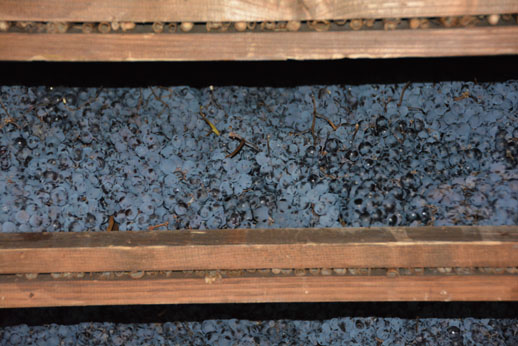
At the top of the pyramid come Recioto (sweet) and Amarone (dry), which have their own DOCGs based on the method of production. In the Appassimento technique, grapes are dried for a minimum of 100 days on wooden trays in drying lofts before pressing and fermentation. This concentrates everything to make wine in a rich, oxidative style, but the style isn’t due just to greater concentration: a wide range of aromatic changes also occur during the drying period (and are emphasized further if any botrytis occurs, although it’s discouraged by many producers). The basic difference between the two styles is that Amarone is fermented dry, but fermentation is stopped for Recioto to leave some residual sugar (typically around 100 g/l). Sometimes the grapes are dried a month longer for Recioto. Masi3 Grapes drying on traditional wooden racks at Masi.

It seems pretty obvious that if the basis for making the wine is concentrating the grapes before fermentation, those grapes are absolutely going to have to be of the highest quality. “You can’t just use any grapes for Appassimento. Large bunches don’t work well as they get too much rot. You need lighter bunches that are open and not too compact. Harvest occurs a few (5-6) days before what would be regarded as peak ripeness, to help to preserve acidity,” says Massimilla di Serego Alighieri at major producer Masi.

AllegriniLoftGrapes drying in plastic boxes in Allegrini’s vast drying loft.

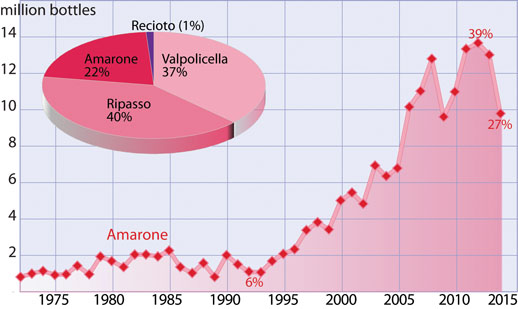
Until the early nineties, Amarone production was 1-2 million bottles, which is around 6% of all production in Valpolicella. But then it took off exponentially, and now is around 10 million bottles, accounting for more than a quarter of the grapes. What does this do for quality? According to Marilisa Allegrini, “Production has increased drastically, and the only way to do that was to expand. People started planting on the plain in the sixties, in areas that aren’t historic for producing Amarone, because of the demand. There is no regulation. The Consorzio [who make the rules in Italy] are dominated by companies that pay more contributions (because of higher volume) – in Valpolicella it’s the coop. The irony is that the people who make the rules today are the people who didn’t make any Amarone ten years ago. Now much of Amarone is produced in areas that never made it before.”

ValpolicellaProductionThe exponential expansion of Amarone. Graph shows use of grapes; pie chart shows proportions of wine produced.

Single vineyard Amarone’s are relatively rare, so it’s difficult to get a direct feeling for the effect of terroir, but at Allegrini all grapes for Amarone come from hillside vineyards. In addition to the effects of increased elevation, the soil turns from clay to limestone. All this brings a certain precision, which in my opinion is needed to counterpoise the effects of the extra concentration from drying. It is awfully easy for the style of Amarone to slide into clumsiness. There’s not a trace of that at the top producers whom I visited, whose wines I’ll discuss in detail in a future blog (I Visit Four Top Producers in Valpolicella).

So what’s to be done? The Consorzio did take a step in the direction of quality by reducing the proportion of grapes that can be used for Amarone from the legal limit of 65% to a lower 50%, but the expansion of plantings has reversed the reduction in output. When Amarone (and Recioto) were promoted to DOCG in 2009, the rules specified the length of the period for drying, the proportion of grapes that could be used—but not which subregions within Valpolicella might be appropriate. It’s time to rectify this major mistake.

When Ripasso is Not Ripasso

Ripasso is a very curious compromise in winemaking. Originating in the need to strengthen Valpolicella – which by itself is a rather light and flighty wine – it was originally made by taking the pommace (skins and seeds) left after pressing dried grapes to make Amarone, and adding it to the wine that had been made previously by fermenting grapes after harvest. There was enough sugar left in the pommace to start another fermentation, increasing alcohol and extract in the wine. But as producers who have abandoned the technique say, “you wouldn’t use a previously used tea bag to make another cup of tea.”

Ripasso has become wildly popular, to the point at which it now represents 40% of production in Valpolicella, more than Amarone or Valpolicella per se. Ripasso della Valpolicella has had its own DOC since 2009. (Production of Ripasso is supposed to be limited to twice the production of Amarone, but the regulation hasn’t had much effect in stifling its growth given that Amarone production has also increased exponentially: see The Scandalous Expansion of Amarone).

Official figures under estimate the extent of Ripasso production, as producers who abandoned the traditional method have relabeled their wines as  IGTs instead of Valpolicella Ripasso. “The original pommace used to leave a bitter residue, and we worked to eliminate it. The solution was to use semi-dried grapes to avoid the bitterness coming from material that had already been fermented. So now we call it double fermentation rather than Ripasso,” explains Massimilla di Serego Alighieri at Masi, whose Campofiorin is a flagship wine now made by double fermentation, when a quarter of the grapes are dried for six weeks and then added to the wine to start a second fermentation.

Masi14Grapes drying for Amarone and Ripasso.

Another IGT is Allegrini’s Palazzo Della Torre, which started as a Valpolicella, but in the 1990s Allegrini decided to take out the Molinara (one of the three major varieties of the region, which was required at the time) when they replanted, and so the wine came out of the DOC. Today the wine is made by double fermentation, which would not have been allowed for classic Ripasso either. “We wanted to have the style of Ripasso but without its oxidative notes,” says Marilisa Allegrini. It’s an old story that the authorities always catch up too late to the needs of quality, so the best producers may be forced to take their wines out of the DOC.

So how much better is it to do double fermentation than classical Ripasso? The problem with Ripasso, to my mind, is that the residual bitterness is a symbol of a certain lack of balance. The second fermentation bumps up extract and alcohol, but the fruit level still corresponds to the original fermentation. I find that sometimes this gives the wine a certain sense of being artificially inflated. That’s not so much a problem with double fermentation using partially dried grapes, although I think there’s still a risk of outrunning the fruits.

I’ve been wondering what effect it has to do a second fermentation with dried grapes, compared to what would happen if it were possible to perform a single fermentation with a mixture of fresh and dried grapes. I suspect the difference is that with double fermentation, the skins are added to wine, so there’s a significant effect of macerating the skins in an alcohol solution. This is likely to extract more astringent tannins, and may explain some of my problems with the taste profile.

You need to be pretty skilled to produced a wine that’s fully integrated using these techniques: here are four really good examples, tasted on my recent visit to Valpolicella. (I discuss the producers in tomorrow’s blog, I Visit Four Top Producers in Valpolicella.)

Masi: IGT Veronese, Brolo Campofiorin Oro, 2011

This special selection is less obvious than Campofiorin, more of a savory impression to the nose with hints of spice. Black cherry fruits are not so obviously aromatic as Campofiorin, and have been damped down by the sense of structure – but with less bitterness on the finish because the extract has given the wine more genuine body.

Allegrini : IGT Veronese, Palazzo Della Torre, 2012

This spends 15 months in old barriques. Very much the classic nose of bitter cherries. Light on the palate, with a smooth, elegant impression. Everything is well integrated. Good fruits with nice balance on palate, but the typical bite on the finish.

Giuseppe Quintarelli: Valpolicella Superiore, 2007

Half the grapes are fermented fresh; half are dried for two months and then there is a second fermentation. This spends 6 years in oak. Cherry fruit impression to nose has hints of piquancy. Rich on palate with bitter cherry fruits increasing in bitterness at very end. Balanced acidity gives a fresh lift to the palate.

Tommaso Bussola, Valpolicella Superiore Ripasso, Ca’ del Laito, 2011

From a mix of young and old vines, this is a classic Ripasso. There’s a round impression from the nose with a touch of chocolate. Round and rich, the palate shows good flavor variety and a nice balance, definitely a cut above the normal Ripasso. It’s light and fresh with a characteristic touch of bitterness at the end.

A Wine for All Seasons: the Tipping Point at Léoville Lascases

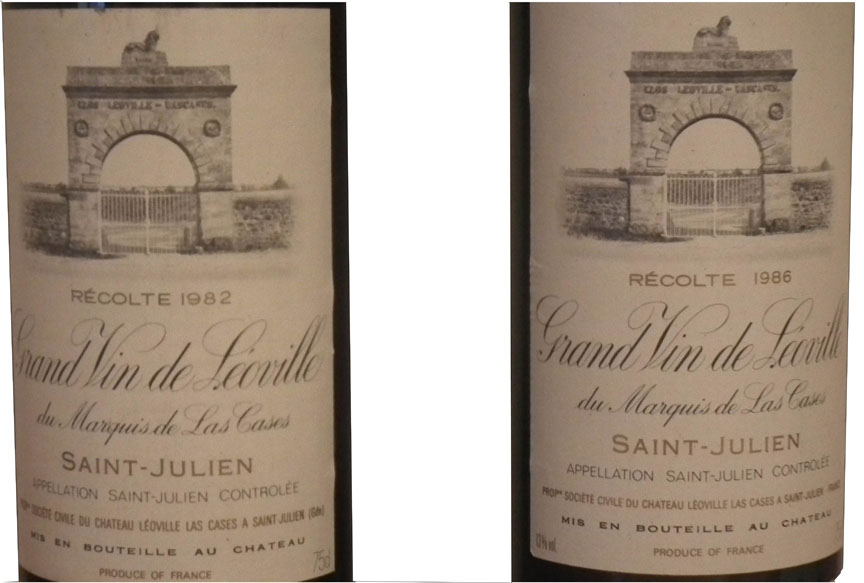
Two vintages of Léoville Lascases over the weekend gave me pause for thought about the view that 1982 was the vintage when Bordeaux made the transition from the “classical” to the more “international” style.LascasesThe 1982 vintage in Bordeaux was super-ripe, perhaps unprecedented if you ignore 1947, but around year 2000 I noticed that the wines were losing their lushness and reverting to type, by which I mean that the overtly fruity character was replaced by something more savory, even in some cases hints of herbaceousness (but only hints given the ripeness of the vintage). If the wines were sometimes difficult to relate to past expectations when the vintage was first released, since 2000 they have been increasingly displaying classic balance of savory fruits and lightness of being. The 1982 Lascases today is very much a classic in the modern idiom – meaning it shows the same flavor profile, increasingly moving in a savory direction, as earlier great vintages, but has the extra level of ripeness of the modern era.

1986 was not so highly rated as 1982 as a vintage in Bordeaux (Parker gives it 94 points compared with 98 points, for example) and some of the wines seemed a bit tough on release. Léoville Lascases was a standout for ripeness, and today gives an impression of first growth richness and power. It seems to be aging at a snail’s pace, and in a blind tasting might well seem ten or more years younger than the 1982. I wouldn’t exactly call it “international” but it really is a far cry from classic Bordeaux; and unlike the 1992, I do not think it will revert to classical type.

For me, these two wines typify the difference between classic and modern Bordeaux. I have never seen the tipping point so clearly demonstrated.

1986 Léoville Lascases

Very much a wine in the modern idiom, showing the power and weight of a first growth; evident why it is a 100 point Parker wine. Scarcely shows its age. Still dark, even some purple hues. Must have been massive when released as it’s still full of flavor; loaded with black fruits, supported by smooth chocolaty tannins, but there’s that typical Bordelais lift at the end to keep it fresh. Nose is complex but palate is only just beginning to develop. In terms of tannins, it’s ready, but in terms of flavor, still has a way to go.

1982 Léoville Lascases

A classic impression, with the leanness of St. Julien leading into smoke and minerality. Now really reverting to type. Original black fruits are more evident on nose than palate, which is moving in a savory direction. Acidity is pretty crisp. Complexity comes out slowly in the glass, with layers of flavor developing as the fruits show their ripeness, with a very faint sense of herbaceousness providing a counterpoise in the background.

The Triple F of Franciacorta

The act of genius in producing Champagne from a region that is (or at least used to be) absolutely marginal for wine production is hard to match: which is why there are so few successful competitors. Because of climate or choice of grape varieties, other European sparkling wines rarely achieve comparable interest or complexity. New World sparkling wines are usually adjuncts to still wine production. Yet with Champagne unable to meet world demand, we could used some alternatives.

So I was happy to spend a few days in Franciacorta last week, doing research for the second edition of Wine Myths and Reality. Producers of Franciacorta like to stress its independence by talking about Franciacorta, Franciacorta, Franciacorta, referring to the name of the area, the name of the wine, and the production method, but the fact is that Champagne has been the model right from the start. A common impetus in the 1960s was that industrialists who wanted to make sparkling wine along the lines of Champagne created what are now the three major producers–Berlucchi, Bellavista, and Ca’ del Bosco between them account for about half of all Franciacorta production. Grapes are essentially Chardonnay and Pinot Noir (there’s a little Pinot Blanc but it’s pretty much fallen out of flavor), and if there are any differences in the production method from Champagne, I have yet to identify them.

Franciacorta is reputed to make wines that are more mineral, more linear, than Champagne. I am a bit puzzled why this should be, as it lies on a line of latitude well south of Champagne. Production is confined to a small region in Lombardy, protected by Lake Iseo and mountains to the north, and an “orphan” mountain to the south. The climate is temperate–it’s the farthest north you can grow olive trees, they are fond of pointing out. Anyway, my tastings suggest that the reputation is only partly correct. Harvest here is the earliest in Italy, starting in the second week of August, not because it’s the warmest place, but because producers need to pick early to keep alcohol levels low; it’s surprising that they can get sufficient ripeness by harvest time.

Because it’s warmer than Champagne, vintage wines are made every year, and there’s a greater proportion of vintage relative to nonvintage. I see a significant difference in style here, in a sense the reverse of what you find with Champagne. It seems to me that nonvintage Franciacorta is softer, and the classic minerality really shows clearly only in the vintage. In nonvintage wines, I was impressed with Ca’ del Bosco’s Cuvée Prestige, which at a million bottles per year is their major production, showing a great sense of smoothness and density. Berlucchi is by far the largest producer, and their 61 Brut Rosé cuvée has terrific freshness for rosé.

The warmer climate means that acidity tends to be lower, so dosage is usually moderate. “In Franciacorta the dosage is not usually indispensable, whereas in Champagne it is necessary,” says winemaker Stefano Capelli at Ca’ del Bosco. There’s a tendency to use dosage at Extra Brut level, especially in vintage wines (although the label most often says Brut), and perhaps that’s partly why that pleasing minerality tends to show in the vintage cuvées. A perfect illustration of why zero dosage is successful in Franciacorta comes from Bellavista’s Pas Opere cuvée, where the ripeness of the fruits gives an impression more like Extra Brut, mineral but dense rather than aggressive.FranciacortaTopoThe other major factor affecting style is location. The northern part of the area is mountainous, with limestone terroirs; opening out from Lake Iseo, the valley in the central part forms an amphitheater with sandier soils. Pinot Noir tends to be concentrated in the cooler areas to the north. Most producers have vineyards all over, and blend to achieve their desired style, but a visit to Majolini in the northeast, where the wines come from local vineyards, shows the difference. A strong sense of minerality runs through all the wines.” My wines need time both before disgorgement and for aging afterwards,” Simone Maiolini explains. Franciacorta9SKY copyVineyards in the north of Franciacorta can be on mountain slopes.

Franciacorta’s descriptions of style mostly follow Champagne, but there is one unique style, Satèn, which is a Blanc de Blancs with lower pressure (4.5 bars instead of the usual 6 bars), designed to bring out creaminess. (Some Champagne producers do this with their Blanc de Blancs also). I have to say that this seems to me to be the antithesis of the reputation for linearity: most Satèn wines show a distinctive style with a broad palate.

Franciacorta14SKYVineyards in the central amphitheater are flatter, with views of the mountains in the distance.

Most producers have a nonvintage cuvée that is their largest production, with several vintage cuvées made in relatively small amounts. Producers often refer to Crus when discussing the origins of their top wines, but there are no single vineyard labels as such, and there is agreement that Franciacorta is a young region that needs to establish its identity more firmly before any hierarchy is established. “We need time and experience to define Crus,” says Stefano Capelli. Riserva wines must have five years before disgorgement, and there are some top cuvées that spend longer, but there’s no real equivalent to the late disgorgement cuvées of Champagne.

Franciacorta is a really interesting alternative to Champagne, and although it’s very much a work in progress, here are four wines that illustrate its range.

Ca’ Del Bosco, Cuvée Prestige

This is impressive for a general nonvintage cuvée, giving the impression of a serious wine, with real depth and weight to the palate. There are citrus impressions to the nose but the palate is all stone fruits, with lots of grip and a good sense of underlying structure. Dosage is not at all evident.

Guido Berlucchi, Brut 61 Rosé

This is 60% Pinot Noir and 40% Chardonnay. It comes from direct pressing with maceration of the Pinot Noir for a few hours at 4 degrees before fermentation. Showing freshness just short of citrus, in fact it seems fresher and less creamy than the regular Brut 61 cuvée.

Bellavista, Pas Opere 2008

Violets and nuts with chocolate impression on nose. You really see the purity of the fruits on the palate. It’s quite dry but I’m not sure I would pick it out as zero dosage, although it’s clearly into extra brut. Quite a tight mineral impression with faintly lemony notes at the end.

Majolini, Satèn 2010

More mineral impression to nose than you usually find with Satèn. The palate has the smoothness of Satèn, with hints of creaminess mixed with minerality. It’s a very nice balance with the dosage of 7.5 g only just showing, and an unusual sense of fruit purity.