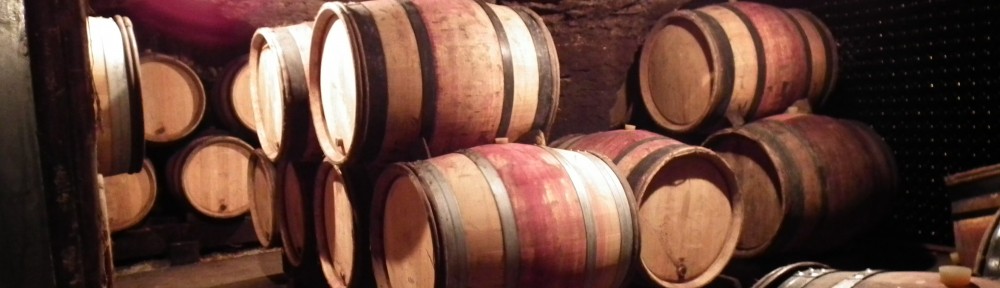
I have always been doubtful about what difference the material of the fermentation container makes to vinification. Aficionados of wood vats say that they give a better rounded wine. Believers in stainless steel argue for increased purity and freshness. Concrete has gone in and out of style, and its present resurgence is based on the argument that it’s as neutral as stainless steel, but allows micro oxygenation like oak. It is clear, of course, that nothing gets through stainless steel, but I do wonder if there is any actual experimental support for the idea that breathing of concrete is a significant factor in fermentation.
Given the turbulence of fermentation, I am inclined think that other factors, such as temperature within the vat, may be more important than the contact surface at the exterior. Of course, maceration to keep the cap in contact with the juice, whether by pump over or punch down, is a major factor in determining the level of extraction. I am suspicious whether the exterior surface has much role here, and more interested in the question of whether the shape has any effect. The latest buzz in shapes was the introduction of tronconique or tulip-shaped vats, where the diameter narrows from bottom to top. The argument is that offers better maceration because the cap has a smaller diameter than the bulk of the liquid. This is plausible, but I am puzzled how it relates to the latest vats, which are suspended in reverse tronconique shape.
When they were renovating the cellars at Chateau Grand Puy Ducasse, there was a problem with space. The chateau is right on the waterfront in Pauillac (one of only two chateaux left in the town; the other is Duhart Milon, a couple of hundred yards inland). So the high water table makes it impossible to dig down deeper, and the waterfront makes it impossible to expand horizontally. Now owned by the bank Crédite Argricole, who wanted to improve quality by introducing plot by plot vinification, the issue was how to get more tanks into the same space. The answer was to invert the tronconique shape and suspend the tanks from the ceiling. Grapes go in at the top level, but after that vinification can be controlled from below walking around the tanks, which are all in stainless steel. It’s quite an engineering feat to sus[ecd tanks that will be full of wine. In fact, the insurance company insisted on double checking all the calculations. (Even though the tanks were empty, I did not have the nerve to walk directly underneath them.)
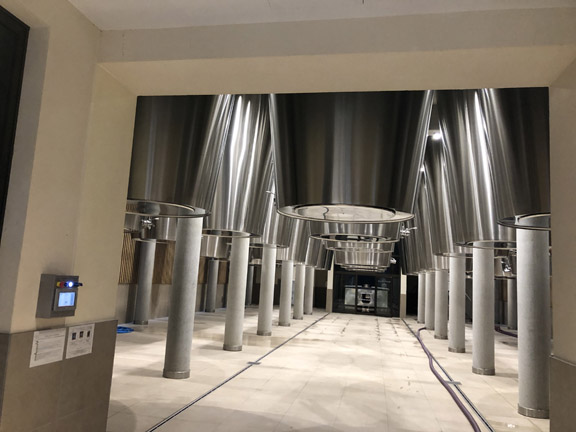
The suspended vats at Grand Puy Ducasse
A similar lack of space to expand led Chateau Branaire Ducru into the same calculation that they could fit in more tanks by suspension. The cellar (actually a building at ground level) was entirely renovated . “From the original building we have only the walls and roof. We didn’t want to take out any vineyards, there was nowhere to expand, so the way tanks were got into limited space was to suspend reverse trannconique tanks,” explains cellarmaster Jean-Dominique Videau. Stainless steel tanks are almost touching at the top, but there is space to walk around and work on them underneath—the bottoms just over a meter above the ground. Jean-Dominique says the shape works well because they use only pump over, not punch down.
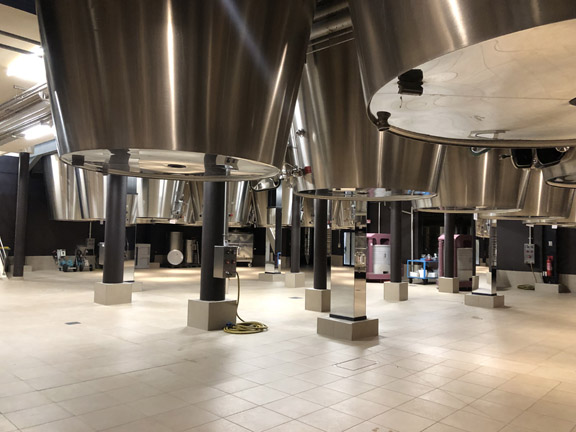
The renovated fermentation hall at Branaire Ducru
“Not much has changed since 2018 except the new winery,” I was told when I visited Angélus. The barrel cellars were renovated in 2012 when the chateau took its present striking form, but the vat room remained. It’s just completed a massive renovation, which will come into use for the 2026 vintage (running two years late). But the vats are not buried underground; they are suspended with the tops at ground level, so grapes can be put in directly by gravity feed. An even more unusual feature is that while most of the vats are stainless steel, there are also 6 concrete vats and 4 oak vats. This required some innovations in manufacture.
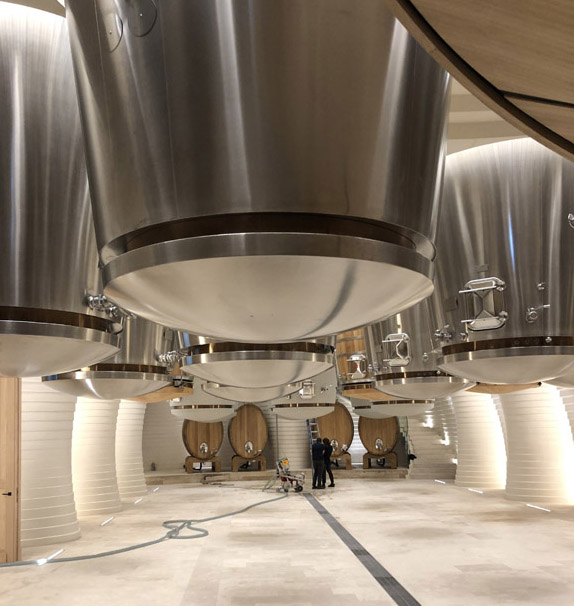
The new fermentation hall at Angelus is being prepared for the 2026 vintage
While admiring the sheer chutzpah in suspending the tanks, the question that remains unanswered is what effect the inverted shape has on vinification. After all tronconique and inverted tronconique can’t both be best for vinification. So does the shape actually make any difference. Or is it just bubble, bubble, toil and trouble?


There is actually pretty good experimental evidence that unlined concrete transmits oxygen. Studies using real winemaking concretes, with model wine against one face and air against the other, have measured meaningful oxygen transmission through ~10 cm tartarized concrete (Nevares & del Alamo-Sanza, 2021). More recent industrial-scale work also found higher dissolved oxygen and redox potential in wine aged in uncoated concrete than in stainless steel or epoxy-lined concrete (Maioli et al., 2024).
As you point out, though, the more interesting question is whether the flux is large enough to matter during primary fermentation. Nevares & del Alamo-Sanza measured about 56–88 cm³ O₂/m²/day through actual winery concretes under liquid-contact conditions. If you apply that to a small commercial concrete egg (e.g. ~700 L with about 4 m² of wine-contact surface) you get something on the order of 0.4–0.6 mg/L/day, or about 5–7 mg/L over a 12-day fermentation. It’s in the same general range as the 5–10 mg/L oxygen additions usually considered enough to affect yeast fermentation kinetics.
That doesn’t mean oxygen coming through the concrete necessarily dominates the vessel effect. A pump-over can introduce around 1 mg/L or more of oxygen, so repeated pump-overs, splashing and other cellar operations could easily match or exceed what is coming through the wall. And from the materials-science side, oxygen transport through concrete varies enormously with porosity, surface treatment and especially how water-saturated the pore network is (Houst & Wittmann, 1994), so I would expect quite a bit of variation from one tank to another.
There has also been at least one direct comparison of Sauvignon Blanc fermented in stainless steel, concrete, polyethylene and clay. They did find differences, but the experiment couldn’t really separate material from vessel size and geometry, and overall the vessel effect was fairly modest (Gil i Cortiella et al., 2020). Concrete also shifted pH and mineral composition a bit, which is a useful reminder that untreated concrete is not really “neutral” in quite the same way stainless steel is.
So I do think there is something to the micro-oxygenation argument, especially in a small unlined vessel. The numbers suggest it could be biologically meaningful during fermentation. But I’d still be very interested in shape and thermal behavior too (e.g. natural convection, temperature gradients, lees circulation, cap behavior, etc) And over six or twelve months of élevage, the oxygen argument becomes much easier to believe, because even a modest continuous flux adds up.
References for your reading pleasure:
Nevares, I. & del Alamo-Sanza, M. (2021), Foods.
Maioli, F. et al. (2024), ACS Food Science & Technology.
Gil i Cortiella, M. et al. (2020), Innovative Food Science & Emerging Technologies.
Houst, Y.F. & Wittmann, F.H. (1994), Cement and Concrete Research.