Alcohol and Tannins in St. Emilion: Cheshire Cat Years?

Austerity is not a word that often comes to mind in the context of St. Emilion, but it did at this year’s New York tasting of Grand Cru Classés, which compared the 2010 and 2012 vintages. This gave me much pause for thought by comparison with the tasting two years ago of the 2009 and 2010 vintages (Oenologues Triumph in St. Emilion). Last time round, the main impression (driven by 2009 but not that much different in 2010) was the softness of the palate, with fruits supported by furry tannins. This time the impression was of much tighter wines; the 2010s have tightened up, and the 2012s can verge on tough. These were not the lush, approachable wines for which St. Emilion is reputed; words like fleshy or opulent never appeared in my tasting notes.

Alcohol levels were punishing, often around 15% for 2010, and a half percent or percent lower in 2012. Now that the fruits of 2010 have lost their initial youthful enthusiasm, alcohol and tannin are driving the palate. What showed as a structural backbone to the fruits two years ago now seems more skeletal. It’s fair to say that alcohol is not directly obtrusive in many wines, but it has an indirect effect in enhancing the bitterness of tannins on the finish. Some wines have an almost tart quality at the end, which clashes with the fruits rather than refreshing. The traditional generosity of Merlot in St. Emilion is largely missing, and I often get an impression biased more towards Cabernet Franc than the dominant Merlot.

It wouldn’t be unfair to say that the 2012s are starting out where the 2010s leave off, with an almost sharp tannic finish often dominating the fruits. This makes me quite concerned as to how they will show in another two years’ time. I don’t often get the impression that the fruits will really emerge when the tannins resolve. Most chateaux have managed to achieve decent ripeness in the tannins, but occasionally you get suspicions of green. The 2012 wines have less alcohol than the 2010s, but they also have less fruit concentration, so the problem of maintaining balance as the fruits thin out is more or less equivalent. The fruits make them seem like wines for the mid-term, but I’m not sure the tannins will resolve in time; and they don’t have the stuffing for the long term. You might expect the greater fruit concentration to let the 2010s resist better, and I’m not so much worried about whether the fruits will outlast the tannins, which are mostly quite fine, but I have a concern that 2010 may be the year of the Cheshire Cat: what will dominate when the tannins resolve is the grin of the alcohol.

Very few of these wines, from either 2010 or 2012, are ready to drink: most need from two to four years more. Of course, this situation would scarcely be a surprise to any survivors who remember Bordeaux of the pre-1982 era. I will say that I saw more evidence of character in these wines than in the 2009s (and the 2010s two years ago) when there seemed to be a sort of interdenominational quality to them: the present question is whether you can handle the character of a bitter tang at the end. There’s evidently quite a lot of extract in today’s wines, and it’s hard to say whether that will give them the stuffing to develop well as tannins resolve, or whether it will remain awkward. In most cases, I preferred the 2010 to the 2012, but in those instances where I preferred the 2012, it was usually due to lower alcohol letting the fruits speak more freely.

My favorite wines were Chateau Fombrauge and Grand Corbin-Despagne in 2010 and Chateau Yon Figeac in 2012.

Chateau Fombrauge, 2010

Slightly nutty, soft impression from nose. Palate well balanced between black fruits and refreshing acidity; still something of a tannic bite at the end. The structure is there but not obtrusive, and the overall impression is refined, showing precision in the fruits. 91 points, drink 2016-2027.

Chateau Grand Corbin-Despagne, 2010

Some black fruits poking through restrained nose, leading into good balance on palate between refined black fruits and tannins with chocolaty overtones. A little tight at the end but should soften in next year or so. Refined impression avoids the bitter tang at the end of many wines. 90 points, drink 2016-2027.

Chateau Yon Figeac, 2012

More sense of black fruits and spices than in the 2010. Refined palate makes an elegant impression, with a touch of tannin at the end. I like the sense of precision in the fruits and the balance. Fine structure should offer some support for aging. 90 points, drink 2017-2026.

STE

I Visit Four Top Producers in Valpolicella at Extreme Ends of the Size Spectrum

Valpolicella is going through a continuing identity crisis, with the growth of Amarone and Ripasso production threatening the existence of “regular” styles of Valpolicella, the expansion of Amarone from the hills to the plains raising questions about its position as a peak quality wine (see The Scandalous Expansion of Amarone), and a switch from Ripasso to “double fermentation” meaning that some leading wines are labeled as IGT Veronese instead of Ripasso della Valpolicella (see When Ripasso Is Not Ripasso.) I visited four leading producers, all still run by the founding families, but varying from the largest (Masi and Allegrini) to the smallest (Bussola and Quintarelli) to see how they view the future of the region.

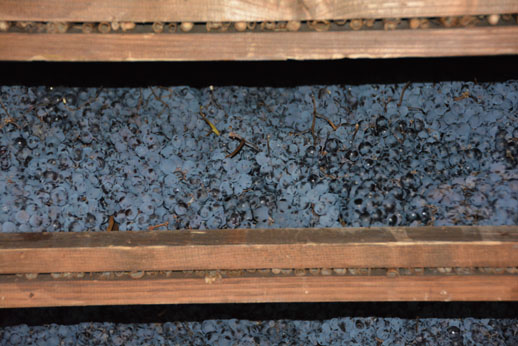
Massimilla di Serego Alighieri at Masi provided a fantastic introduction to the region. The wine from her family estate, just up the road from Masi HQ, has been made by Masi (under the Alghieri label), and the estate has a wonderful palazzo in the center of the vineyards. Masi takes its name from the first vineyard acquired by the Boscaini family, Vaja dei Masi (the little Masi valley), in 1772. There are 993 ha in the Veneto and more in Tuscany. A huge drying loft where grapes are prepared for Amarone is a mix of tradition (grape bunches dry on wood trays with bamboo bottoms to allow air circulation) and technology (humidity and temperature are controlled by a computerized system that assesses the state of drying). There’s a whole laboratory area devoted to experimentation.
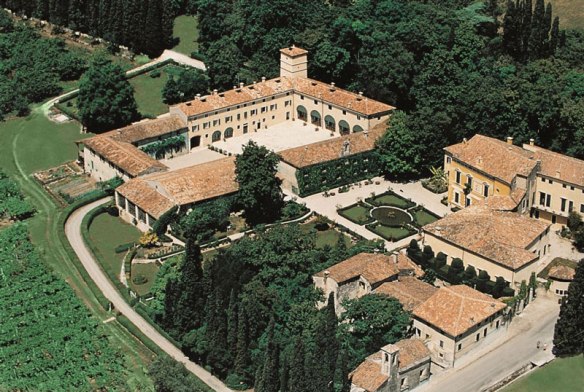
Seregeo-Alighieri-VillaThe Seregeo-Alghieri villa.

Masi’s thinking altogether is characterized by that mix of traditional and innovation. They are still using all three grape varieties for Valpolicella: Corvina, soft and sweet, is the predominant, of course, supported by Rondinella and Molinara, which is no longer required by the rules, but Masi retain it because they feel it adds useful spice and acidity. But they have resurrected an old variety, Oseleta, which has very small grapes and ripens late. It has lots of tannin to add structure, and is matured in barriques to soften the tannins.

The house style at Masi is rich and opulent, with a sense through all the wines of glycerin – this is one of the main results of the Appassimento drying technique. In fact, the house style is maintained by using smaller proportions of dried grapes in other wines, such as the Masianco white and the Rosa dei Masi (rosé).

The next day, we spent the afternoon at Allegrini, which is rather discreetly run, to the point at which I had some difficulty identifying the right location. We started out at a vast drying facility, which handles all Allegrini’s grapes, as well as those of several other producers. It’s just identified as the Center for Appassimento Research. Grape bunches are collected in plastic bins in the vineyard, and then bins go directly into the drying center.

From there we went to Allegrini’s new headquarters. They’ve made wine from the vineyards of the Palazzo Della Torre for a long time, but in 2008 the opportunity arose to buy the villa in the center of the vineyards. Villa is a bit of a misnomer – it’s a splendid Renaissance palazzo, currently being extensively renovated. This may be a lifetime endeavor. The 110 ha of vineyards are on the hills in all the communes of Valpolicella.
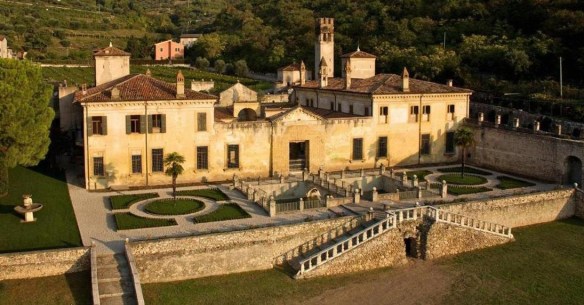
Palazzo-della-Torre-VillaThe villa at Palazzo della Torre.

A splendid tasting in which we compared current vintages with those of the past decade demonstrated Allegrini’s range. Unusually it’s not focused exclusively on Valpolicella; some of the top wines are IGT Veronese. What is now one of the major vineyard sites of the region, the La Grola hill, was abandoned in the 1970s as everyone wanted to plant on the plain to make the simple fruity wines of the era. Giovanni Allegrini invested heavily into buying it, in fact he borrowed twice the annual turnover of the company to do so. Today two wines are made from the hill. La Grola started in the nineties as a blend of Corvina, Shiraz, and Oseleta; since 2012 it’s been only Corvina and Oseleta. “Oseleta works exactly like Petit Verdot in Bordeaux,” says Alberto Lusini. La Poia is the vineyard right on top of the La Grola hill, and is planted only with Corvina, in fact with a specific clone called red stem Corvina. so deeply colored that some of the color goes into the stem. Both wines are made conventionally (no dried grapes), and La Poia offers an unusual opportunity to see Corvina as a monovarietal. “When La Poia was being planted, at that time they were focusing on Cabernet Sauvignon and Merlot, but my father said, I think we can make a special wine with Corvina,” recalls Marilisa Allegrini.

“We are called modernists– but we are modernists in the sense that we produce Amarone without oxidation and Amarone tastes traditional with raisined notes. We do some modern things and some traditional things,” is how Marilisa explains the house style. Her father was among the first to move from the traditional pergola pruning to Guyot; at the time, another winemaker asked: “what are you doing, are you planting vines or growing salad?” Now the pergolas have more or less disappeared from most quality producers.

The style at Allegrini is unusually refined. La Grola and La Poia are smooth, sophisticated wines. The equivalent of Ripasso, the Palazzo della Torre (the largest production wine), is made by double fermentation (When Ripasso Is Not Ripasso) and is elegant for this style. About 10% of production, the Amarone is intense, but shows a rare sense of precision. “Unlike other producers, our style for Amarone is completely dry,” says Marilisa. Recioto comes from a selection of the ripest grapes, which spend an extra month in drying.

We spent the morning at two smaller, but exceedingly high quality, producers. Tommasso Bussola is located round the back of Negrar, with the winery somewhat hidden behind a group of slightly shabby looking buildings. The range from their 14 ha is all Valpolicella, except for l’Errante, a Bordeaux blend.

I’m not sure you’d quite describe the style as modern, but it is more forceful than most and there’s a good deal of new oak around. Certainly the Amarone’s are very rich, really reinforced when you move from the basic cuvée to the special bottlings of TB (from 50-year-old vines) or Vigneto Alto (from 65-year-old vines, made in about half the vintages). The sweet wines give a positively decadent impression. There’s a classic Ripasso, one of the very few I’ve had where the style really comes off as adding extra complexity as well as weight.

L’Errante is a Bordeaux blend, started in 2003 with grapes that were in the Ca’ del Laito vineyard which they bought in 2001 (the most recent purchase). “We made an experiment We started by making it like a Ripasso. Then in 2007 we started to make it like an Amarone. It’s a little sweeter than Amarone, with 18 g/l residual sugar. It’s 50% Merlot, 30% Cabernet Franc, and 20% Cabernet Sauvignon. Production method is now the same as Amarone, with 42 months in new tonneaux,” explains Guiseppe Bussola.

Quintarelli stands out above everyone else in Valpolicella, both literally and metaphorically. The winery is in a spectacular locale on the heights above Negrar. Access is up a narrow mountainous hairpin road with views right over the valley. It was dramatic when we arrived as we were above the clouds on the other side of the valley. The facility is a modern building going storeys underground, basically underneath the house constructed two generations ago. The winery was founded the generation before that, in 1924.

There are 3 ha of vineyards immediately below the house. Corvina is grown under pergola; Guyot is used for the French grapes. There are another 8 ha farther away. Quintarelli’s wines have a level of subtlety and sophistication that is rare for Valpolicella. All are marked by an extremely elegant balance, there is never too much extraction, the style is if anything understated. Layers of flavor have to be teased out of each wine. One mark is that the Recioto is of course sweet, but perceived sweetness is much less than you would expect from residual sugar, and the wine is simply deliciously balanced.

Quintarelli3The view from Quintarelli.

Alzero is an unusual wine that Francesco Quintarelli’s grandfather started to produce in 1983. “The idea was to make Amarone with Bordeaux grapes. It was almost all Cabernet Franc at the beginning. Today there is also some Cabernet Sauvignon and Merlot,” Francesco explains. Personally, I have mixed feelings about the use of Bordeaux varieties for Amarone-style wines. Indirectly they seem to make the point that Corvina is such a good grape for Amarone because it offers an aromatic lift that helps to avoid a massive style. There are fewer aromatics with the Bordeaux varieties. However, there is no wine at Quintarelli that isn’t simply top of its class.

I would like to get a more direct feeling for the characters of the different grape varieties in Valpolicella. Allegrini’s La Poia shows the smooth aromatics of Corvina, and really makes me wonder what a monovarietal Amarone (not allowed by the DOCG) would be like. Rondinella and Molinara probably don’t have enough intrinsic interest to justify monovarietals, and Oseleta would be too powerful. Corvina with a pinch of Oseleta might be the perfect combination.
The Scandalous Expansion of Amarone

Valpolicella is an area of extremes. On the one hand, Valpolicella tout court is simple, light, and fruity. On the other hand, Amarone is a weighty wine, with lots of extraction coming from the use of dried grapes, definitely in the direction of power and opulence. Given this bifurcation, you might expect the emphasis in the region to be on methods of vinification, but on a recent visit I discovered that in fact a major concern is the abuse of terroir.

You might say the problem started years ago, when the area of Valpolicella was extended. The original area, close to Lake Garda, is now called Valpolicella Classico, and remains (or should remain) the mark of quality. The general Valpolicella area extends far to the east, past Verona, and to the north of Soave.

Three types of wine are made in the Valpolicella region. Lowest in the hierarchy is the regular wine labeled with the name of the DOC (Valpolicella Classico or Valpolicella). Superiore is supposed to indicate slightly higher quality. These are very much wines for quaffing, a bit like Beaujolais. Then there’s what you might call an intermediate style called Ripasso, which I will discuss in tomorrow’s blog (When Ripasso Is Not Ripasso).

At the top of the pyramid come Recioto (sweet) and Amarone (dry), which have their own DOCGs based on the method of production. In the Appassimento technique, grapes are dried for a minimum of 100 days on wooden trays in drying lofts before pressing and fermentation. This concentrates everything to make wine in a rich, oxidative style, but the style isn’t due just to greater concentration: a wide range of aromatic changes also occur during the drying period (and are emphasized further if any botrytis occurs, although it’s discouraged by many producers). The basic difference between the two styles is that Amarone is fermented dry, but fermentation is stopped for Recioto to leave some residual sugar (typically around 100 g/l). Sometimes the grapes are dried a month longer for Recioto. Masi3 Grapes drying on traditional wooden racks at Masi.

It seems pretty obvious that if the basis for making the wine is concentrating the grapes before fermentation, those grapes are absolutely going to have to be of the highest quality. “You can’t just use any grapes for Appassimento. Large bunches don’t work well as they get too much rot. You need lighter bunches that are open and not too compact. Harvest occurs a few (5-6) days before what would be regarded as peak ripeness, to help to preserve acidity,” says Massimilla di Serego Alighieri at major producer Masi.

AllegriniLoftGrapes drying in plastic boxes in Allegrini’s vast drying loft.

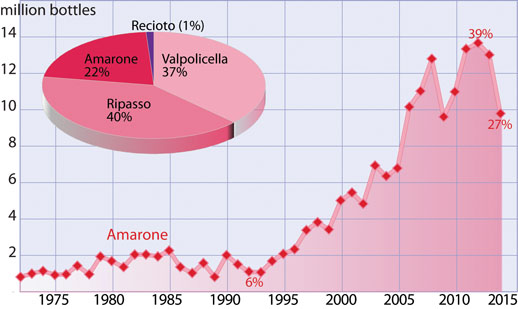
Until the early nineties, Amarone production was 1-2 million bottles, which is around 6% of all production in Valpolicella. But then it took off exponentially, and now is around 10 million bottles, accounting for more than a quarter of the grapes. What does this do for quality? According to Marilisa Allegrini, “Production has increased drastically, and the only way to do that was to expand. People started planting on the plain in the sixties, in areas that aren’t historic for producing Amarone, because of the demand. There is no regulation. The Consorzio [who make the rules in Italy] are dominated by companies that pay more contributions (because of higher volume) – in Valpolicella it’s the coop. The irony is that the people who make the rules today are the people who didn’t make any Amarone ten years ago. Now much of Amarone is produced in areas that never made it before.”

ValpolicellaProductionThe exponential expansion of Amarone. Graph shows use of grapes; pie chart shows proportions of wine produced.

Single vineyard Amarone’s are relatively rare, so it’s difficult to get a direct feeling for the effect of terroir, but at Allegrini all grapes for Amarone come from hillside vineyards. In addition to the effects of increased elevation, the soil turns from clay to limestone. All this brings a certain precision, which in my opinion is needed to counterpoise the effects of the extra concentration from drying. It is awfully easy for the style of Amarone to slide into clumsiness. There’s not a trace of that at the top producers whom I visited, whose wines I’ll discuss in detail in a future blog (I Visit Four Top Producers in Valpolicella).

So what’s to be done? The Consorzio did take a step in the direction of quality by reducing the proportion of grapes that can be used for Amarone from the legal limit of 65% to a lower 50%, but the expansion of plantings has reversed the reduction in output. When Amarone (and Recioto) were promoted to DOCG in 2009, the rules specified the length of the period for drying, the proportion of grapes that could be used—but not which subregions within Valpolicella might be appropriate. It’s time to rectify this major mistake.

When Ripasso is Not Ripasso

Ripasso is a very curious compromise in winemaking. Originating in the need to strengthen Valpolicella – which by itself is a rather light and flighty wine – it was originally made by taking the pommace (skins and seeds) left after pressing dried grapes to make Amarone, and adding it to the wine that had been made previously by fermenting grapes after harvest. There was enough sugar left in the pommace to start another fermentation, increasing alcohol and extract in the wine. But as producers who have abandoned the technique say, “you wouldn’t use a previously used tea bag to make another cup of tea.”

Ripasso has become wildly popular, to the point at which it now represents 40% of production in Valpolicella, more than Amarone or Valpolicella per se. Ripasso della Valpolicella has had its own DOC since 2009. (Production of Ripasso is supposed to be limited to twice the production of Amarone, but the regulation hasn’t had much effect in stifling its growth given that Amarone production has also increased exponentially: see The Scandalous Expansion of Amarone).

Official figures under estimate the extent of Ripasso production, as producers who abandoned the traditional method have relabeled their wines as  IGTs instead of Valpolicella Ripasso. “The original pommace used to leave a bitter residue, and we worked to eliminate it. The solution was to use semi-dried grapes to avoid the bitterness coming from material that had already been fermented. So now we call it double fermentation rather than Ripasso,” explains Massimilla di Serego Alighieri at Masi, whose Campofiorin is a flagship wine now made by double fermentation, when a quarter of the grapes are dried for six weeks and then added to the wine to start a second fermentation.

Masi14Grapes drying for Amarone and Ripasso.

Another IGT is Allegrini’s Palazzo Della Torre, which started as a Valpolicella, but in the 1990s Allegrini decided to take out the Molinara (one of the three major varieties of the region, which was required at the time) when they replanted, and so the wine came out of the DOC. Today the wine is made by double fermentation, which would not have been allowed for classic Ripasso either. “We wanted to have the style of Ripasso but without its oxidative notes,” says Marilisa Allegrini. It’s an old story that the authorities always catch up too late to the needs of quality, so the best producers may be forced to take their wines out of the DOC.

So how much better is it to do double fermentation than classical Ripasso? The problem with Ripasso, to my mind, is that the residual bitterness is a symbol of a certain lack of balance. The second fermentation bumps up extract and alcohol, but the fruit level still corresponds to the original fermentation. I find that sometimes this gives the wine a certain sense of being artificially inflated. That’s not so much a problem with double fermentation using partially dried grapes, although I think there’s still a risk of outrunning the fruits.

I’ve been wondering what effect it has to do a second fermentation with dried grapes, compared to what would happen if it were possible to perform a single fermentation with a mixture of fresh and dried grapes. I suspect the difference is that with double fermentation, the skins are added to wine, so there’s a significant effect of macerating the skins in an alcohol solution. This is likely to extract more astringent tannins, and may explain some of my problems with the taste profile.

You need to be pretty skilled to produced a wine that’s fully integrated using these techniques: here are four really good examples, tasted on my recent visit to Valpolicella. (I discuss the producers in tomorrow’s blog, I Visit Four Top Producers in Valpolicella.)

Masi: IGT Veronese, Brolo Campofiorin Oro, 2011

This special selection is less obvious than Campofiorin, more of a savory impression to the nose with hints of spice. Black cherry fruits are not so obviously aromatic as Campofiorin, and have been damped down by the sense of structure – but with less bitterness on the finish because the extract has given the wine more genuine body.

Allegrini : IGT Veronese, Palazzo Della Torre, 2012

This spends 15 months in old barriques. Very much the classic nose of bitter cherries. Light on the palate, with a smooth, elegant impression. Everything is well integrated. Good fruits with nice balance on palate, but the typical bite on the finish.

Giuseppe Quintarelli: Valpolicella Superiore, 2007

Half the grapes are fermented fresh; half are dried for two months and then there is a second fermentation. This spends 6 years in oak. Cherry fruit impression to nose has hints of piquancy. Rich on palate with bitter cherry fruits increasing in bitterness at very end. Balanced acidity gives a fresh lift to the palate.

Tommaso Bussola, Valpolicella Superiore Ripasso, Ca’ del Laito, 2011

From a mix of young and old vines, this is a classic Ripasso. There’s a round impression from the nose with a touch of chocolate. Round and rich, the palate shows good flavor variety and a nice balance, definitely a cut above the normal Ripasso. It’s light and fresh with a characteristic touch of bitterness at the end.

A Wine for All Seasons: the Tipping Point at Léoville Lascases

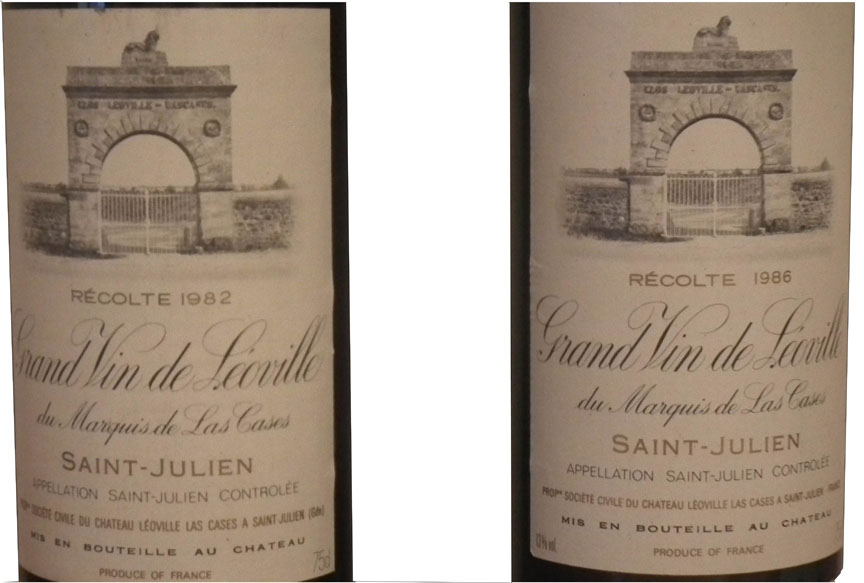
Two vintages of Léoville Lascases over the weekend gave me pause for thought about the view that 1982 was the vintage when Bordeaux made the transition from the “classical” to the more “international” style.LascasesThe 1982 vintage in Bordeaux was super-ripe, perhaps unprecedented if you ignore 1947, but around year 2000 I noticed that the wines were losing their lushness and reverting to type, by which I mean that the overtly fruity character was replaced by something more savory, even in some cases hints of herbaceousness (but only hints given the ripeness of the vintage). If the wines were sometimes difficult to relate to past expectations when the vintage was first released, since 2000 they have been increasingly displaying classic balance of savory fruits and lightness of being. The 1982 Lascases today is very much a classic in the modern idiom – meaning it shows the same flavor profile, increasingly moving in a savory direction, as earlier great vintages, but has the extra level of ripeness of the modern era.

1986 was not so highly rated as 1982 as a vintage in Bordeaux (Parker gives it 94 points compared with 98 points, for example) and some of the wines seemed a bit tough on release. Léoville Lascases was a standout for ripeness, and today gives an impression of first growth richness and power. It seems to be aging at a snail’s pace, and in a blind tasting might well seem ten or more years younger than the 1982. I wouldn’t exactly call it “international” but it really is a far cry from classic Bordeaux; and unlike the 1992, I do not think it will revert to classical type.

For me, these two wines typify the difference between classic and modern Bordeaux. I have never seen the tipping point so clearly demonstrated.

1986 Léoville Lascases

Very much a wine in the modern idiom, showing the power and weight of a first growth; evident why it is a 100 point Parker wine. Scarcely shows its age. Still dark, even some purple hues. Must have been massive when released as it’s still full of flavor; loaded with black fruits, supported by smooth chocolaty tannins, but there’s that typical Bordelais lift at the end to keep it fresh. Nose is complex but palate is only just beginning to develop. In terms of tannins, it’s ready, but in terms of flavor, still has a way to go.

1982 Léoville Lascases

A classic impression, with the leanness of St. Julien leading into smoke and minerality. Now really reverting to type. Original black fruits are more evident on nose than palate, which is moving in a savory direction. Acidity is pretty crisp. Complexity comes out slowly in the glass, with layers of flavor developing as the fruits show their ripeness, with a very faint sense of herbaceousness providing a counterpoise in the background.

The Triple F of Franciacorta

The act of genius in producing Champagne from a region that is (or at least used to be) absolutely marginal for wine production is hard to match: which is why there are so few successful competitors. Because of climate or choice of grape varieties, other European sparkling wines rarely achieve comparable interest or complexity. New World sparkling wines are usually adjuncts to still wine production. Yet with Champagne unable to meet world demand, we could used some alternatives.

So I was happy to spend a few days in Franciacorta last week, doing research for the second edition of Wine Myths and Reality. Producers of Franciacorta like to stress its independence by talking about Franciacorta, Franciacorta, Franciacorta, referring to the name of the area, the name of the wine, and the production method, but the fact is that Champagne has been the model right from the start. A common impetus in the 1960s was that industrialists who wanted to make sparkling wine along the lines of Champagne created what are now the three major producers–Berlucchi, Bellavista, and Ca’ del Bosco between them account for about half of all Franciacorta production. Grapes are essentially Chardonnay and Pinot Noir (there’s a little Pinot Blanc but it’s pretty much fallen out of flavor), and if there are any differences in the production method from Champagne, I have yet to identify them.

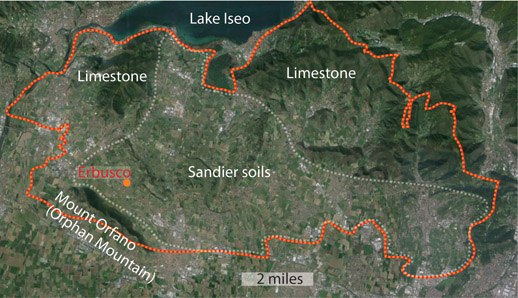
Franciacorta is reputed to make wines that are more mineral, more linear, than Champagne. I am a bit puzzled why this should be, as it lies on a line of latitude well south of Champagne. Production is confined to a small region in Lombardy, protected by Lake Iseo and mountains to the north, and an “orphan” mountain to the south. The climate is temperate–it’s the farthest north you can grow olive trees, they are fond of pointing out. Anyway, my tastings suggest that the reputation is only partly correct. Harvest here is the earliest in Italy, starting in the second week of August, not because it’s the warmest place, but because producers need to pick early to keep alcohol levels low; it’s surprising that they can get sufficient ripeness by harvest time.

Because it’s warmer than Champagne, vintage wines are made every year, and there’s a greater proportion of vintage relative to nonvintage. I see a significant difference in style here, in a sense the reverse of what you find with Champagne. It seems to me that nonvintage Franciacorta is softer, and the classic minerality really shows clearly only in the vintage. In nonvintage wines, I was impressed with Ca’ del Bosco’s Cuvée Prestige, which at a million bottles per year is their major production, showing a great sense of smoothness and density. Berlucchi is by far the largest producer, and their 61 Brut Rosé cuvée has terrific freshness for rosé.

The warmer climate means that acidity tends to be lower, so dosage is usually moderate. “In Franciacorta the dosage is not usually indispensable, whereas in Champagne it is necessary,” says winemaker Stefano Capelli at Ca’ del Bosco. There’s a tendency to use dosage at Extra Brut level, especially in vintage wines (although the label most often says Brut), and perhaps that’s partly why that pleasing minerality tends to show in the vintage cuvées. A perfect illustration of why zero dosage is successful in Franciacorta comes from Bellavista’s Pas Opere cuvée, where the ripeness of the fruits gives an impression more like Extra Brut, mineral but dense rather than aggressive.FranciacortaTopoThe other major factor affecting style is location. The northern part of the area is mountainous, with limestone terroirs; opening out from Lake Iseo, the valley in the central part forms an amphitheater with sandier soils. Pinot Noir tends to be concentrated in the cooler areas to the north. Most producers have vineyards all over, and blend to achieve their desired style, but a visit to Majolini in the northeast, where the wines come from local vineyards, shows the difference. A strong sense of minerality runs through all the wines.” My wines need time both before disgorgement and for aging afterwards,” Simone Maiolini explains. Franciacorta9SKY copyVineyards in the north of Franciacorta can be on mountain slopes.

Franciacorta’s descriptions of style mostly follow Champagne, but there is one unique style, Satèn, which is a Blanc de Blancs with lower pressure (4.5 bars instead of the usual 6 bars), designed to bring out creaminess. (Some Champagne producers do this with their Blanc de Blancs also). I have to say that this seems to me to be the antithesis of the reputation for linearity: most Satèn wines show a distinctive style with a broad palate.

Franciacorta14SKYVineyards in the central amphitheater are flatter, with views of the mountains in the distance.

Most producers have a nonvintage cuvée that is their largest production, with several vintage cuvées made in relatively small amounts. Producers often refer to Crus when discussing the origins of their top wines, but there are no single vineyard labels as such, and there is agreement that Franciacorta is a young region that needs to establish its identity more firmly before any hierarchy is established. “We need time and experience to define Crus,” says Stefano Capelli. Riserva wines must have five years before disgorgement, and there are some top cuvées that spend longer, but there’s no real equivalent to the late disgorgement cuvées of Champagne.

Franciacorta is a really interesting alternative to Champagne, and although it’s very much a work in progress, here are four wines that illustrate its range.

Ca’ Del Bosco, Cuvée Prestige

This is impressive for a general nonvintage cuvée, giving the impression of a serious wine, with real depth and weight to the palate. There are citrus impressions to the nose but the palate is all stone fruits, with lots of grip and a good sense of underlying structure. Dosage is not at all evident.

Guido Berlucchi, Brut 61 Rosé

This is 60% Pinot Noir and 40% Chardonnay. It comes from direct pressing with maceration of the Pinot Noir for a few hours at 4 degrees before fermentation. Showing freshness just short of citrus, in fact it seems fresher and less creamy than the regular Brut 61 cuvée.

Bellavista, Pas Opere 2008

Violets and nuts with chocolate impression on nose. You really see the purity of the fruits on the palate. It’s quite dry but I’m not sure I would pick it out as zero dosage, although it’s clearly into extra brut. Quite a tight mineral impression with faintly lemony notes at the end.

Majolini, Satèn 2010

More mineral impression to nose than you usually find with Satèn. The palate has the smoothness of Satèn, with hints of creaminess mixed with minerality. It’s a very nice balance with the dosage of 7.5 g only just showing, and an unusual sense of fruit purity.

The Pseudo-Science of Investigating Terroir (and Why Some Reports May Prove the Opposite of What They Think)

I am fed up with reading reports in the press that scientists have shown a role for microorganisms in terroir. I don’t know which is worse: the lack of logical analysis in the original scientific papers, or the uncritical acceptance of the conclusions by the press.

The running defect in all these papers is a misunderstanding of the meaning of terroir. The concept of terroir is simple enough: fruit grown in one place will have consistently different characteristics from fruit grown in another place. In the case of grapes, this translates to differences in wines according to their origins. But a crucial feature is consistency: it does not prove a basis for terroir to show a difference between grapes from different sources, but that difference has to be persist over multiple vintages.

Whether local microbial populations – in particular yeast, which are responsible for creating most of the flavors of wine during fermentation – contribute to terroir is the subject of paper just published by a group led by Sarah Knight at the University of Auckland.[i] It goes so far as to put “evidence for a microbial aspect to terroir” in the title. But the work is fatally flawed.

The approach superficially seems controlled: yeast were collected from different vineyards and then used to ferment examples of the same batch of sterilized juice from Sauvignon Blanc grapes. Differences in the resulting wine must be due to the yeasts. The analysis rests upon previous work from the same group that showed genetic differences in S. cerevisiae populations in different locations in New Zealand.[ii] Ignoring the fact that only 4 yeast genotypes were found on grapes (potentially able to affect the properties of wine) while the remaining 21 genotypes were limited to soil, this makes the unsurprising point that there are variations in natural yeast populations.

Each isolated yeast population gave wine with a different profile of volatile compounds. Talking about reinventing the wheel! There have been too many demonstrations to count that different cultivars of yeast can have profound effects on the character of wine. Indeed, this is the basis for a sizeable industry in which yeasts selected to emphasize (or de-emphasize) particular aspects of wine character are available commercially. It’s almost trivial to choose yeast to bring out herbaceous character in Sauvignon Blanc, for example.

The logical error in the paper is to conclude that the observations demonstrate any role for microbes in terroir. Taking a single snapshot entirely misses the point, because the population of yeast may be quite different the next year. According to Ribéreau-Gayon’s authoritative book on viticulture and vinification: “In a given vineyard, spontaneous fermentation is not systematically carried out by the same strains each year; strain specificity does not exist and therefore does not participate in vineyard characteristics. Ecological observations do not confirm the notion of a vineyard-specific yeast.”[iii] Surely it behooves any new work to explain why this wrong?

A couple of years ago, a group led by Dr. David Mills at the University of California showed directly by DNA sequencing that different microbes were present on the skins of grapes in different vineyards.[iv] That work was fatally flawed because most of the microorganisms were what are known as spoilage organisms, and are probably not part of useful fermentation (see The Answer to Terroir Does Not Lie on the Skin).

After that, a group led by Régis D. Gougeon at the University of Dijon sampled two vineyards in Burgundy and claimed that they could find differences in both grapes and wine, although differences between vintages were more significant than differences between vineyards. I reckon their samples were too small to be significant because they analyzed only 100 berries from each vineyard, but anyway it’s interesting that vintage was a bigger effect than origin (see Will people please stop trying to prove terroir exists. It’s more useful to look for gold at the end of the rainbow).

These studies are naively touted in the press as showing the involvement of microbes in terroir, but to date there is really no evidence at all: in fact, if the microbes vary significantly from year to year, they may dilute the effect of terroir rather than contributing to it. One could make a career of debunking these studies, which could provide a really good exercise for students of science in how to misinterpret uncontrolled studies.

References

[i] Sarah Knight, Steffen Klaere, Bruno Fedrizzi & Matthew R. Goddard.Regional microbial signatures positively correlate with differential wine phenotypes: evidence for a microbial aspect to terroir. Nature Scientific Reports 5, 2015, doi:10.1038/srep14233.

[ii] Sarah Knight and Matthew R Goddard. Quantifying separation and similarity in a Saccharomyces cerevisiae metapopulation. (The ISME Journal (2015) 9, 361–370; doi:10.1038/ismej.2014.132; published online 25 July 2014).

[iii] Pascal Ribéreau-Gayon et al., The Handbook of Enology, Volume 1, The Microbiology of Wine and Vinifications, 2nd edition (John Wiley & Sons, New York, 2000), p. 46.

[iv] Nicholas A. Bokulich, John H. Thorngate, Paul M. Richardson, and David A. Mills. Microbial biogeography of wine grapes is conditioned by cultivar, vintage, and climate (Proc. Nat. Acad. Sci. USA doi/10.1073/pnas.1317377110).

A Visit with Ernie Loosen

Not only is Dr. Loosen one of the top producers in the Mosel, but Ernie Loosen is one of the most interesting people to visit, as he has a wide range of activities and trenchant opinions on many issues. A day spent with Ernie is an insight into trends in wine production in Germany in general and the Mosel specifically.

Ernie’s mother and father were both single children who inherited wine estates. He is the first dedicated winemaker in the family: his grandfather was in business, and his father was a lawyer. The estates were regarded as an investment, although Ernie’s father later became fully involved as a retirement activity. Ernie took over in 1988, and combined the estates under one name (previously they had been separate in Bernkastel and Urzig). Bernkastel is his mother’s estate, which produced only sweet wines. His paternal grandfather thought that sweetness was a fault, and his estate produced only dry wine until 1953 when it changed to fruity-style wines. Ernie introduced dry wines when he took over. Here in a microcosm is the great change in Germany to trocken (dry) wines.

Ernie recollects that sweet wines took over after the war because the technology became widely available. Ernie’s view is practical. “Before the technology the only way to have sweet wines was to do it naturally. The barrels of sweet wines got the higher prices, so this led to a drive to have technology that would make it generally more feasible. After the war, sweet was absolutely big, everybody wanted sweetness. I remember people drinking only Auslese. The demand for dry wines shrank so dramatically there was no market. My father stopped producing them when he took over in 1953. In the 1990s the whole fashion in Germany switched from fruity to dry; now we hardly sell any fruity wines in Germany.”

The ability to make high quality dry wines is relatively recent, and owes much to global warming. “It would have been more difficult for my father or grandfather to make great dry wines in their cooler conditions. We did make some great dry wines when the cellarmaster forgot to stop fermentation – there was some good 1985. But every time I drink it – it’s nice now – I wonder how it was 30 years ago; it must have been sour and not at all attractive. So I don’t see global warming as pessimistic here.”

In fact, Ernie is quite pragmatic about global warming. “The reaction to global warming is a bit fatal – we are not in the hands of global warming, we will not have to plant Syrah here in ten years. We have enough viticultural tools, we can alter yields; you used to have to reduce yields drastically to get ripeness, but we don’t have those really cool vintages like 1984 any more. My father and grandfather had only three ripe vintages per decade. We get our fruit ripe every year, but not over-ripe, that is the difference. We jumped up in the last 30 years from average ripeness at 8.5% alcohol to 10.5% alcohol – but that’s not high.”

A major difference in approach from the past is that now it’s the grapes with greatest potential alcohol that go into the dry wine. “There is selection in the vineyard right from the first day of picking, with different buckets for healthy fruit, partially botrytized (Auslese), and totally botrytized (BA etc). For the healthy grapes, if potential alcohol is less than 10.5% it goes to Kabinett, at 10.5-11.5% it goes to Spätlese, over 11.5% it goes to dry wine. We would never be able to produce only dry wines because being on the river and having moisture, we always have some botrytis.”

One of Ernie’s major concerns today is to produce dry wines that age well. “For me a great wine can only be a great wine if it has aging potential. Before 2008 we produced our dry wines mostly in stainless steel with cultured yeasts. They performed beautifully as young wines – the stainless steel really brings out beautiful fruits – but I call them poppy wines because as soon as the fruit lightened after a year they became one dimensional. The driving force (for rethinking) was a 1950 Urzig Würzgarten which was brilliant now. So what did my grandfather do? I wanted to make dry wines that will age again. So we are now making wines with more aging potential – they may not be so charming when young. I have changed many things to make the wines longer aging.”

Now there is a Reserve program for the oldest vineyard in each of the three major terroirs, with 20,000 bottles being set aside each year. In due course, these will become late releases. With lunch we had a Reserve wine from Wehlenner Sonnenuhr (not yet released): just one cask was produced, and the wine spent 24 months on full lees. It shows more depth and body than the Grosses Gewachs Sonnenuhr, with more grip and less delicacy. “This is exactly what I’m looking for,” says Ernie, “it should be closed now or it can’t open out with age.”

Comparing Loosen wines is always an exercise in understanding terroir. In the estate wines, Blue Slate is more precise and fragrant than Red Slate. In the Trocken single vineyard wines, Wehlener Sonnenuhr is delicate and elegant, Urziger Würzgarten has more weight with hints of the famous spice, Erdenner Treppchen shows slightly more herbal aromatics. Moving to Kabinett or Spätlese, the same relative differences show, but the wines are fuller bodied, with more of a delicious sweet/sour edge to the finish. As the Reserve wine program matures, there will be more opportunities to see how these differences play out with age.

DrLoosen copySince this photo was taken, a major expansion has been undertaken and new cellars are being constructed to the right of the house.

What eBooks Have Got Right and What Amazon Has Got Wrong

With Wines of France now published, I’ve been working on an electronic edition. With 350 pages of text discussing the wine regions of France, and 250 pages for profiles of individual producers, it’s really rather big for a single electronic book, but I think it may be useful as a series of seven guides to the individual regions: Bordeaux, Burgundy, Champagne, Rhône, Loire, Alsace, Languedoc & Provence. Each guide will have the information about the region from the book plus the profiles of producers from the region, and maps to show where to find the producers for people who want to plan an itinerary.

It seems blindingly obvious that an electronic format is a good way to go for a guide, as it’s easy to include direct links, e.g. to producers’ web sites, maps of the region, or other information, and also can be updated quickly and easily. But surprisingly the eBook format is not very hospitable. The problem is that the content – like any guide – is heavily dependent on graphics – pictures of the region, maps to show appellations and vineyard locations, maps to show where to find producers, and so on – and these are difficult to handle in the electronic format. One problem is the small size of the screen; but more important is the difficulty of achieving a layout like a print book, where the big effort is always to get the graphics close to the text that relates to them.

It’s possible to do a reasonable job for the generic eBook format, although it will come off better on a tablet than an iPad. But you can see the maps in color, legends can be fixed neatly below or besides them, and text can be wrapped around them. You can’t see a two page spread, of course, but you can move around the text and maps in a pretty workmanlike way, and of course you can go off to ancillary links quite easily. For people who carry iPads or tablets around, I think this will be quite useful.

The big problem comes with the Kindle, which, after all, is more than half of the eBook market. The programming for Kindle is amazingly primitive: Amazon must have made an early decision that the main appeal would be for books which are essentially text only. (This reminds me of the disastrous decision IBM made when it introduced the personal computer, that there would be different formats for black and white screens (no graphics) compared to color screens. And it’s really difficult to see any justification for Kindle using a different format from all other eBooks.)

For the Kindle, this is not just an issue of color, although it’s certainly more difficult to use maps and so on in black and white: it’s really difficult to do any sort of layout for the Kindle, as the software essentially limits the material to flowing in strictly linear order. Many of the commands that work with the generic eBook format have been disabled for the Kindle. That’s why so many books have odd spaces and look weird. The situation is supposed to be better with the latest formats for Fire, closer to the generic eBook format, but that’s not yet a really significant part of the market. I appeal to Amazon to make it possible to integrate graphics with text for the basic Kindle, as this will open the whole market up to guide books and other books that extend beyond simple text.

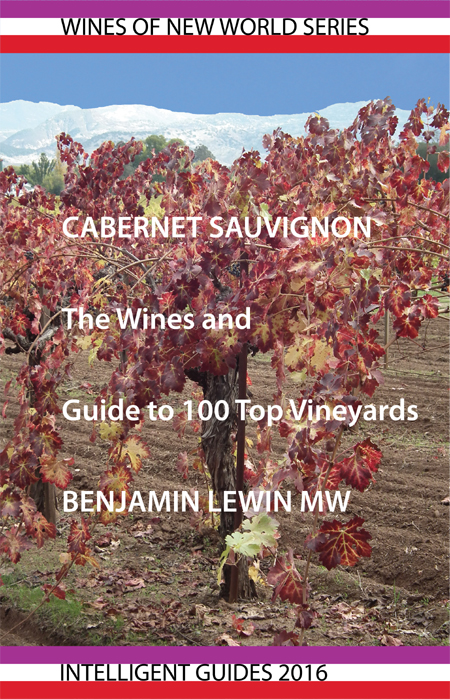
My first eGuide will be New World Cabernet Sauvignon: The Wines and Guide to Top 100 Vineyards, in a few weeks. I have some tastings to complete so that it will be really up to date, then it will be ready for release. The seven guides to French regions will follow in the New Year. All the guides will be available for both iPads and other devices as well as for Kindle, but it would be great if Amazon improved the Kindle format.

Kindle8 copy

The Revival of Haute Cuisine in France (Was it Ever Dead?)

Ever since Michael Steinberger wrote Au Revoir to All That: Food, Wine, and the End of France, I’ve been on the qui vive for signs of moribundness (is that a word? if not maybe it should be) or liveliness in restaurants in France. In four days in Paris last month, I had a series of innovative meals; Michael’s argument stands insofar as none of them were really classic; a common feature was an emphasis on Asiatic spicing (see New Paris Cuisine is a Challenge for Wine). (In fact, I had some difficulty in finding restaurants that I thought would give an impression of the present state of classic cuisine, as many seemed to have gone overboard for foreign influences.) Those I went to had a subtle interplay of classicism and new influences that I would regard more as reinvigorating their style than abandoning tradition, so in that respect I would take issue with Michael’s conclusions.

In the south of France this month, near Nice, experiences have been mixed, but two restaurants in Nice stand out for modern, innovative style, although the influences are entirely different from those I saw in Paris. They share the feature that a key factor in quality is that there’s only a single tasting menu, with no separate à la carte. Both have styles that are crisp and modern with a wonderful lightness of being. In both, you can watch the chef assembling every dish through a window into the kitchen.

L’Aromate is an amazing jewel of a restaurant, occupying a tiny space in a shop front in the center of Nice. It has a staff of only two: Mickaël Gracieux is the chef; his wife is the front of house. (There’ve been some complaints about slow service on the web, but don’t worry about it: this is not at all a problem). Crab with ginger influences was a terrific starter. The main course of sea bass with a sauce based on basil and truffles was as good as it comes. A tube of chocolate with caramelized hazelnuts was a brilliant finish. Every dish is presented with a challenge to the imagination. The menu changes every quarter.

Restaurant Jan is a little larger, as South African chef Jan Hendrik has an assistant or two in the kitchen, and maintains a style of coruscating brilliance. Salmon marinated with beets was a brilliant starter. Angus beef with beetroot combined a new set of flavors for me. Finally fruits with a sauce of red fruits and roses gave a brilliant combination between influences of fruits and perfume. Two courses on the menu change every fortnight.

Wine is a bit of a challenge at both restaurants, as lists are fairly short (but reasonably priced) and courses are so varied, but at both we settled on a red Sancerre, light enough to go with the starters, but enough weight to match the main courses. If you haven’t had a red Sancerre in the era of global warming, you should try one, as they are light years away from the old image of the near-rosé.

Outside of Nice, my best experience by far was at the Table of Patrick Raingeard at Éze-Bord-de-Mer (a few miles to the East), where one evening à la carte (which is quite extensive), and another with a tasting menu (which changes each week), both showed wonderful precision of cuisine. Cucumber and half-smoked salmon returned to the theme of Asian spices I found in Paris, and a cassoulet of lobster with spices was the most acclaimed main course. Perched in a garden a few yards from the beach, the restaurant has a positively romantic setting.

Classic cuisine, if by that we mean overt use of butter and cream, may have largely died, but new cuisine is alive and well in France. Of course, you can now eat equally well in other countries, and the level of innovation is just as great in, say, London or New York, so France no longer has a monopoly on innovation..