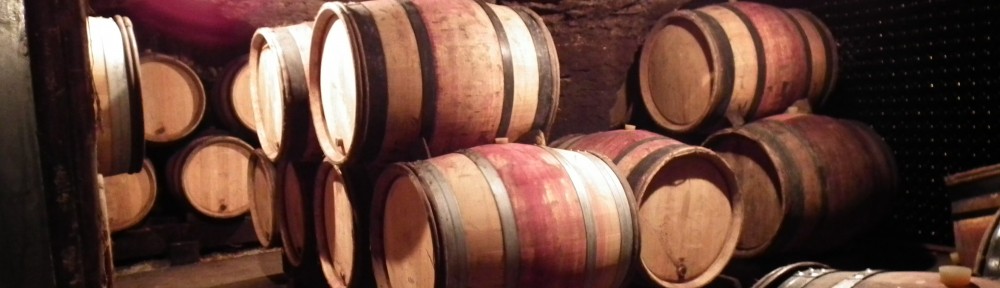
“This was my grandparent’s house,” Alexandrine Roy says, “I grew up here,” as we walk down the garden to the winery. From the exterior, it appears as an ordinary residence in a side street off the D974 in Gevrey Chambertin. The fermentation vats—all stainless steel—are in a building at the bottom of the garden, and the cellars extend underneath, divided into three areas, one for stockage, and two barrel cellars. Space is somewhat limited. We tasted barrel samples from 2023.

The domain is very much a family affair. “We are a very small producer in Gevrey, we have about 4 ha, it’s mostly me and my dad.” The tiny domain produces only 5 wines, including 4 village reds and a white from Marsannay, but has been considered to punch above its weight since Alexandrine Roy took over from her father in 2003, after working in New Zealand and Australia.
The white is the result of a relatively late harvest. “It’s very unlikely but we pick the Chardonnay after the reds. It’s a spot with a lot of diurnal variation and we get the best expression of aromatics and acidity by keeping the grapes longer.” The plots are in the highest altitudes of Marsannay, close to Fixin. the wine has no malolactic fermentation and ages in barriques with 20% new oak. “This ferments in stainless steel which really keeps the profile of the place and the grapes,” Alexandrine says. It is transferred to barriques and stays on the lees with no battonage for 12 months.
There are four cuvées of Gevrey Chambertin. Everything is destemmed, and there is extensive use of new oak, generally around 50%. But it is scarcely detectable in the wines. “We make wines that are charming and approachable when young,” is how Alexandrine describes the style. The idea in winemaking is to keep things as simple as possible.
“We always have the same pickers, so we sort in the vineyard, everyone is responsible for their own basket. Destemming is 100% but there are lots of whole (i.e. not crushed) berries.” Reds spend 11 months aging before bottling (the small cellar needs to be emptied out for the next vintage). Filtration at bottling depends on the conditions.
The main cuvée is the Vieilles Vignes Gevrey Chambertin, from 80-year-old vines in two climats, Vignes Belles and La Justice, which Alexandrine purchased in 2010. La Justice comes from the top of the climat, from younger vines (50-years-old). The Vieilles Vignes shows a great transparency of red and black fruits backed by silky tannins, and to my palate its elegance seems more like Morey St Denis than Gevrey Chambertin. It is so approachable that even a barrel sample seems ready to drink. La Justice shows firmer tannins with more sense of grip on the palate, but still in that charming, elegant style.
Clos Prieur is more of a regular village wine. Located just below Mazis Chambertin, Clos Prieur has a premier cru part and a village part. “Our plot is in the village part, but it tastes like a premier cru, so I don’t mind,” Alexandrine says. The wine shows greater density, increased impressions of black fruits, with a great sense of purity, and is more overtly structured. This perhaps makes the most classic impression of Gevrey, and needs a little time to develop.
Created in 2005, Cuvée Alexandrine has an unusual basis, designed to attract attention. coming from a selection of millerandaged grapes. These are berries that remain very small because they were incompletely fertilized. They have a higher ratio of solids to liquids, and the extra concentration lifts the quality of the wine. Sweet black fruits give a real sense of that extra concentration and character you usually get only from very old vines. This is a vin de garde that will undoubtedly benefit by aging for a few years. There are usually only 4 barriques.
Alexandrine’s cuvées show what would be called ‘range’ in the theater, from the absolute elegance of the Vieilles Vignes to the vin de garde-like character of Cuvée Alexandrine. It is fair comment that the wines taste as though they come from higher-ranked appellations than they actually do. In saying that winemaking is ‘simple,’ Alexandrine means that it follows traditional precepts with no unnecessary manipulations; but the wines are a far cry from traditional if by that you mean the old-style rather hard-edged Gevrey Chambertin that took years to become soft enough; rather these are in the modern idiom and attractively approachable.
Tasting Notes for 2023
Marsannay-la-Côte, White
Fresh nose with some herbal or savory notes. Juicy and flavorfull with quite a silky impression on the palate. Fresh but not at all aggressive. The overall impression is lively and energetic. Marc Roy 89 Drink –2030
Gevrey Chambertin, Vieilles Vignes
Some acidity with herbal impressions on the nose. Fresh and juicy underneath, with red and black fruits supported by silky tannins. It is very charming in an elegant style that reminds me more of Morey St Denis than Gevrey Chambertin. Transparent would be a good description of the overall impression. It is so approachable you feel you could even drink the barrel sample. 90 Drink 2026-2036
Gevrey Chambertin, La Justice
More aromatic lift to the nose compared with the Vieilles Vignes. Palate shows the same charming style but has more grip, with firmer tannins, and this is more clearly Gevrey (rather than Morey) The wine needs a little time. 91 Drink 2027-2039
Gevrey Chambertin, Cuvee Alexandrine
Significant increase in intensity and concentration compared to other cuvées. Slightly nutty impressions on palate in the background. Sweet black fruitts give a real sense of that extra concentration and character you usualy get only from very old vines. Firm tannins leave a touch of bitterness at the end; this is something of a vin de garde. It is very textured and needs some time. 92 Drink 2030-2042
Gevrey Chambertin) Clos Prieur
2024-06-03 Greater sense of density to the nose than Gevrey La Justice. Palate moves towards black fruits with some sense of spice. This wine marks a transition from the style of the Gevrey village and La Justice towards a blacker, deeper, more overtly structured character. This perhaps makes the most classic impression of Gevrey. Very pure impressions of black fruits. A litle bitterness at the end from tannic structure needs some tie to resolve. Marc Roy 92 Drink 2028-2040
 Lewin on Wine