Visiting Chateau Grillet is not for the fainthearted. It is discrete in the extreme. First you have to find the steep road rising up from the river behind the hamlet of Vérin. Then you have to spot the narrow entrance to the property, unmarked by any sign, with a small road between old stone walls, barely wide enough for small car. It’s a feat to get equipment in and wine out.
An enclave entirely surrounded by Condrieu, Château Grillet is the second-smallest AOP in France. (The smallest is La Romanée in Vosne Romanée.) Owned by the Neyret-Gachet family from 1827 to 2011, it was a benchmark for Viognier (the only grape grown), although after the planted area was expanded from 1.7 ha to 3.5 ha in 1979, the style was felt to be a little tired. In 2004, Denis Dubourdieu, who was largely responsible for resurrecting white wine production in Bordeaux, was brought in as a consultant, and the style became fresher.
Things changed entirely when Château Grillet was sold to François Pinault’s winery-holding company, Artemis Domaines (owner of Château Latour). Changes in the vineyard led to a dramatic drop in yields. A new cellar was installed in 2012, with many small stainless steel tanks, so each plot can be fermented separately. Winemaker Jae Cramette came from Burgundy in 2019.
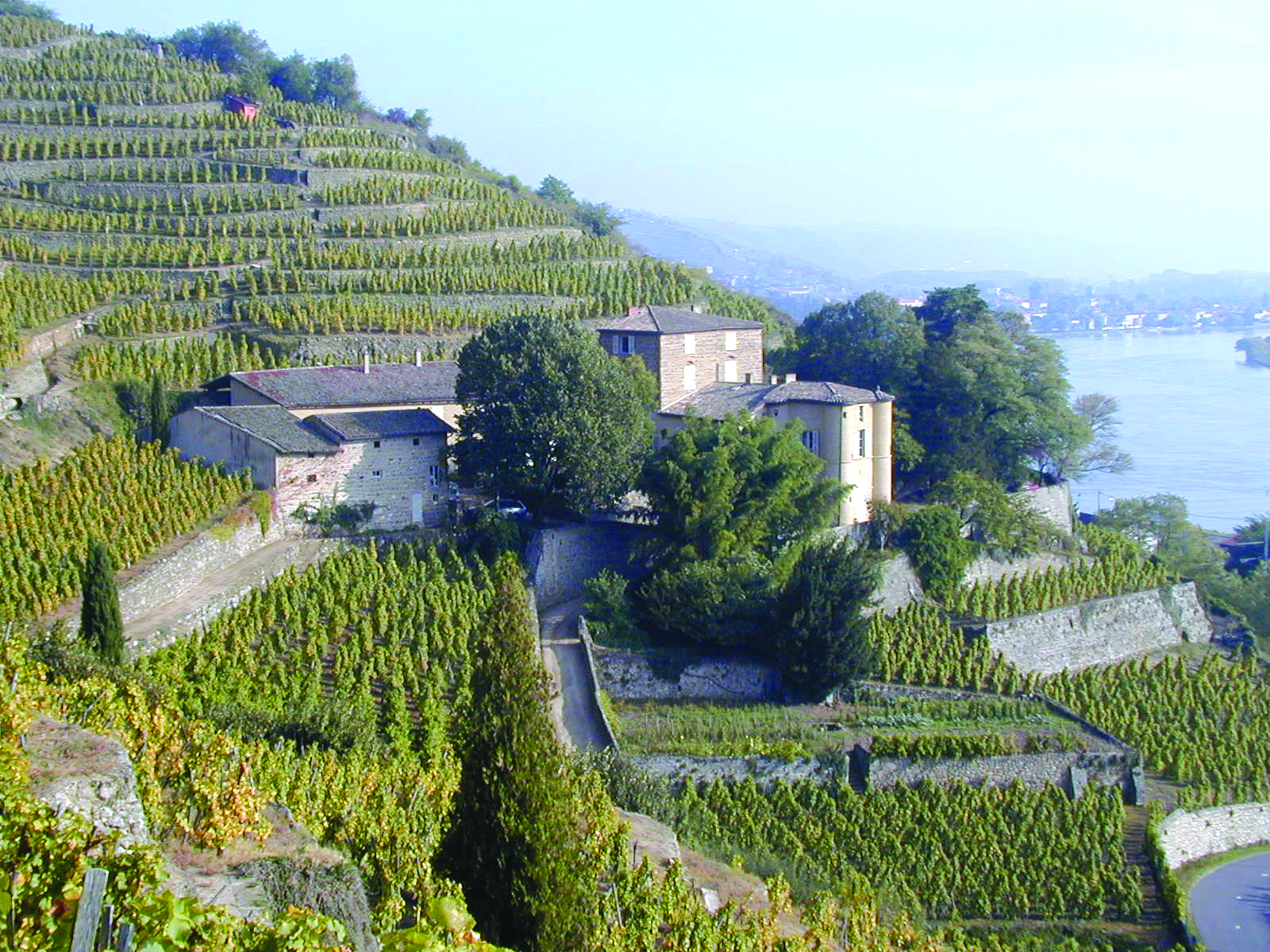
Standing in the vineyard you can see how it forms a protected amphitheater trapping the sun, with steeply terraced vineyards running from 150m up to 200m overlooking the Rhône. The best vineyards are above the château; the vineyards below (planted in the extension of 1979) are more exposed. In spite of its small size, there’s significant variation in terroir, and the final blend balances richer lots with fresher lots. Maturity varies quite a bit across the vineyard and harvest lasts 5-6 days.
Why is it a separate AOP as opposed, perhaps, to a Cru within Condrieu (which is also restricted to Viognier)? The appellation was created in 1936, one of the first in France, before Condrieu was created. “We had a château and some vines so it was posssible then, it would not be so easy now,” Jae says. The difference from Condrieu is not just the soils, which are mostly based on biotite (a form of granite), found also on the Coteaux de Vernon in Condrieu, but because of the south-facing exposure.
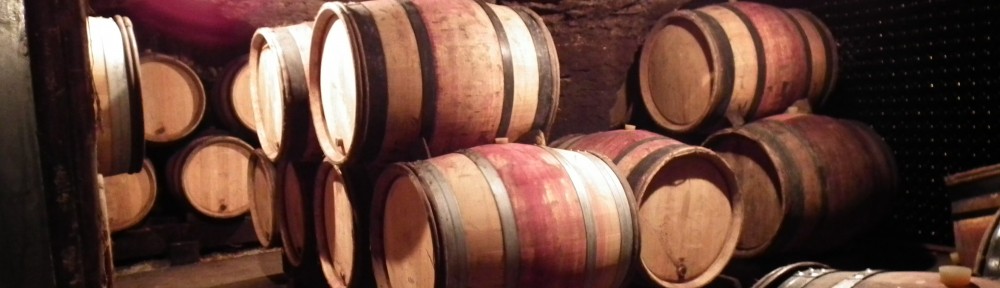
Vine are separated by 102 terraces of old stone walls, and are divided into 15 groups for vinification. In any other situation, the stainless steel fermenters in the cellar would be described as micro-vinification, as each tank is only 6.5 hl (the quivalent of just over two barriques). The aging aging cellar contains the whole production in 25 barrels (ranging from barriques to 350-liter), 2 demi-muids, and an amphora. “I buy one or two new barrels each year, so new oak is 5-10%,” Jae says.
How does making wine here compare with Burgundy, I asked. “It’s really different here. Viognier is not an easy variety. Pinot Noir is not particularly easy but Viognier is really not easy. I thought I might harvest earlier to keep acidity, but it would be a mistake because then you get vegetal aromas and you don’t get complexity. You really have to wait. It’s easier to fix the date for harvest in Burgundy, but here it’s more difficult, you have a very narrow window to harvest.”
With the intention of restoring Grillet to its former glory, a second wine was introduced under the Côtes du Rhône appellation; called Pontcin, it is declassified from Château Grillet and sells for about a quarter of the price of the grand vin. It includes the grapes from younger vines, some of the terraces at the bottom, and other lots that may vary each year. There are about 2,000 bottles of Château Grillet and 1,000 bottles of Pontcin.
If you had the Côtes du Rhône without paying attention to the name of the producer, you would be surprised. It is not at all like the typical Cotes du Rhone whites, which come mostly from the south, and tend to be rather aromatic. “I don’t get apricots or honey as you get in some Condrieu.” One reason is that Jae uses only the first pressing, the last pressing tends to heavier aromatics, and is used just to make a wine for internal purposes.
The Château Grillet cuvée follows the same general style, but is more subtle. If I were to use a single descriptor, it would be ‘delicate.’ It’s very much the mineral, saline side of Viognier, with the palate showing a silky texture with a mineral finish. The wine is quite reticent on release, with more floral notes emerging slowly in the glass. When will it peak? “Wait a minimum of 7-10 years,” Jae says.
 Lewin on Wine