A Visit to the Second-Smallest Appellation in France

Visiting Chateau Grillet is not for the fainthearted. It is discrete in the extreme. First you have to find the steep road rising up from the river behind the hamlet of Vérin. Then you have to spot the narrow entrance to the property, unmarked by any sign, with a small road between old stone walls, barely wide enough for small car. It’s a feat to get equipment in and wine out.

An enclave entirely surrounded by Condrieu, Château Grillet is the second-smallest AOP in France. (The smallest is La Romanée in Vosne Romanée.) Owned by the Neyret-Gachet family from 1827 to 2011, it was a benchmark for Viognier (the only grape grown), although after the planted area was expanded from 1.7 ha to 3.5 ha in 1979, the style was felt to be a little tired. In 2004, Denis Dubourdieu, who was largely responsible for resurrecting white wine production in Bordeaux, was brought in as a consultant, and the style became fresher.

Things changed entirely when Château Grillet was sold to François Pinault’s winery-holding company, Artemis Domaines (owner of Château Latour). Changes in the vineyard led to a dramatic drop in yields. A new cellar was installed in 2012, with many small stainless steel tanks, so each plot can be fermented separately. Winemaker Jae Cramette came from Burgundy in 2019.

Standing in the vineyard you can see how it forms a protected amphitheater trapping the sun,  with steeply terraced vineyards running from 150m up to 200m overlooking the Rhône. The best vineyards are above the château; the vineyards below (planted in the extension of 1979) are more exposed. In spite of its small size, there’s significant variation in terroir, and the final blend balances richer lots with fresher lots. Maturity varies quite a bit across the vineyard and harvest lasts 5-6 days.
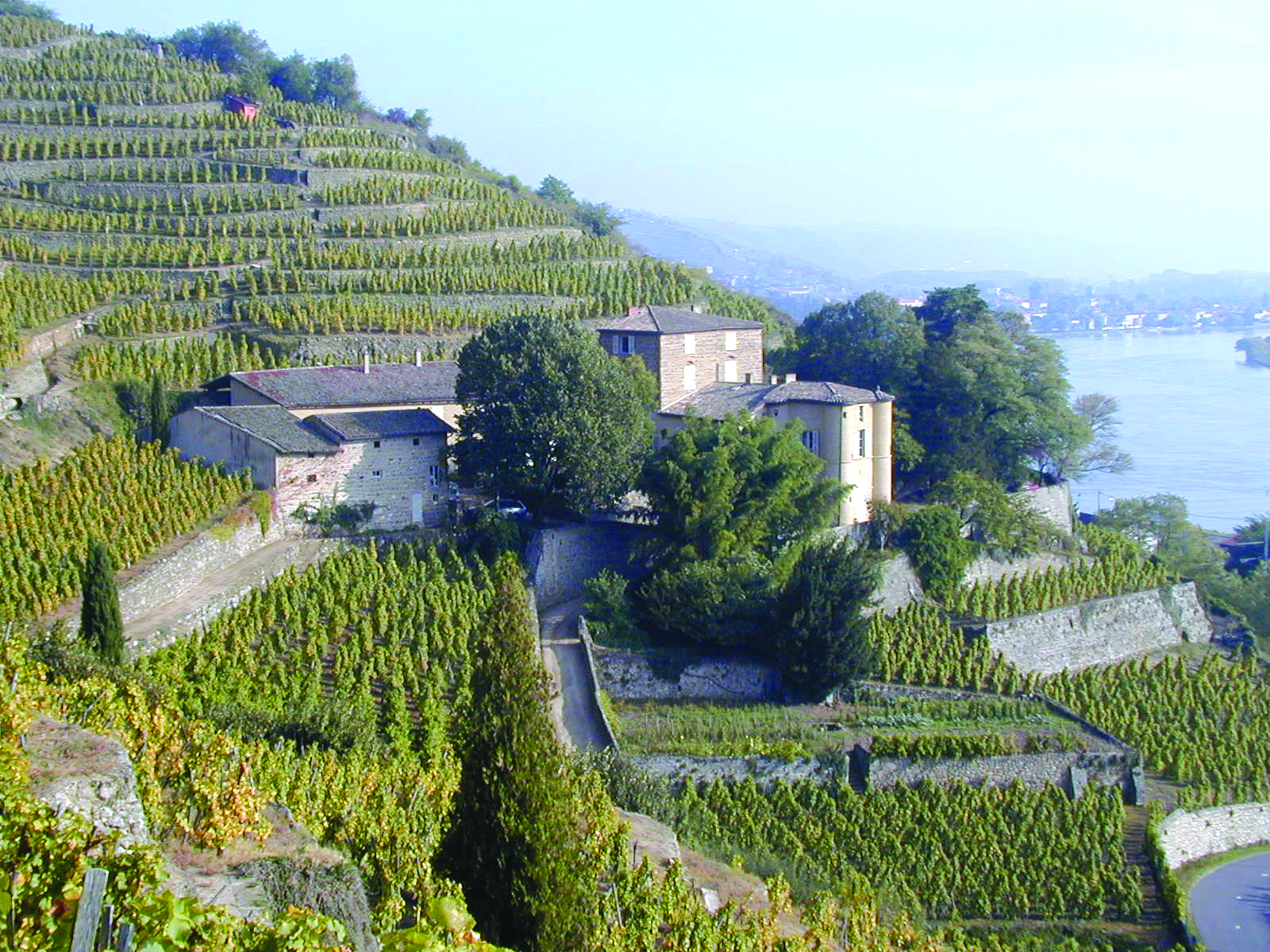
Why is it a separate AOP as opposed, perhaps, to a Cru within Condrieu (which is also restricted to Viognier)? The appellation was created in 1936, one of the first in France, before Condrieu was created. “We had a château and some vines so it was posssible then, it would not be so easy now,”  Jae says. The difference from Condrieu is not just the soils, which are mostly based on biotite (a form of granite), found also on the Coteaux de Vernon in Condrieu, but because of the south-facing exposure.

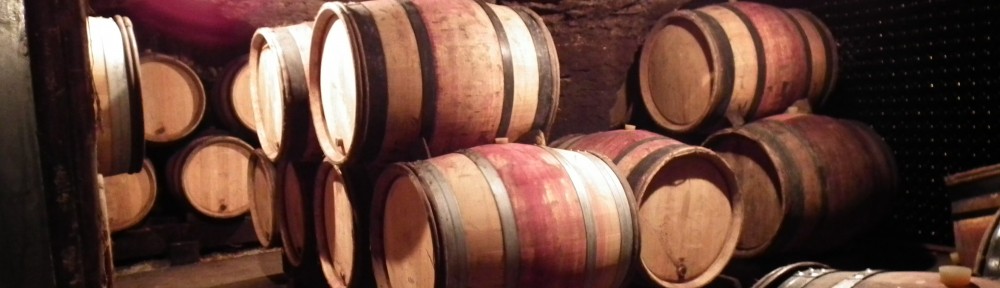
Vine are separated by 102 terraces of old stone walls, and are divided into 15 groups for vinification. In any other situation, the stainless steel fermenters in the cellar would be described as micro-vinification, as each tank is only 6.5 hl (the quivalent of just over two barriques). The aging aging cellar contains the whole production in 25 barrels (ranging from barriques to 350-liter), 2 demi-muids, and an amphora. “I buy one or two new barrels each year, so new oak is 5-10%,”  Jae says. 

How does making wine here compare with Burgundy, I asked. “It’s really different here. Viognier is not an easy variety. Pinot Noir is not particularly easy but Viognier is really not easy. I thought I might harvest earlier to keep acidity, but it would be a mistake because then you get vegetal aromas and you don’t get complexity. You really have to wait. It’s easier to fix the date for harvest in Burgundy, but here it’s more difficult, you have a very narrow window to harvest.”

With the intention of restoring Grillet to its former glory, a second wine was introduced under the Côtes du Rhône appellation; called Pontcin, it is declassified from Château Grillet and sells for about a quarter of the price of the grand vin. It includes the grapes from younger vines, some of the terraces at the bottom, and other lots that may vary each year. There are about 2,000 bottles of Château Grillet and 1,000 bottles of Pontcin.

If you had the Côtes du Rhône without paying attention to the name of the producer, you would be surprised. It is not at all like the typical Cotes du Rhone whites, which come mostly from the south, and tend to be rather aromatic. “I don’t get apricots or honey as you get in some Condrieu.” One reason is that Jae uses only the first pressing, the last  pressing tends to heavier aromatics, and is used just to make a wine for internal purposes.

The Château Grillet cuvée follows the same general style, but is more subtle. If I were to use a single descriptor, it would be ‘delicate.’ It’s very much the mineral, saline side of Viognier, with the palate showing a silky texture with a mineral finish. The wine is quite reticent on release, with more floral notes emerging slowly in the glass. When will it peak? “Wait a minimum of 7-10 years,” Jae says.

The Whirlwind at Domaine Stephane Ogier: Tasting Cote Rotie lieu-dits

Stéphane Ogier is something of a whirlwind. He greeted us when we arrived at the winery, while simultaneously sending out a delivery of a few cases, and saying goodbye to a large group who had just had lunch and a tasting. Originally his parents had a winery in the village, but Stéphane built a striking winery in contemporary style on the main road between Ampuis and Condrieu 2013. The ground floor includes a spacious tasting room, and there’s a vast winery underneath.

The new winery has a striking design.

Stéphane spent five years studying viticulture and oenology in Burgundy, and then returned home to join the domain in 1997. “That is why great Burgundy, along with Rhônes, are my preferred red wines,” he says. Michel Ogier had sold his grapes to Chapoutier and Guigal until 1983, when he started to bottle his own wine from his tiny 3 ha vineyard in Côte Rôtie. One of Stéphane’s main objectives was to increase the estate to a more economic size, and he added vineyards in several lieu-dits in Côte Rôtie, now totaling 11 ha, and at La Rosine just above Côte Rôtie, as well as planting Syrah farther up the river at Seyssuel, and acquiring a hectare in Condrieu.

Tasting here is an extended process, as the focus is on barrel samples from Stéphane’s many different lieu-dits in Côte Rôtie, all of which are vinified and aged separately. It’s the way par excellence to understand the different terroirs and the basis for making individual wines versus blends. You really get a sense of the variety within Côte Rôtie. At the end, you feel you are almost ready to start blending…

IGP La Rosine comes from the plateau above Côte Rôtie; rich and plush, it offers a foretaste of the Côte Rôtie. IGP L’Âme de Soeur comes from Seyssuel and is more mineral. The Côte Rôtie Reserve is a blend from 10 lieu-dits. There are four single-vineyard wines. “There are no Grand Crus in Côte Rôtie, but I have mine—they are the cuvées of Belle Hélène, Lancement, and Côte Blonde,” Stéphane says. Viallière has also been a single-vineyard release since 2015. Other lieu-dits may be bottled separately depending on the year.

Lots are variously destemmed or fermented as whole bunches. Viallière is elegant, Côte Blonde is rounder with slightly lifted aromatics (it includes 5% Viognier), Lancement is broader and may age longer, and Belle Hélène, from 80-year old vines, is the most complete and subtle. All wines age in barriques, with 1-year to 6-year old barriques for the Côte Rôties, but the only cuvée showing obvious oak is Belle Hélène. The approach is modern, showcasing elegance and purity of black fruits. “Elegant” appears often in my tasting notes.

The wines mature slowly. When you taste the 2010 and can still see the tannins, you think the current vintages must be brutal, but not atall. Tannins seem, for example, to be quite similar in their impression on the finish in 2015 and 2010. Stéphane says it is best to wait 10 years to start, and 15 years for a great vintage.

2018 barrel samples from Côte Rôtie lieu-dits

Besset: nice aromatic lift with chocolaty impressions on nose. Very fine on palate, quite precise, greater precision and breed than La Rosine. Very fine, silky tannins, very elegant, sense of purity to the black fruits enhancing the sense of precision. All destemmed.

Mont Lys: very fine, precise, linear, not quite the breed of Besset, relatively lighter, more sense of linearity, not so profound. This is a wine to blend.

Montmain: chocolaty impression to nose, fine but rounder than Besset or Mont Lys, chocolaty at first, but then a sense of minerality grips the palate. Whole bunch.

Côte Boudin: comes from the lower slopes, all destemmed. More coffee than chocolate on nose, soft impression on palate, furry tannins, showing a touch of bitterness at end. Moving towards floral impressions although whole bunch.

Fonjeant: chocolaty nose moves to become slightly tart and then palate shows faintly acid edge. Partially destemmed, this will bring freshness to the blend.

Champon: always the last parcel to harvest. Very fine impression here points to potential delicacy. Quite tight, tannins fine but a little bitter, Very good acidity. This will really bring freshness.

Lancement: one parcel here goes to the separate cuvée, the others go into the general Côte Rôtie. All destemmed. Tight impression to nose, follows to palate, delicate impression, but less floral than Boudin. Precise impression, the most Burgundian, the most lingering finish, moving in a savory direction.

Côte Blonde: faintly chocolaty, faintly acidic, very fine, a chocolate edge, sense of coffee at the end, more evident aromatic lift. This will be fragrant as it ages. This has 5% Viognier, which explains the aromatic lift.

Belle Hélène: gives the most complete impression on the nose, with some delicate aromas of vanillin, hints of coffee and spice, very fine granular texture. This will be very elegant. Solely Syrah but 80 years old, planted by Stéphane’s grandfather.