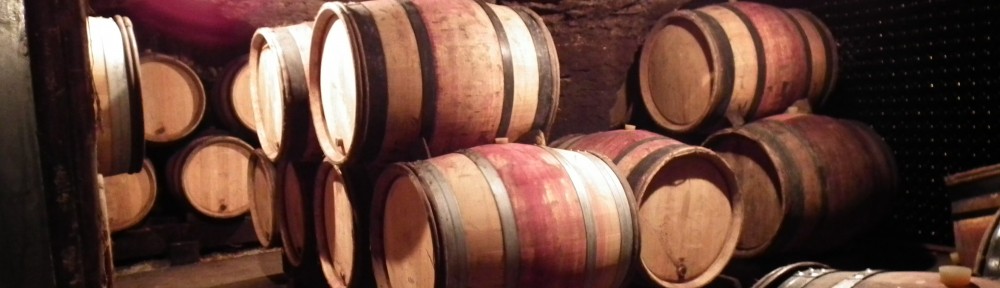
A Visit to Liber Pater Provokes Thoughts about the Meaning of Authenticity

Liber Pater is the most expensive wine in the world, with a release price since 2015 of €30,000 a bottle (up from €5,000 per bottle for the first vintages). Visiting Liber Pater is something like the quest for the holy grail, with a series of obstacles that have to be overcome. Putting Liber Pater into your GPS or Google maps (if you have phone service in the middle of nowhere) will take you to a spot on the main road near a vineyard, but with no habitation in site. Using the address of the lieu-dit takes you up a side road, with another vineyard en route, but no sign that any of the houses along the path have anything to do with Liber Pater. At this point, the only thing to do is to call Loïc Pasquet, who says “are you near the olive trees or the big tree.” As you are basically in a forest, this is difficult to answer. Eventually you find some olive trees (well, really stumps of olive trees) next to one of the vineyards, and Loïc comes to meet you there and explain his design of the vineyard. After that, you follow him back to the cellar, several miles away in Podensac, on the other side of the autoroute. Only those with sufficient perseverance make it through…
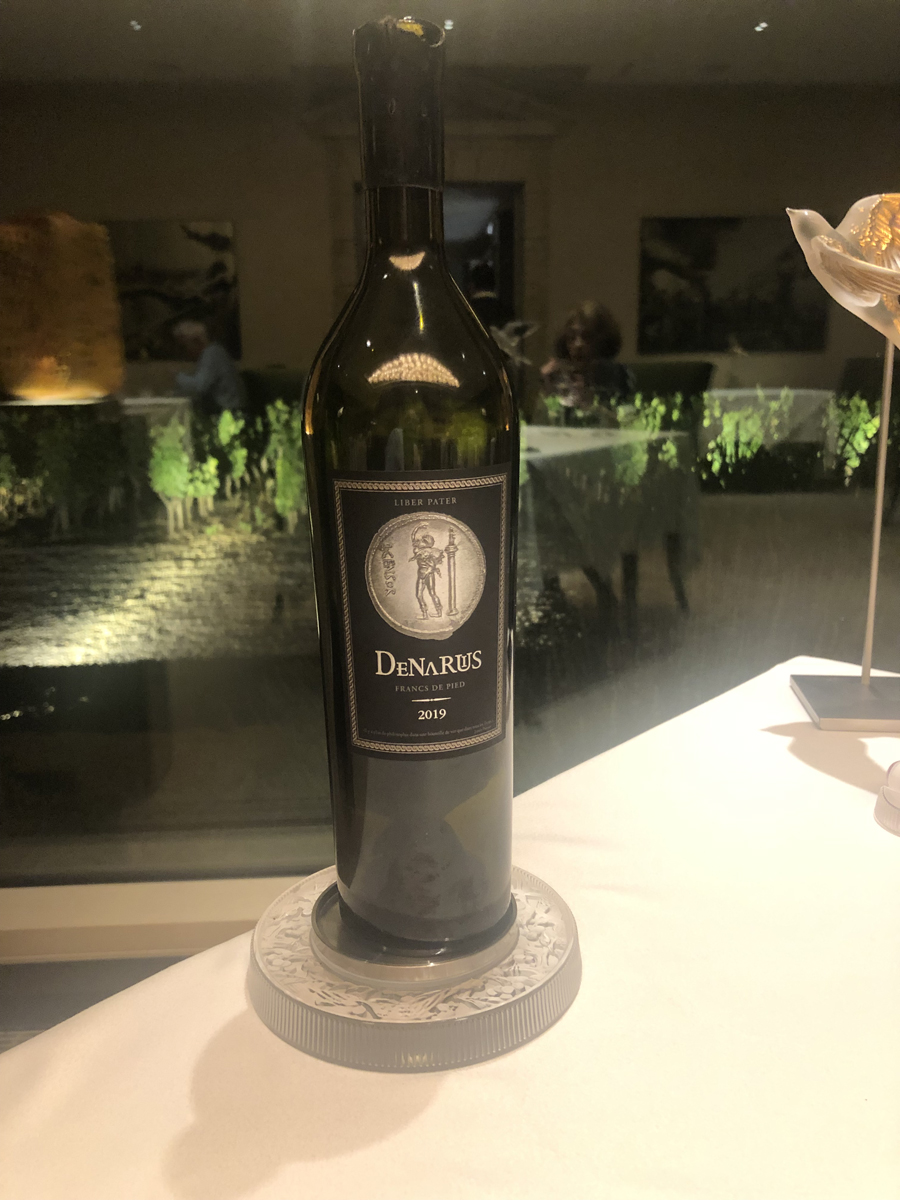
Denarius 2019 at dinner

Loïc bought a tiny estate in Landiras in the Graves in 2005 and set out to produce a wine from pre-phylloxera varieties. He planted the vineyard with ungrafted vines at the density of 20,000 /ha (twice the density of the usual high density vineyards in Bordeaux) as free-standing bushes on individual stakes (with vines 80 cm apart in a row and rows 60 cm apart), somewhat like a more organized version of a pre-phylloxera vineyard. The story goes that the wine comes from pre-phylloxera varieties, and reconstitutes the taste of nineteenth century Bordeaux. The major grape is Petite-Vidure, which is an old name for Cabernet Sauvignon. There are small quantities of Petit Verdot and Malbec, and around 2% of the really rare varieties: Tarnay-Coulant (also known as Mancin); Sainte-Macaire (formerly planted in marshes of the Garonne, but rather unproductive); Castets (an old variety of the Right Bank). All of these harvest late, which made them problematic, but is less of an issue in the era of global warming, and they are somewhat susceptible to fungal diseases. The 2015 vintage was the first to come exclusively from ungrafted wines. It fermented in amphorae, and aged 85% in amphorae, 15% in barriques, but from 2018 the wine has been vinified exclusively in amphorae. Going forward, vintages will have higher proportions of the rare varieties as recent plantings come on line. The first vintages were Graves AOP, but from 2015 the wine is labeled as Vin de France, because the rare grape varieties are not allowed in Bordeaux AOPs.

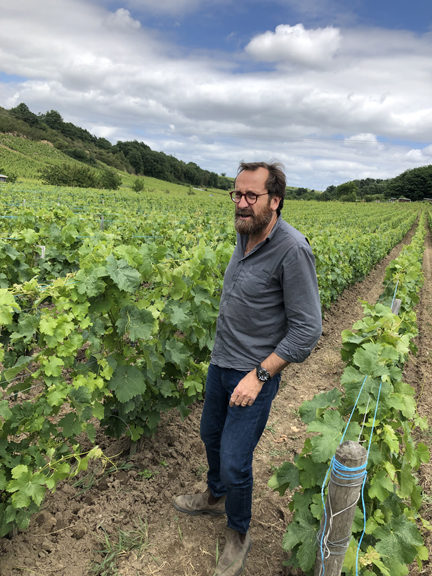
“There’s been a vineyard here for 2000 years,” Loïc says as we walk through the vines. At one time it was in the family of the writer, Montaigne. “We’ve planted it using techniques from the Roman era,” Loïc says, with 5 rows of vines separated from the next 5 rows by an empty row. The vines are planted in small blocks to match varieties with the terroir. The first planting was followed by another five years later. The vineyard up the side road to the lieu-dit is also part of Liber Pater, planted a year ago. Will there be any further plantings? “No, because we planted the best vineyards.” Because the vines are ungrafted, they are relatively small and don’t really show their age. “Grafting increases vigor and sugar production. Our leaves are smaller, it’s more like a Bonsai. The berries are smaller, 50g instead of 150g.” Harvest is between 11.5 and 12.1% potential alcohol.

The back part of the vineyard has more clay, the front part by the road has more gravel, and to the side there’s more of a mix. Long ago it was the bottom of a river coming from the Pyrenees.  “I don’t want to make wine on the basis of varieties,” Loïc says, “with Cabernet Sauvignon for structure, Merlot for fat, and Petit Verdot for spice, instead we need to plant each variety on the soil where it’s born. This is the difference between Bordeaux and Burgundy. In Burgundy they have all sorts of soil and one variety. I don’t want to calculate the varieties in the blend, that would be like making Coca Cola, it would be a very bad idea. We need to make a wine to reflect the place and the vintage. The mistake in Bordeaux is to produce a blend based on varieties, not on the terroir. You can produce that blend anywhere in the world. We used to blend plots, but now they blend varieties. We’ve destroyed 8000 years of heritage for 40 years of scores. The difference (in the Liber Pater vineyard) from grafted vineyards is that with grafting you can put any variety on any terroir, but with Franc de Pied (the French term meaning vines planted on their own roots) you have to match the variety to the soil. Harvest is always the first week of October and takes only 3 days. If you match the variety to the soil, everything ripens together, whereas when you graft there can be two weeks difference between Cabernet Sauvignon and Merlot.”

The Liber Pater vineyard in Landiras

Will the vines survive? “We are on the oldest geological zone of Bordeaux which is 50 million years old, whereas the main part of Bordeaux is only 2-4 million years old. We are at 90 meters above sea level. At this geological point, there is a top layer of gravels, and sand below—Aeolian sands which came from the sea with the wind, which are around 20cm deep. This is a natural protection against phylloxera because it cannot dig holes to spread, because the sand falls back when you dig,” Loïc says.

The tiny cellar is filled with amphorae of various sizes. “I only produce a little wine,” Loïc says. There are only around 500 bottles of Liber Pater, and 2,000 bottles of his other cuvée, Denarius, added in 2021. “We do not make a second wine. We make Liber Pater and we make Denarius; they are two wines, but one is not an inferior version of the other,” he says. Denarius is mostly Cabernet Sauvignon, fermented and then aged in amphorae for two years. It is less expensive than Liber Pater, under $1,000 per bottle. All aging is now in amphorae with the finish called grès, which literally means sandstone, reflecting the fact that some sand is used when the clay is fired at over 1,200°C.  This makes the material less porous, compared to terra cotta, which is fired at a lower temperature. The result is a reductive environment. “We don’t use barriques because oak can change the taste of the wine, you can adjust it to make more vanillin, or chocolate, like Coca Cola. But me, I want the pure taste of the wine.” Alcoholic fermentation lasts about 5 days in the amphorae, and malolactic fermentation takes place simultaneously, “because we don’t use any sulfur.” After about two weeks maceration, the amphorae are closed, and then remain untouched for 30 months.
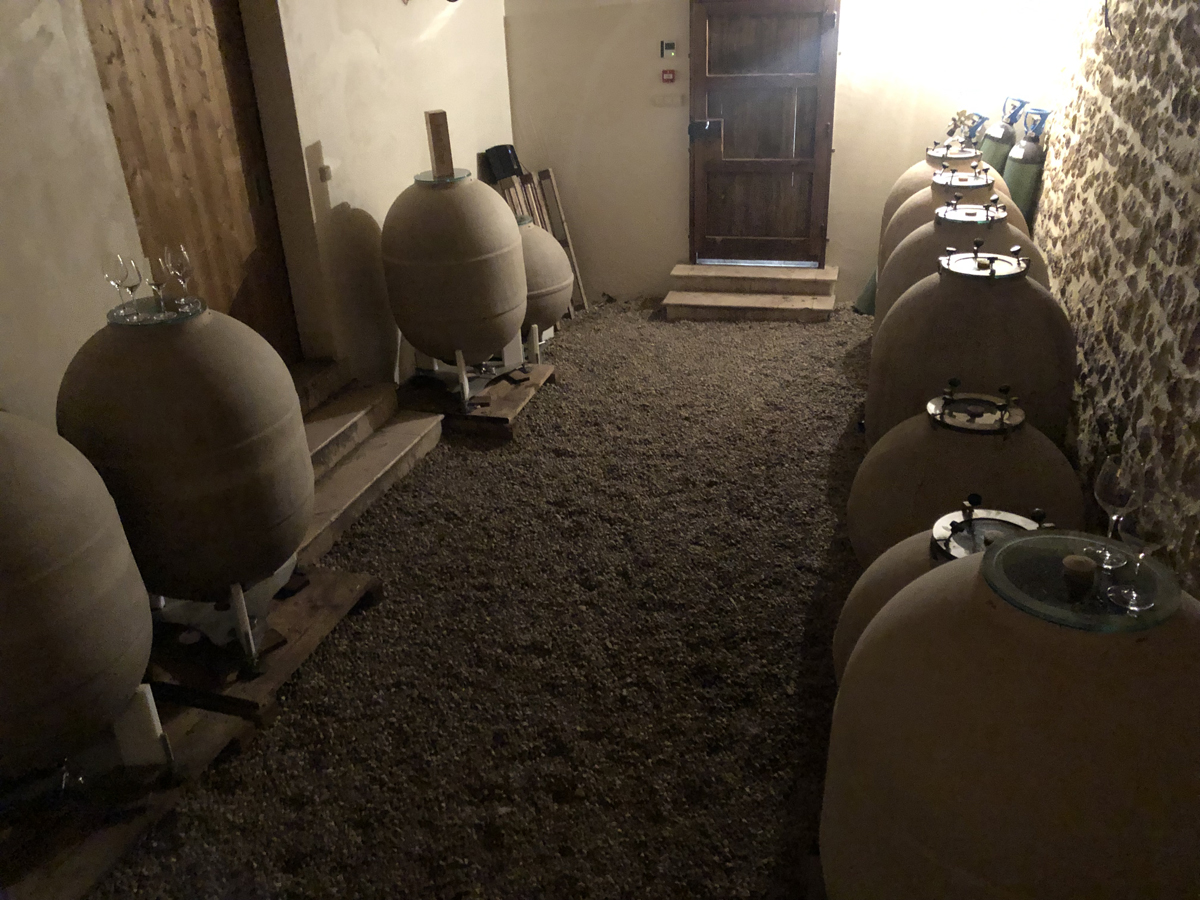
Wines aging in amphorae in the Liber Pater cellar

We go up a tricky spiral staircase from the cellar to the tasting room above, where Loïc also has a small collection of old books on viticulture and vinification. This is his reference library to guide production. In fact, at one point during the tasting he tuned in to an auction of old books on wine. Loïc opens a bottle of Denarius 2019, and tasting starts by decanting the wine, actually pouring it vigorously from glass to glass several times, to provide aeration to counter the reductive environment. The wine starts out with impressions of very ripe black fruits, tense on the palate, fresh and a little appley on the finish. It’s a forceful contrast with the sleek, polished impression of modern Bordeaux. It’s constantly changing in the glass, and Loïc gives us the rest of bottle to take back to our hotel to have with dinner. It’s very hard to find any appropriate reference points with which to compare the wine. In terms of modern wine, if you had this blind there would be conflicting messages about origin. The sommelier thought the combination of acidity and maturity pointed to a more northern location, such as the Loire. The moderate alcohol level also might point towards a cooler climate. For me, the intensity of color and the forcefulness of the palate, with fruits tending towards plums on the palate and a sense of white pepper showing on the nose, faintly nutty on the finish, pointed farther south, towards the northern Rhône. Although there is a strong sense of structure, there is no tannic bitterness on the finish. After a while, a sense of tobacco develops on the finish to give impressions resembling Cabernet Franc, and acidity picks up a bit with some herbal impressions. The gravely texture and flavor make the polished modern wines of Bordeaux seem almost eviscerated, if you wanted to pursue the argument. The pattern of changes makes it hard to project future development. It is really sui generis.
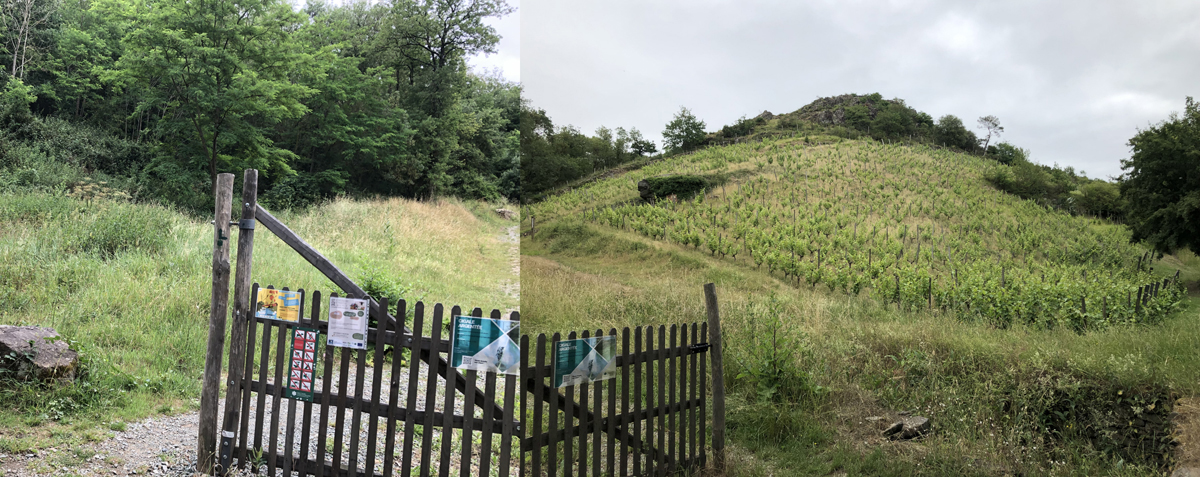
Belargus: the Heresy of Dry Wine in Quarts de Chaume

The domain was originally the Pithon-Paillé domain, owned by renowned winemaker Jo Pithon, known especially for his dry Chenin Blancs, and in particular for the heresy of producing dry white wine from vineyards in the Quarts de Chaume appellation for sweet wines. In 2018, Jo retired and sold the domain to businessman Ivan Massonnat, who has continued and expanded the heresy. Winemaker Adrien Moreau joined the domain for the first vintage.

Jo Pithon sold it in 2018 because his sons weren’t interested in taking it on. Ivan is in private equity and had helped his friends to buy land. “Ivan knows Burgundy but did not know this area,” Adrien explains. “He looked at Vouvray but the appellation is very large and does not have any similarities to Burgundy. But here there are small AOPs and estates and there’s something of a hierarchy. Jo brought Ivan to the Coteau de Treilles vineyard and Ivan said, ‘that’s my grand cru’.”

Coteau de Treilles was abandoned after the second world war when viticulture moved from the coteaux to the flat lands. Jo bought 70 plots from 25 owners, cleared the land, and planted vines, starting in 2000. The 2.7 ha are long and narrow with slopes from 30-70%. It’s actually in a 15 ha nature reserve.  “We say that there’s  Mediterranean micro-climate here, with unusual flora and fauna. It’s the habitat of the blue butterfly, Belargus, which gave its name to the domain.”

Coteau de Treilles vineyard is on the right. On the left, the land is in its original state.

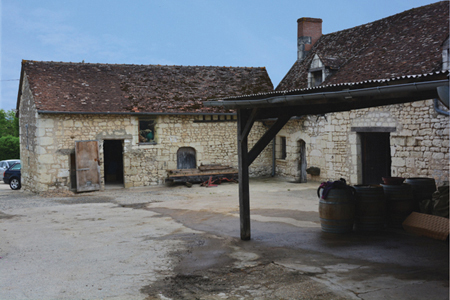
The premises haven’t changed at all since this was Domaine Pithon-Paillé. The exterior is still quite shabby, consisting of old buildings on a corner lot, dating from the 1970s. The plan is to build a new winery. “We found a clearing near here and we’ll build a winery just for vinification and aging. Logistics will be elsewhere. The present building (designed for half the vineyard area) is never big enough,” Adrien says.

“The domain is 100% dedicated to Chenin Blanc,” is the motto at Belargus. The estate started with 9 ha, but is now 21 ha, with the major expansion coming from purchase of Château de L’Écharderie (one of the original estates in Quarts to Chaume). Ivan also added 3 ha in Savennières. There are now 15 cuvées. The holdings in Chaume and Quarts de Chaume are about half of the total, but most of production is dry, although proportions vary widely from year to year—in 2018 25% was sweet, because of frost there was no sweet wine in 2019, in 2020 there was 5% Coteaux du Layon, but it was only 5%, In 2021 there were two (not complete!) barrels of sweet wine.

Only one cuvée is a blend. Anjou Noir comes from a series of plots along the Layon river, ages in stainless steel, and offers a fresh fruity impression. The other cuvées all come from single plots and age in barriques for one year, two years for the top plots, and three for Coteau de Treilles, on the full lees. There are 3 passes through the Quarts de Chaume for dry wines and 2 passes for sweet wines. Grapes go into a pneumatic press, are left exposed to oxidation—“Chenin Blanc fights oxidation very well. My philosophy is that a molecule has to oxidize every week in the press so it doesn’t oxidize later”—and then start fermentation. New oak is a bit higher in current vintages because of the expansion of the domain. “When we went from 9 ha to 21 h we had to buy some new barrels. I would like new oak to be about 10%. It was 20% in 2018.”

Ronceray(named for the abbey that owned Quarts de Chaume in the Middle Ages) comes from several plots in Quarts de Chaume, and three cuvées come from single plots with different soil types and exposure. Rouère faces southeast, with its surface covered with pudding stones. Vines are 35 years old. “Wines from the pudding stones are always larger,” Adrien says. Le Veau faces southwest and is on schist with very little soil. The wine is much tighter. Les Quarts is south-facing on schist but with 20-30 cm of loam on top.  The style is “almost at the middle between generosity and tension.”

Ruchères in Savennières  is 0.4 ha in a southwest-facing amphitheater. It’s on purple schist (due to manganese). The wine has more amplitude than the cuvées from Quarts de Chaume. Coteau de Treilles spends two years in a mix of barrique, 400-liter barrels and demi-muids,  and then one year in stainless steel. It’s fine and silky with herbal intimations.

In the sweet wines, Les Quarts offers a classic impression of the Quarts de Chaume, with the balance between passerillage and botrytis depending on the year, but always showing depth. Rouère adds an extra layer of complexity.

Pithon-Paillé produced about an equal amount of wine from the domain and from a negociant activity, but Ivan has segregated the two activities and kept the name Pithon-Paillé for the negociant.

Tasting Notes on Barrel Samples

Anjou Blanc, Anjou Noir 2021 
2022-06-18     Very nice Anjou Blanc, quite fruity, still with just a touch of sweetness (it will be dry when fermentation completes).   87 Drink -2024

Anjou Blanc, Le Veau 2021 
2022-06-18    Nose is tight, almost austere, quite a contrast with Rouère, with a steely if not quite mineral impression on the finish. Quite a sense of tension here.   92 Drink -2028

Anjou Blanc, Les Quarts 2021 
2022-06-18    Almost smoky impression on nose, reserved and almost austere. A distinctly dry style, and at least at his stage, the most reserved of the trio.   92 Drink -2028

Anjou Blanc, Roncerets 2021 
2022-06-18    Faintly savory intimations to nose. Much more reserved on palate than Anjou Noir. Quite a subtle impression. Savory impressions strengthen on finish.   89 Drink -2026

Anjou Blanc, Rouère 2021 
2022-06-18    Barrel sample, with 1.5g residual sugar as fementation not finished yet. tone fruits on nose follow to palate, no perceptible sweetness but some softening from the residual sugar but “wines from the pudding stones are always larger,” Adrien says. 14.0%   90 Drink -2028

Quarts de Chaume, Les Quarts 2021 
2022-06-18    Very complex nose mingles smoke, spie, honey, enormously flavorful, sweetness cut by a little piquancy. Very honeyed but still offers a pure expression of Chenin Blanc. Very long finish redolent with figs and apricots. 190g   94 Drink -2035

Quarts de Chaume, Rouère 2021 
2022-06-18    Herbal notes of sweet thyme and rosemary add to the white stone fruits of Les Quarts. “Les Quarts is more strightforward,” Adrien says. Melange of spicy fruits, bitter orange, and marmalade. 210g    95 Drink -2040

Anjou Blanc, Coteau de Treilles 2020 White
2022-06-18    Reserved nose is faintly smoky. Ripe fruits are very fine and silky on palate, with stone fruit impressions favoring peaches, and some herbal impressions adding complexity.   Belargus 93 Drink -2028

Savennières, Ruchères 2020 White
2022-06-18    Spicy nose leads into slightly spicy, slightly smoky palate, fruits showing more as whit stone than citrus. Good expression of the appellation.   Belargus 91 Drink -2028

Vin de France, Voile 2019 White
2022-06-18    Unclear actually what category this would be if it’s ever commercialized. It started out as a dry Quarts de Chaume before it continued development under a layer of yeast (the voile). Powerful nose in style of sherry or vin jaune. Palate has more softness than either of those as it seems to have more glycerin (perhaps difference is due to whatever particular yeast form the voile here). It’s quit subtle on the palate but shows some force retronasally. 16.5%   Belargus Drink -null

A Visit to Charles Joguet in Chinon

Charles Joguet had no knowledge about wine when he took over his family estate and turned it into one of Chinon’s top produers of red wine. The estate was originally a farm, before Charles converted it exclusively to viticulture when he came back to Sazilly from art studies in Paris in 1959 following the death of his father. “My father left me some vines, some debts, and zero ideas about vinification,” he recollected, Following the model of Burgundy, he decided to see what effect terroir would have in Chinon, and introduced cuvées from different vineyards. “I experimented, it was only that which interested me,” he said. Charles retired in 1997, and since then the domain has been owned by the Genet family. “He was quite an innovator, some things worked, some didn’t,” recalls winemaker Kevin Fontaine. Joguet had the first stainless steel tanks in the Loire: today they are the standard.

The old winery at Charles Joguet

The focus remains on cuvées from different terroirs, although there have been some changes in the vineyard holdings. “We’ve slowly got rid of some alluvial terroirs to get more limestone terroir,” says Anne-Charlotte Genet. “W bought 6 ha in Les Charmes (west of Sazilly just south of the Vienne river), but we didn’t want to get bigger , so we got rid of some other areas.” 

The style here tends to freshness, with increasing fruit density and structure going up the scale; the wines are never aggressive or heavy. There’ve been some changes in vinification to increase precision, moving to malolactic fermentation in barrique for the lower-level cuvées, and adding some aging in cuve after the barriques for the top cuvées. “I’m concerned that people who can’t store wine should be able to enjoy it when they buy it, and (for the three top wines) I advise them to decant the wine first,” Anne-Charlotte says.

The entry-level red Chinon, Silènes, comes from a sandy area on the other side of Chinon in Beaumont-en-Veron. “It should be fruity and easy drinking.” It gives a crisp impression of light red fruits. Les Petites Roches is a blend from several parcels on gravelly terroir, aged in stainless steel, and makes a rounder impression than Silènes, but still overall very fresh. Le Cure comes from a single vineyard of clay on heavy gravel. MLF is done in old barriques and then the wine moves soon into stainless steel for 8 months. It’s rounder, blacker, and more aromatic, but still has that trademark freshness. It’s a fine example of the typicity of Cabernet Franc from stainless steel. The red Les Charmes cuvée comes from 1.5 ha of the vineyard; more elegant and more focused, it the effects of limestone terroir. Aging is similar to Le Cure.

Cuvées from the top three vineyards age in barrique. Clos La Dioterie is immediately outside the house and is north-facing. Wasn’t that a problem, at least before climate change? “No, because the terroir is so special. It’s limestone, with yellow tufa at the bottom and pure white mother rock at the top.”  Les Varennes du Grand Clos is more or less adjacent with similar exposure, and slightly sandier soil. The third of the top vineyards, Chêne Vert (which takes its name from a green oak at the top of the slope) is a  warm spot on the other side of the Vienne, facing southwest. Clos de la Dioterie shows in tastings as more complex than Les Varennes du Grand Clos, with a more finely textured backbone and more smoke and tobacco on the finish. Previously I had always placed it above Chêne Vert in tastings, but more recently Chêne Vert has seemed to be a bit more generous and approachable, rounder and deeper

The white Clos de la Plante Martin used to be one of the finest white Chinons, but the vineyard was leased, and now has reverted to the owners. The new top white comes from Les Charmes, offering nutty impressions of ripe Chenin Blanc. It ages for 8 months in barrique followed by 8 months in tank. There is also now another white. “We want to have two levels of quality in whites, and we added a more accessible cuvée,” Anne-Charlotte explains. This is Les Petites Roches, first vintage 2020, from a gravelly part of Les Charmes. It ages half in oak and half in stainless steel, and MLF is blocked, giving an impression of white stone fruits in a relatively soft style.

Tasting Notes

Chinon AOP Red

Silènes, 2018

Quite a light nose, tending more to red than black fruits. Good acidity gives a crisp impression.    87 Drink now-2025.

Les Petites Roches, 2018

A rounder imprssion than Silenes, moving more towards black fruits on the nose. Following to the palate, black fruits are tart and elegant. This maintains nice freshness.    88 Drink now-2026.

Cuvée de la Cure, 2018

Rounder, blacker, slightly more aromatic than Silenes or Les Petites Roches. Simultaneously more supple and brighter, still with that trademark freshness. A fine example of the typicity of Cabernet Franc from stainless steel. Some herbal impressions on the finish.    88 Drink now-2028.

Les Charmes, 2018

Greater aromatic variety on the nose than Le Cure, more elegant, more focused, with black fruits on the palate. Good sense of precision.    89 Drink now-2028.

Les Varennes du Grand Clos, 2018

More sense of variety to nose than the mid level cuvees. Trademark freshness has overlay of chocolate texture, giving an impression of furry tannins. There’s a faintly piquant edge to the black fruit palate (bottle was opened previously,. Still a bit tight, but nice balance in a fresh style.    89 Drink 2024-2032.

Les Varennes du Grand Clos, 2017

Nose shows influences poised between herbal and spicy. Very elegant impression showing the cooler conditions of the vintage. “This is a more typical year,” Anne-Charlotte says. Quie bright impression palate poised between red and black fruits. A very good result for the year.    89 Drink now-2028.

Clos de la Dioterie, 2017

Nose is rounder and more complex than Varenne, but also has some faint herbal impressions in background. Not so finely textured as Dioterie 2018. Still a little taut, waiting to release its fruits. Fugitive sense of smoky tobacco on finish.    89 Drink now-2028.

Clos du Chene Vert, 2017

Faint impression of smoky tobacco. Smoother than Dioterie, a little softer and more approachable, slightly furry tannins on finish, almost a touch spicy. Lovelyprecise impression of a cooler vintage.    90 Drink now-2029.

Chinon AOP White

Les Petites Roches, 2020

Nice balance on palate inclined to white stone fruits, giving relatively soft impression for Chenin Blanc, with acidity well tamed, but with a tang at the very end.    88 Drink now-2025.

Les Charmes, 2018

Faintly nutty nose sugests typicity of ripe Chenin Blanc. Follows to relatively soft palate, with quite pronounced nutty aftertaste.    90 Drink now-2026.

A Visit with Thierry Germain at Domaine des Roches Neuves

When I first met Thierry Germain, he was a young Turk making waves with his focus on terroir and biodynamics. Now he is a well established example to others, perhaps even something of an elder statesman. He’s the six generation of winemakers from his family in Bordeaux, but he left there in 1991 and bought this old domain in 1996. There was a single tiny building when he started, but this has now been extended into a modern warehouse. He’s presently expanding in order to be able to stock older vintages.

Tasting with Thierry is an exercise in terroir and its implications. All the reds are Saumur Champigny, which can be the most distinguished AOP in the Loire for Cabernet Franc. Cuvées are distinguished by their soil types, varying from sandy to calcareous to siliceous. The introductory Saumur Champigny red, from calcareous terroir,  is a typical expression of Cabernet Franc from the area: bright and fresh with a touch of asperity. It ages in stainless steel and wood vats. The color of the label changes each year to express Thierry’s view of the vintage. “2021 is a very pure, saline year,” Thierry says. The 2021 label is green. (2020 was blue.)

Terres Chaudes comes from the Poyeux lieu-dit “but it’s calcareous clay, less sandy than Clos Rougeard’s plot.” It shows the typical sense of precision from this lieu-dit. It ages in a mix of 12 hl and 60 hl oval foudres. Les Marginales was the first cuvée Thierry produced, in 1996. It comes from deeper clay. It conveys a broader impression than Terres Chaudes. It ages in foudre. “We always do élevage from clay in a large container. If you use a smaller container you constrain the wine.” Clos L’Echelier comes from pure limestone–this is the calcareous material that was excavated to construct the houses of the region. It ages in oval 12 hl foudres. “It is very vertical. If you use a round container for limestone terroir it abolishes the energy of the wine.” Les Mémoires comes from siliceous terroir on the plateau Dampierre. The vines are 118 years old, growing as individual bushes (they look like old Grenache in Châteauneuf du Pape). It includes 80 areas that were the first plantation after phylloxera and another 40 areas that were planted later. The wine ages in round foudres and some old barriques. Franc de Pied comes from vines planted at high density (8000/ha) on their own roots. It is vinified as whole clusters and ages in oval foudres. The terroir is quite sandy, which makes it appropriate for ungrafted vines because phylloxera doesn’t penetrate so well. The vines are still in good health, indeed they seemed to be flourishing when I visited the vineyard. This is perhaps the most elegant of the red cuvées, with the palate showing very pure fruits and texture.

Thierry German in the high-density vineyard of vines planted on their own roots.

All the four white cuvées are Saumur Blanc. L’Insolite may be the best known. Coming from 90-year-old vines on siliceous terroir, it ferments as whole clusters at low temperature, and then ages in oval foudres. L’Echelier comes from tufa; a slightly spicy nose leads into a really elegant palate, fine and silky, with an unusual sense of precision for Chenin Blanc. Clos Romans comes from hard limestone and ages in old 400- or 500-liter barrels. It shows the savory side of Chenin Blanc, lots of flavor, quite elegant, but with greater underlying breadth than L’Insolite or L’Echelier. The finish shows almost an impression of umami. Terres ferments in 800-liter qvevri, buried underground in the Georgian style; after 4 months it’s transferred to old barriques for aging. This is not an orange wine but it has a similar sense of texture on the palate. Thierry’s view is that the style of most of the wines in Saumur Blanc is too rich; these all definitively offer more precision than is usual.

The vineyard is worked by a horse.

Tasting Notes

Saumur-Champigny, 2021

A slight sense of piquancy to the nose is followed by fresh acidity on the palate, which is typically Cabernet Franc with a characteristic slight note of asperity. This is quite a bright, pure expression of the variety with lots of flavor.    90 Drink 2023-2031.

Saumur-Champigny, La Marginale, 2020

Broader than Terres Chaudes, with fresh acidity on the palate, and a sense of tobacco on the finish. The clay has replaced the tension of limestone with a broader expression, more granular, of Cabernet Franc.    90 Drink 2024-2032.

Saumur-Champigny, Clos de L’Echelier, 2020

Faintly spicy notes to the nose. Almost a chalky texture to the palate. More grip on the finish with chalky tannins showing a little bitterness. Acid support is almost piquant but overall the impression retains that sense of chalkiness.    91 Drink 2025-2033.

Saumur-Champigny, Les Memoires, 2020

Slightly spicy notes first, with black fruits following. Not quite tight, but the palate certainly conveys a sense of precision with fresh supporting acidity.    92 Drink 2024-2032.

Saumur Blanc, L’Insolite, 2021

Slightly spicy nose leads into palate with typical savory notes of Chenin Blanc and a nice spicy finish showing white fruit and floral aromatics,    90 Drink now-2026.

Saumur Blanc, L’Echelier, 2020

Slightly spicy nose leads into really elegant palate, fine and silky, with an unusual sense of precision for Chenin Blanc. I would not have expected such elegance from tufau.    92 Drink now-2028.

Saumur Blanc, Clos Romans, 2020

This shows the savory side of Chenin Blanc, lots of flavor, quite elegant, but with greater underlying breadth than L’Insolite or L’Echelier. This finish shows almost an impression of umami.    91 Drink now-2028.

Saumur Blanc, Terres, 2020

Not an orange but offers a similar sense of granular texture on the palate. Faintly spicy impression to nose. Palate has rounded out the savory impression of Chenin Blanc to bring more obvious white stone fruit flavors to the fore, with a slightly spicy finish. In effect the maceration has overlaid the character of Chenin Blanc with more texture.    92 Drink now-2026.

Clos Naudin and Domaine Huet: the Peak of Vouvray

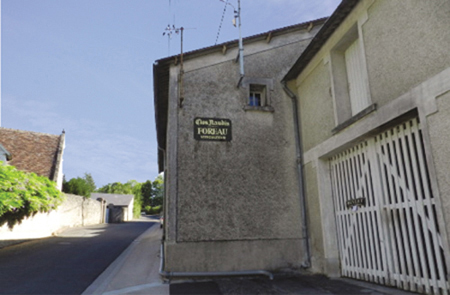
I started my week in the Loire to update the Guide to the Loire for next year’s edition with visits to two top producers in Vouvray, located on the same street just out of the town. Domaine Huet (the accent was removed from Huët after the Hwang family took over from the founding family in 2003) is the flagship domain of Vouvray. Domaine du Clos Naudin, now in the fourth generation of the Foreau family under Vincent, who took over in 2017, is a bit smaller (12 ha versus 30 ha).

Similarities of approach are more evident than differences. Domaine Huet owns three vineyards on different terroirs, Le Haut Lieu (the origin of the estate with clay soil over the tufa rock), Le Mont (perruches), and Clos du Bourg (very shallow soil directly on tufa). Cuvées are made separately from each, at each sweetness level (Sec, Demi Sec, Moelleux, Liquoreux), giving 12 possible still wines. Clos Naudin’s vineyards are all on the famous perruches soils (greenish clay containing large flinty pebbles). “Because our soils are all similar, we don’t produce single vineyard wines,” Vincent Foreau explains, so there are (up to) 4 cuvées of still wines each year.

Domaine Huet has tasting room at the end of the courtyard

The domains have old, cold cellars coated in black mold, lined with empty barriques at this time of year. “For dry wines élevage is always only 6 months because we consider that aging occurs in the bottle. It takes around 10 years,” says Johan Le Calonnec at Domaine Huet. Vincent Foreau explained the practical problems in keeping the barriques empty for six months until the next harvest. They are all old, of course. “We buy three barriques a year,” Vincent says. This amounts to about 3% new oak.

Tasting at Domaine du Clos Naudin is in the old cellars

Both domains are among the holdouts still harvesting by hand. “95% of Vouvray is machine-harvested, there are only 6 producers out of 151 who are committed to manual harvesting,” Johan says. “Chenin Blanc is a very specific variety; you can see adjacent vines at quite different stages of maturity. If you harvest vines where some are below maturity and some are above maturity, you will never achieve equilibrium. Manual harvest is crucial,” says Vincent Foreau.

Neither domain has any fixed objective with regards to the proportions of dry versus sweet wines. Winemaker Jean-Bernard Berthomé, when he retired from Domaine Huet in 2019, said, “In 40 years I have never made the same wine.” At Clos Naudin, Vincent Foreau says, “We don’t have a fixed objective for style. I will give you two extreme examples. 2013 was a very cold year and the wine was almost all dry. In 2003 or 2018 by contrast it was impossible to make dry wine, almost all the wine was sweet. There is no average for the ratio of dry to sweet.” Johan Le Calonnec  explains that, “ It’s the climate, especially the conditions in September,  that determines the proportion of dry and sweet wine.” That uncertainty extends to the style of moelleux sweet wines. “Usually the moelleux has 20% botrytis, but there is no objective to maintain a consistent style, every year is a new adventure.” Indeed, I tasted one moelleux with no botrytis and another vintage with 30% botrytis. Of course, variations in production create a problem for marketing. “Some buyers don’t understand why they can’t get a dry wine in some years. If sugar levels are too high we make sweet wine, we don’t want to make a dry wine at 14.5% alcohol,” Johan says.

There’s a common view of what constitutes dry wine. Both domains say Sec can be anything from 2g/l to 8 g/l of residual sugar. Now I’ve complained many times before about the derogation in European law that allows a wine to be called dry when it has more than 4g/l residual sugar (the level below which all wines are unambiguously dry) so long as acidity is high enough. Chenin Blanc typically has such high acidity that this can often be applicable. The unpredictability of whether a Sec Vouvray will in fact taste dry has put me off ordering it in restaurants, for example. However, on this visit I tasted very few wines where I could detect sweetness, even when the residual sugar was above the magic 4g/l limit. Usually the only giveaway was a certain softening of the texture.

The criterion in deciding how much sugar to leave is a matter of balancing the acidity. When you quiz producers or sommeliers in the region as to whether a wine is dry, the usual euphemism has been to say, “Well, it’s fruity,” but this recent tasting makes me feel more confident that Sec on the label is likely to mean a wine tastes dry, at least from the producers I visited.

In the past, I’ve found most interest in the wines at both ends of the spectrum, dry and liquoreux, with the demi-sec losing the typicity of dry wines, and the moelleux not fully showing the typicity of sweet wines. On this visit, both demi-sec and moelleux seemed better balanced, offering subtle variations of the typicity of Chenin Blanc, going from acidity supporting a savory fruit spectrum in dry wines, to white stone fruits in sweet wines, and (of course) honey and nuts in botrytized wines. Although wines at all sweetness levels can be enjoyed on release, people are familiar with the idea that sweet wines can age very long, I’m inclined to the view that it is just as important, perhaps even more so, to hold the dry wines. Most really come out after 5 or 6 years and don’t begin to peak until 10 years.

Tasting at Clos Naudin, vintages of Sec from 2021 to 2006 varied from 3g to 8g residual sugar. It wasn’t always always obvious which wines had the most residual sugar. A savory thread runs from recent to older vintages, segueing into tertiary notes after more than a decade. The demi-sec shows a rare delicacy for this sweetness level. Tasting moelleux vintages a decade apart, purity changes to truffles as the wine ages. Liquoreux varies from based exclusively on triage in 2020 (greater purity) to extensive botrytis in 2020 (viscous and honeyed). The Première Trie from 1989 (a fully botrytized cuvée) could challenge any top Sauternes.

At Domaine Huet, the tasting was more about comparing the different plots. At each level, Le Haut Lieu shows its freshness first. This can appear austere in the dry wine. There are rounder, deeper, impressions to Le Mont and Clos du Bourg. Clos du Bourg always has the most evident complexity, and I suspect the gap with the other cuvées may widen as the wines age.

Clos Naudin Tasting Notes

2021 Sec
Quite appley on the nose, perhaps still a touch reduced. Very acid, very linear, with a hint of that sour character that can make the finish on Chenin Blanc. There’s a lot of underlying flavor variety that needs some time to come out. It is quite dry. When would this be ready? “It’s perfect right now, but it will hold for ten years.”   88 Drink 2024-2032

2020 Sec
“This has lost a bit of fruit since its first youth,” Vincent said. Still it shows a ripe fruity impression tending to pears on the nose. The palate shows the pressing acidity of Chenin Blanc, but has that richness showing as pears. There’s lots of flavor with the promise of variety to develop. 5.0g   90 Drink -2032

2019 Sec
“Now for a different one with malolactic fermentation,” Vincent says. The cold conditions of the year and the late harvest show in a faint touch of green apples, followed by some quasi-savory impressions. The sugar barely shows as sweetness, more really as increased texture on the palate. Even so, there is less obvious typicity than in drier vintages. “This has always been open, it never really closed up,” Vincent says. 6.0g   89 Drink –2028

2016 Sec
Nose is a little spicy with some notes of quince followed by some quasi-savory notes. Sugar is not at all noticeable, in fact this shows less sweetness than some vintages with lower degrees of residual sugar, although after a while in the glass you can sense it on the texture. Nose is beginning to evolve, giving an impression of some tertiary notes in the background. 8.0g   90 Drink -2027

2006 Sec
Developed nose shows some tertiary impressions. Palate shows some savory impressions, moving towards truffles, but cut by an underlying sense of richness. Flavor variety takes some time to come out in the glass, but is quite full as it opens. 3.0g   90 Drink -2028

2016 Demi sec
Nose is much fuller than the Sec, developing towards apricots with hints of more exotic fruits, including some lychees as it moves in a tertiary direction. Sweetness shows on the finish but seems less than the actual level of residual sugar, feeling more like the German halbtrocken. That sense of lychees accentuates in the glass. 20.0g   90 Drink -2027

2015 Demi sec
Nose is less developed than 2016, palate gives an impression of greater purity, you might say more delicate, with some hints of sweet/sour balance. Perhaps the sweetness is just a touch more evident than in 2016. Lovely balance for demi sec with very long aging potential. 23.0g   91 Drink -2032

2018 Moelleux
“For us this is a Petit Moelleux,” Vincent says, referring to the moderate level of residual sugar. Nose and palate show lovely purity of fruits, followed by a transition to show some truffles in the background. Apricots and peaches come out on the palate, with the high acidity maintaining freshness. There’s a great sense of delicacy and precision for moelleux; the wine has not really developed much yet, but it has a long way to go. 60.0g   92 Drink -2034

2009 Moelleux
Light golden color. Quite an evolved nose with tertiary notes running to truffles coming through, giving a very complex impression. Palate shows viscosity with a hint of honey. The sweetness is obvious but very well cut by refreshing acidity. 45.0g   93 Drink -2030

2020 Liquoreux
Extensive botrytis in this wine, making the nose more forceful than the 2018, with a sense of confiture of apricots and prunes (Vincent also sees red fruits). The palate is viscous and honeyed, with notes of caramel, marmalade, and bitter oranges – it’s hard to grab it all. Seems very young with much development to come. 145.0g   94 Drink –2040

2018 Liquoreux
There was no botrytis this year, it’s all triage. Nose is more subtle than the Moelleux. Very sweet on palate, especially as acidity is not so pressing, but good sense of fruit purity, showing as apricots and peaches, with just some faint tertiary hints, and a faint impression of bananas. I wonder if and when this will mature in a tertiary direction? 145.0g   92 Drink –2037

Premiere Trie 1989 
Golden marmalade color. Evolved botrytized nose with some faint hints of truffles is very complex. Spicy on the palate, showing confiture of fruits and notes of dates, complexity lives up to promise of nose, with sweetness very well balanced by savory acidity. Very long finish. Classic botrytized cuvee very much showing the typicity of Chenin Blanc at this sweetness level. 210.0g   95 Drink –2037

Domaine Huet Tasting Notes

Le Haut Lieu sec, 2021

Austere impression to nose, with some typical savory impressions of Chenin Blanc. Quite a tang to the finish.   13.0%  89 Drink 2024-2032.

Clos du Bourg sec, 2021

A touch more fruit showing on the nose than Haut Lieu, a rounder impression on the palate with fruits poking through the acidity. There’s a sense here of flavor variety waiting to evolve.   13.5%  89 Drink now-2032.

Le Haut Lieu sec, 2019

Dry impression to nose with a faint suggestion of tobacco. Quite dry on palate with savory impressions, almost a sense of umami. Flavor variety slowly beginning to poke out.    89 Drink now-2032.

Le Haut Lieu, demi-sec, 2020

There was no dry wine this year, berries for the demi sec Haut Lieu were the first to be harvested. Muted nose, sweetness is nicely integrated with the fruits on the palate, ranging from citrus to apricots. Softens a bit in the glass.   13.5%  19g 89 Drink now-2030.

Clos du Bourg, demi-sec, 2020

From the plot planted in 1985. Muted nose. Not any sweeter than Haut Lieu but deeper. Slightly nutty overlay on finish compares with the greater freshness of Haut Lieu. Palate here tends more towards apricots than the citrus of Haut Lieu. The gap between the cuvees may widen as the Clos du Bourg develops.   13.5%  20g 91 Drink now-2032.

Le Mont moelleux, 2010

More of a meld of citrus with chocolate than the clear citrus of Haut Lieu on the nose, sweetness just a touch more evident, that chocolate coating showing on palate. The sense of concentration on the palate outranks Haut Lieu, with fruits turning towards a white fruit spectrum. A touch of bitterness shows at the end.   13.0%  49g 91 Drink now-2032.

Clos du Bourg moelleux, 2001

Medium gold color shows age. Faint sense of truffles is creeping in, acidity is high, and this tastes distinctly less sweet than a wine from a warm year. The sense of truffles continues through the palate to the finish. This is a good result for a difficult year (there was rain at harvest), but it does not show the overtly delicious character you expect from Moelleux.   12.0%  42g 89 Drink now-2028.

Le Haut Lieu première trie, 2003

There was no botrytis this year. Light-medium golden color. Faint truffles on nose. Sweet on palate with the truffles bringing a counterbalance that adds complexity. Palate shows fruits of apricots and sweet citrus with a faint touch of bitterness at end on long finish.    85g 91 Drink now-2028.

Le Mont première trie, 2005

There was 30% botrytis this year. Light-medium gold color. Nose is quite developed, redolent with truffles, balancing the apricot fruits dominating the finish. Palate has intriguing meld of apricot and other stone fruits against truffles melding into tobacco,   13.0%  78g 93 Drink now-2028.

Mosel Diary: Something Completely Different at Dr. Loosen

You can’t say the Loosen Reserve wines are something new, because as Ernie Loosen describes them, “We are concentrating more on reserve wines, as my great great grandfather did, wines that age for 6 or 8 years. We’ve done a lot of experiments on aging. We ferment and then keep the wine in the barrel as they did in the old days. They had to do it like this, because they had no technology, filtering, fining etc. We discovered that if you do it the old way the wines come together more naturally and seem to have much more ageability.”

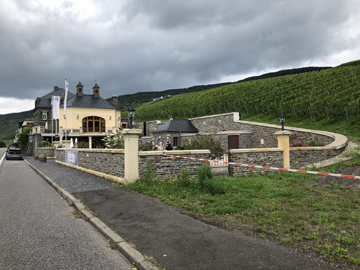
Dr Loosen’s new vinotek three years to build besides the old building

The Reserves come only from the best lieu-dits in grand cru (Grosse Lage) vineyards. They spend two years in barrel (the barrels are topped up every month) and three in bottle before release. (There have also been wines that have aged much longer in barrel.) Production is 200 cases each of Sonnenuhr and Würzgarten, just over half that for Prälat.

The special character of these wines is due not only to the aging process, but also to selection in the vineyard. “They are specifically selected only from the millerandaged fruit (with very small seedless berries resulting from incomplete fertilization); the normal berries go into the Grosses Gewächs.”

The extended aging shows another side of  Riesling. Ernie describes it as a more Burgundian style, and indeed it is intense and deep and textured rather than light and racy. We tasted the three current releases, the 2015 vintage (released (May 1 this year).

Wehlener Sonnenuhr (Im Laychen) shows a sense of austerity compared to the regular release. There is not only more intensity to the palate but also more counterpoise or herbal notes against the fruits with herbal notes. A greater sense of texture to the palate, makes this really deep. Acidity and sugar are integrated to the point that it seems dry.

Ürziger Würtzgarten (Unterst Pichter) is  restrained on the nose. The palate intensifies the spicy herbal impression of Würtzgarten, especially evident on the finish, and the deeply textured palate gives impression of austerity. Beautifully integrated acidity and sugar to point that I would take it for dry in blind tasting.

Erdener Prälat (Alte Reben) comes from 120-year old ungrafted vines. This is intense, a little spicy, very textured, all stone fruits here, really showing mostly as peaches, but the fruits are into the secondary phase showing some maturity. The palate is cut by the sense of austerity on the finish. It can only deepen and strengthen.

Stefan Doktor at Schloss Johannisberg has had a similar idea. “I had a crazy idea and said, what would happen if we aged the wine like they used to a hundred years ago,” he says.  “Riesling aged in wood for a long time expresses itself in a new way.” The Gold Label was introduced last year with the 2017 vintage. It ferments in 1,200 liter fuder and ages for 6 months on the full lees, then racking to age on fine lees for another 24 months.”

This may be the forerunner of a movement to age Riesling longer. The Rheingau VDP has just decided to require Grosses Gewächs to age one year longer before release. The 2020 vintage is the last that can be released on September 1 in the year following the vintage. Future vintages will have to wait a further 12 months before release. However, the regulation does not require any particular model for aging: the wine could rest in barrel or tank for the extra year or could be bottled at the same time as before and just wait out the delay. Even in the latter case, this is likely to mean a change in appreciation as Grosses Gewächs can be really restrained and backward on release, and a year’s extra aging in bottle usually makes a significant difference to approachability.

Mosel Diary: The Terrassen of the Upper Mosel

My first impression of  Heymann-Löwenstein was dominated by the striking new cellar, a  cuboid contemporary building, covered by a skin that has a poem by Neruda (The Ode to Wine, translated into German, and running in stainless steel letters across the front). Next to it is the old house, built in 1899, with cellars underneath. (Actually it was originally occupied by negociants, who used the cellars to age wine that they had purchased; it became a full winery when Heymann-Löwenstein moved there in the nineties.) I asked Sarah Löwenstein whether the contrast between the buildings was some sort of statement, but she explained that because the old house is a listed building, when they got permission for the extension in 2013, the town required them to build it in a modern style.

The new winery space is a contemporary cube adjacent to the old building.

Her parents established the winery.  “They were not happy with the way wine was made in the area and took the iconoclastic approach of vinifying separate vineyards. They started with stainless steel because it doesn’t have a large influence on taste so they could see the characteristics of individual vineyards.” In 1992 they started to use natural fermentation. “It was revolutionary then, it was like playing with the devil,” Sarah says. “In 1999 they decided the wines were too reductive and too tight and they bought the first wood cask. Then they added another cask every year. All come from oak trees grown on slate, but sources vary from Germany to Czechoslovakia.”

“Natural fermentation was tricky at first and we had some stopped fermentations. My father worried about how he could get more energy to motivate the yeast. Because cows make better music when you play them Mozart, he wondered whether yeast would respond and he installed organ pipes at the end of the cellar: they make sound when the wind blows. Sound is the sign of control by Apollo, so there is also a constant flow of water along the floor (Dionysus represents uncontrolled).”

The unusual feature here is that almost all the vineyards on the Terrassen. “My parents had no money to buy a tractor so they had to buy the terraces, which no one else wanted. So we are a bit different, we don’t have the entry-level vineyards, we are lucky to have so many high quality vineyards.”

Schieferterrassen is the relatively (entry-level) wine, from slate terraces (mix of different colors but soils all the same age), a blend from about 10 parcels, always the same, plus some declassified lots from the grand crus. Sarah describes it as premier cru level. “The work is the same as in the grand cru vineyards.” The front label doesn’t mention trocken or even Riesling. “The details, that it’s dry or Riesling, are not important for me, what’s important is the wine.”

There’s a grand series of 6 Grosses Gewächs, with the heart in Ühlen, an amphitheater round the river with three parts, each with different terroir. Blaufüsser Lay at the north is blue slate. Lauben is the middle section, with chalky aspects due to a lot of fossils in the slate, which gives higher pH to the soil. Ühlen Roth Lay is at the south, with hard red slate.

“After fermentation I like to keep the wine on the full lees,” Sarah says. “I sulfur then to stop MLF unless acidity is so high that I don’t need it. The wine stays until March or May and then is racked on to the fine lees until it’s filtered and battled in July.” The three Uhlens spend one year longer aging (with 3 months on full lees followed by 9 months on fine lees). The first to do this was Ühlen Roth Lay, the other two are making the transition  as of 2020 – which means they’ll be off the market for a year. “It would be great for all our wines to age longer but it’s not practical.” Sugar levels are low in GG but not below bone dry (4g), but sweetness is not usually directly perceptible, it’s more evident by a roundness that softens the finish.

Many producers have switched to screwcaps for at least the basic wines. The Löwensteins did experiments and decided that that they could not see any adverse effects; “the variation between cork and screw cap is within the range of individual bottle variation for either,” Sarah says. “We switched to screwcaps in 2009, now everything except just a few wines is under screw cap.”  We tried a 2012; it was aging beautifully, in fact I would say in oxidative style (blind I would have assumed it was under cork).

The dry wines are great demonstrations of terroir, and the sweet wines move to botrytis with the Auslese. Grapes are sorted in both vineyard and winery. “I don’t want botrytis in my dry wines.” Botrytized grapes go into the Auslese (occasionally BA or TBA). “Recent years have been 100% botrytis for the Auslese – that’s what I prefer. It’s botrytis but it has to be healthy – I don’t like a fungal smell. The refreshing quality even in the BA and TBA is very important for me.”

Tasting Notes on Grosses Gewächs 2019 vintage

Kirchberg (Hatzenport)

Red slate and quartz. Sense of restrained power, not quite austerity, stone and citrus fruits on palate with balanced acidity and citrus lingering on stony finish. A touch of softness suggests some residual sugar, although actually it’s marginal. 90 drink-2028

Stolzenberg (Hatzenport)

More of a yellow slate. A slightly softer impression to the nose with a faint hint of spice that follows through to palate. A more mineral impression to the palate, with quite a stony, almost austere finish. 90 drink-2028

Röttgen (Winningen)

Blue slate vineyard. Nice tension, faint sense of spice, balanced acidity with racy edge. Some peaches as well as citrus on the palate, peachy edge to the finish. It’s only just not quite dry, more as a sense of roundness on mouthful than overt sweetness. Relatively forward and more expressive than the two crus from Hatzenport. 91 drink-2029

Ühlen Blaufüsserlay (Winningen)

Hard blue slate. Real sense of tension to nose follows to palate. Citrus palate shows flavor variety (this is all citric compared with the tinge of stone fruits in Röttgen) and there is an austere minerality on the finish, more linear,  ending with a touch of bitter lemon. Very flavorful. 92 drink-2030

Ühlen Laubach (Winningen)

Slate with fossils. Subtle mineral impression to nose. More linear impression than Blaufüsserlay. Racy impression to palate with lot of tension, although acidity is balanced. Might describe the acidity as edgy. Palate is restrained citrus with some bare hints of bitter lemon. Sarah describes it as a bit wilder. 92 drink-2031

Ühlen Roth Lay (Winningen)

Hard deep colored red slate. Aged a year longer, so this is due to be released in September. Deeper color. Getting away from racy Riesling to a deeper more textured palate. Stone fruits mingle with citrus, supported by balanced acidity. No impressions of sweetness at all (although tech specs are same as other GGs). Very textured impression to long finish. You could describe it as earthy. 93 drink-2033.

Tasting Notes on Grosses Gewächs 2020 Vintage (from VDP Preview tasting in Wiesbaden)

Kirchberg
Nose is quite different from the Winningen GGs, more driven towards minerality, and the palate is more herbal. Nice complexity developing already, this is relatively approachable. There is just a suspicion of residual sugar on the finish. 90, drink-2029
Stolzenberg
A slightly more granular texture than Kirchberg, a slightly rounder impression on the palate with more sense of stone fruits than citrus and a hint of spice adding complexity, 91, drink-2030
Röttgen
Faint sense of spice to nicely rounded fruits on palate, although residual sugar is less obvious than Kirchberg,  showing stone as well as citrus, with impression of white fruits at end. A very fine complex expression,  quite close in style to Ühlen Blausfusser Lay. 91 drink-2030
Ühlen Blaufüßer Lay
Lovely sense of texture with hints of spice, more advanced than Laubach, not as spicy as Roth Lay, stone fruits ending in citrus on palate, already showing a sense of complexity. 91, drink-2030
Ühlen Laubach
Acidity with a lemony edge, flavor variety developing on palate broadens citrus flavors beyond the nose, quite a silky texture, just a suspicion of residual sugar to soften and round out the palate. I would wait a few months to let flavor variety round out further. 90, drink-2030
Ühlen Roth Lay
Palate broadens from Ühlen Laubach with a sense of spice in the direct of cinnamon, stone fruits as well as citrus, very attractive and immediately approachable. More sense of complexity than Ühlen Laubach. 92, drink-2030

Saar Diary: An Impressive Tasting at von Hövel

“My philosophy is to produce wines that are authentic and show the Saar region; you think it’s just the southern part of the Mosel, but that’s wrong, the elevation here is 200m, most vineyards are on the Devonian slate, there is also some volcanic rock, we are surrounded by the mountains,” says Max von Kunow as we begin a marathon tasting at Weingut von Hövel.

“Wine has been made here for 1400 years, and my family has owned the estate since the early nineteenth century,” he says. The range is extensive, from entry-level dry wines to the top Grosses Gewächs, and for the full extent of sweet wines from the Prädikat range. When I ask about the proportion of dry to sweet wine, Max says, “You have asked about sweet but we call the wine fruity. People especially in Germany taste Kabinett and say, ‘it’s sweet,’ I hate this: sweet is not what we produce. We produce 20% dry, 20% medium dry, and 60% fruity.”

The winery practices sustainable viticulture. “We don’t want our vineyard to look like a golf course, we want lots of flowers, it’s only when you have soil with a lot of life that you can produce good grapes. The important thing is to find the right moment to harvest, not too green, not too ripe. We use natural yeast but we are not dogmatic, if the wine needs yeast, we give it yeast.” All the Grosses Gewächs age in 1000 liter fuder.

Max took over from his father in 2011. Production today is 80% Riesling, The dry range starts with a Saar Riesling, and  then there are three village wines, Niedermenning, Krettnäch, and Oberemmel. After tasting these from the 2019 vintage (the current release here, while elsewhere it’s mostly 2020), we tasted younger and older vintages of the Grosses Gewächs from Hütte (in Oberemmel, a monopole that is the estate’s largest vineyard with 5.5 ha) and Scharzhofberg (one of the most famous vineyards in the region). The same herbal character runs through all the Scharzhofberg vintages and really beings complexity as a contrast to the fruits. Hütte seems tighter and more saline.

All the Grosses Gewächs really do  taste dry or very close to it (as opposed to the slight touch of perceptible sweetness found at many houses which take advantage of the derogation allowing up to 9g/l residual sugar if acidity is high enough). The 2019s are relatively forward, 2017 is beginning to round out, and when you get back to 2015 or 2012, flavors really begin to come out. You see what Max means when he says, “The problem with our wines is that they all need time. We produce wines for long ageing. The first few years the wines show winemaking. Then after a few, 10 years or so, they really return to showing the terroir.”

Moving away from dry wines, the range starts with GL wines (having a couple of grams more sugar than the off-dry Halbtrocken category), and then the Prädikat range. Those herbal impressions in Scharzhofberg continue through the sweet wines to provide a delicious contrast with the fruits; Hütte shows a counterpoise of a slight austerity to offset the fruits. It’s a great range.

Tasting Notes for Rieslings

Niedermenning (trocken), 2019

The most mineral and most racy of the village wines, this really expresses the elegance of the Saar. Acidity is between balanced and crisp. Lots of iron in the soil. 89, drink-2026.

Krettnäch (trocken), 2019                                                                                                  

A light nose lads into a palate showing the racy acidity of the Saar. Light citric fruits on palate lead on to saline finish. Devon slate. 89, drink-2025.       

Oberemmel (trocken), 2019                                                                                    

Intensely herbal nose leads into spicy palette with peppery notes, backed by balanced acidity, showing citric notes on palate with hints of bitter lemon and lime. 88, drink-2026.

Hütte (Oberemmel), Spätlese trocken, 2008                                                                

Nose is only a little more developed than 2012 and shows subtle nutty, buttery hints. The racy acidity is there on the palate, which shows some tertiary notes: not tired yet, but there is a touch of sourness, and the wine is moving into a different, more tertiary flavor spectrum. 11%,  92, drink2022

Hütte (Oberemmel), GG, 2012                        

Nose shows some developed notes, not quite tertiary, but moving towards nutty and buttery. Although the racy acidity of the Saar shows on the finish, the palate has really softened, the fruits cut by a touch of bitter lemon on the finish. Delicious sweet/sour catch on finish, even though wine is quite dry. 12%, 92, drink-2025

Hütte (Oberemmel), GG, 2017                                                                  

The nose shows a little development with some roundness, but the palate is tighter than 2019, with citric notes including bitter lemon reinforcing an impression of salinity on the finish.. The racy acidity makes this seem close to bone dry. Coiled spring waiting to open, needs time to open, and should then become rather elegant. 11.5%, 92, drink 2022-2032

Hütte (Oberemmel), GG, 2019 Already there is some complexity here, with herbal notes to counterpoise fruits that some stone elements as well as citrus. Some residual sugar shows a softness on palate more than direct sweetness although there is just a catch of sugar at the end. Developing relatively quickly, but promising real complexity in a few years. 12%, 91, drink-2028

Scharzhofberg,  GG, 2019  

Faintly herbal nose, already developing some flavor variety (this seems to be a more quickly developing year). You can just detect that sugar is above 4g. Overlay of savory herbs adds complexity, relatively soft and round for GG in the Saar. This is a forward vintage, 12.5%, 91, drink-2028.

Scharzhofberg,  GG, 2018  

More austere impression to nose than 2019, some sweet and savory herbs contrast with salinity on the palate, which is already showing complexity. There are beautiful contrasts here, 12.5%, 92, drink-2030.

Scharzhofberg,  GG, 2017  

This is tight and austere, reflecting the year, but already showing quite a bit of complexity with the typical herbal character of the vineyard coming through the austerity. It is readier to drink than Hütte. There are some faintly nutty notes in the background, 12.5%, 92, drink-2032.

Scharzhofberg,  GG, 2015  

Some development shows in some nutty buttery notes on the nose. Has really softened on the palate, there are some tertiary notes on the palate. This is the most complex of the flight. Delicious herbal versus fruit contrasts. This is à point, 11.5%, 93, drink-2030.

Saar,  GL (off-dry), 2020  

Light fragrant nose, just a touch of sweetness on the palate, pretty serviceable for category and price,  87, drink-2023.

Scharzhofberg,  GL, 2018  

Sweetness is quite evident and you no longer see the herbal character, but there’s a delicious sweet/sour catch at end,  88, drink-2024

Höreck,  GL, 2018  

Relatively complex for the category, with distinct herbal notes contrasting with the sweetness. This is the most concentrated of the off-dry category (yields only 10 hl/ha).  88, drink-2024.

Saar,  Kabinett, 2020  

Faint spicy herbal notes on nose, hints of sweet/sour on finish, quite good flavor variety for a generic level. 8%, 88, drink-2025.

Hütte,  Kabinett, 2018  

Some austere herbal notes to nose. Sweetness is an elegant overlay, citric fruits meld into peaches and apricots, a little on the weighty side for the Saar. 7.5%, 90, drink-2028.

Hütte,  Kabinett, 2019  

Austere and drier compared with the 2018, unlike the dry wines where 2019 was the most forward, this is the most backward. Lovely contrasts of herbs and fruits, promising complexity to come. 10%, 91, drink-2032.

Scharzhofberg,  Kabinett, 2019  

Faint herbal impressions lend a note of austerity to the first impression. The herbal character is a lovely contrast to the fruits and the sweetness, really bringing complexity to the Kabinett level. This is more forward and a lot more complex than Hütte. Lovely texture to the palate.  93, drink-2032.

Scharzhofberg,  Kabinett, 2020  

Faint cereal impressions to nose, more straightforward on palate then 2019, more of a standard Kabinett.  89, drink-2028.

Saar,  Kabinett Lilly, 2018  

Complex herbal and nutty notes offset the fruits and the sweetness is quite elegant in the background, Plate is quite textured,  91, drink-2030.

Saar,  Kabinett S, 2020  

More overtly sweet although it comes from the same source as Lilly, here the sweetness dominates the palate.  89, drink-2026.

Hütte,  Spätlese, 2018  

Faintly austere herbal notes on nose. Sweeter and richer than the Kabinett, deeper fruits, peaches and apricots with citrus more in background, delicious sweet/sour catch on finish.  91, drink-2031.

Rheingau Diary: Sampling the Last 100 Years at 50-Year Intervals

It is not every day that I get to drink both 50-year-old wine and 100-year-old wine. And no, I did not spit: I enjoyed these wines to the full.

“This is an old wine,” Wilhelm Weil says as he pours the glasses without showing us the label, as we follow a tasting through the 2020 vintage at Weingut Robert Weil with something completely different.

The wine is a dark caramel color and looks and smells sweet with a very mature nose showing honey, figs, caramel, and all the signs of intense botrytis. But it tastes almost dry.

It’s a Cabinet (with a C not a K). “Cabinet was the idea of dry wine in the early part of the twentieth century,”  Wilhelm says.  “I don’t know exactly, but there was a different view of dry wine then, and I would expect it had about 20g residual sugar.”

The 1921 Kiedricher Berg concluded a tasting of the 2020 vintage in the Robert Weil tasting room.

I’m sure that it must predate the second world war, and I’m thinking it might be 1937 or 1934 when Wilhelm shows us the label: it is 1921, perhaps the greatest year of the twentieth century. We celebrated its one hundred anniversary.

Botrytized notes dominate the palate, but without the kick of sweetness you usually get with a botrytized wine. It’s quite buttery, with the dryness letting some herbal impressions come through,  still lively, and wonderfully elegant.

We then went to dinner with Peter Winter of Siftung Georg Müller. After several current wines, we finished up with the 1971 Hattenheimer Wisselbrunnen Auslese.

It is now a medium caramel color. The restrained nose shows botrytis, following to a palate which is honeyed, figgy, buttery, with notes of caramel. The palate is now just off-dry. The wine has moved to an almost savory overall impression on the palate with age, but acidity still keeps it lively.

Peter says that not every bottle is this good, and that accords with my own experience of a 1971 Schloss Vollrads Spätlese, where I have been drinking one bottle from a case in my cellar every few years. (I have one bottle left.) There have been some real ups and downs, but the last bottle, a few years ago, was almost dry and quite savory, and contrary to all expectations, the best yet.

Based on the extensive statistical sample of these three instances, my rule of three is that an off-dry wine will taste bone dry after 50 years, a sweet wine at Spätlese level will taste almost dry, and an Auslese will taste off-dry.

This reinforces my view that if you find German wines to be a little sweet at any level (from nominally dry Grosses Gewächs to rather sweet Auslese) just wait a few years for the sweetness to lessen. Of course, it may not be practical to wait 50 or 100 years, but even after 10 years there is some reduction in sweetness, and after 20 years it can be quite substantial.

A certain absence of information on the subject leaves room for much misunderstanding. When I was discussing Grosses Gewächs last week with a sommelier in the Mosel, he advocated a younger vintage on the grounds that “it has more acidity, older vintages lose acidity”. Oh dear. In fact, hydrogen ions (i.e. acidity) have nowhere to go, and acidity does not change much as wine ages. Sweetness on the other hand really declines. The basis for the reduction in sweetness is quite unknown, but the best suggestion I have seen is that sugars might polymerize like tannins and lose sweetness as a result. I wish someone would investigate this scientifically.

Napa Diary Day 18: A European Aesthetic at Kapcsándy

Discretion starts right at the front door. The property is identified only by a street number, and a small notice saying, ‘this is not Goosecrest cellars.’ Under the name of State Lane Vineyard, it was originally a family farm providing wine to Beringer for the Private Reserve from 1975 to 1991. The vineyard became infected with phylloxera, and the owners decided to sell; Lou Kapcsándy, a passionate collector of Bordeaux, purchased the estate in 2000. The property is a single block of 20 acres, with the Yountville Cross Road and Napa River as borders. The 15 acres planted with vines are divided into 15 blocks with different soil types. The first wine was made in 2003 and the first commercial release was 2005.

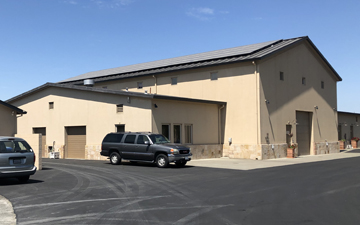
The winery is surrounded by vineyards between Yountville Cross Road and the Napa River.

The wines are all based on Bordeaux varieties, except for the one white, a Furmint based on vines that came from Tokaj, a hommage to Lou’s origins (he left Hungary in 1956). Each of the four reds has a core block as its main source, and other sources vary with the year. The Estate Cuvée has been a blend since 2005 (two vintages were 100% Cabernet Sauvignon). “This is the representation of the estate.” The first vintage of Rhapszodia was 2010. It started as a 50:50 blend of Merlot and Cabernet Franc, and then the Merlot was steadily reduced until it effectively became a Cabernet Franc varietal in 2015. Roberta’s Reserve is usually a blend, but has sometimes been 100% Merlot, coming from blocks along the river where there is more clay. The Grand Vin is the top Cabernet Sauvignon.

The house style is quite reserved. Each of the cuvées shows the characteristic flavor spectrum of its principal (or sole) varietal with its supporting structure almost imperceptibly integrated. Cabernet Franc shows purity, Merlot shows more roundness, Cabernet Sauvignon is structured. Each is a textbook for its type, within the context of the power of Napa. All could be drunk not too long after release, but will benefit from some time to develop.

Tasting Notes

2017 Estate Cuvee Cabernet Sauvignon (Cabernet Sauvignon 89%, Merlot 8%, Petit Verdot 3%)
Quite reserved aromatics on the black fruit nose, quite a stern impression on the palate, with a slightly crisp edge and a touch of asperity, not quite bitterness, on the finish. Blackberry fruits dominate the palate with a touch of asperity, and you see the freshness, even a touch of salinity. All this gives the impression of a broader-based blend than it really is. 14.2%    90 Drink 2022-2034
2015 Rhapszodia Cabernet Franc
Reserved nose is still rather dumb. Nice purity of fruits, makes an unusually elegant impression for Napa Valley, with well-delineated black fruits of ripe Cabernet Franc. Silky tannins are barely evident on finish, perhaps there is a very faint hint of tobacco, before the tannins kick in to show some bitter chocolate and dryness at the end. The palate is moving towards minerality with some cooler-climate impressions. You could drink this now but personally I would wait a year or two. 14.4%    2 Drink -2033
2014 Roberta’s Reserve Merlot (Merlot 97%, Cabernet Franc 3%)
Greater roundness to the nose than in the Cabernet Sauvignon or Cabernet Franc cuvees, slowly releasing black fruit aromatics. Smooth palate shows some flavor variety in what is certainly a reserved style for Merlot; in fact, you might say the house reserve is coming through. Nice sense of delineation to the fruits, although the palate is broader than the Cabernet Franc of Rhapszodia. Tannins are supple on the finish, and you can see the structural support, although there’s no overt bitterness. This is an unusually pure impression of Merlot. 14.4%    92 Drink -2034

2014 Grand Vin Cabernet Sauvignon (Cabernet Sauvignon 95%, Merlot 5%)
Quite reserved nose shows hints of blackberries. Sweeter and riper impressions than the Merlot or Cabernet Franc varietals, overall more forthcoming. Black fruits are cut by almost crisp acidity. The structure is well integrated, tannins are firm but not obvious, with just a faint touch of bitter chocolate on the finish. This needs time, not so much for tannins to resolve but to let flavor variety develop. 13.9%    94 Drink -2040