Visit to Dão: Quinta dos Carvalhais

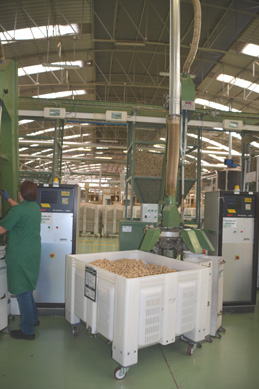
Portugal’s largest wine company, Sogrape, started in the Dão in 1957 by buying grapes, but bought the Quinta dos Carvalhais only in 1987, with the first vintage in 1990. Today this is a vast enterprise, really two wineries, one for making 300,000 bottles annually from Quinta dos Carvalhais’s 50 hectares, the other for producing 2 million bottles of entry level wine from other sources. I met with Beatriz Almeida, who started with Sogrape in 2007, and has been making all the wines at Carvalhais since 2012.

Cavarlhais2The modern winery

Beatriz is convinced by the merits of blending. “We did a study of soils and found five soil types, so when we make a varietal wine, we blend from all five terroirs and get more complexity,” Beatriz says. She takes the logic further. “If you accept that blending varieties and blending sources makes more complex wine, why should you reject blending of vintages?” This resulted in the Especialidada wine, which came from blending lots of individual varieties that had been originally kept for experimental purposes.

“The varieties are the same but the wines are completely different from the Douro; the terroir of the Dão is quite different. It’s mostly granite, but with some clay which gives higher water retention,” she says. Whites are about 25% of production (this is pretty standard for the Dão). The style of the wines is elegant and smooth, with a sort of silky edge to the finish of both reds and whites. The whites show minerality, reds a taut precision., showing why the Quinta is a leader in the move towards elegance in the Dão.

Reserva, Red, 2011

This is a roughly equal blend of Encruzado and Verdelho. Fermentation is in stainless steel and then the wine is transferred to old oak barriques to mature for three years. “It will keep for 20-30 years,” Beatriz says, “because after three years in barrel, it won’t oxidize any more.” Smoky sense of oak shows on nose, but is less obvious on palate, although there is a faint bitterness on the finish. Medium weight palate has real sense of smoothness, showing sweet, ripe, stone fruits with touch of lemon, and quite a silky impression at the end.

Especialidada, white, no vintage

This is an unusual wine which is a blend of vintages (in this case 2005 and 2006), all of which stayed in barrel until 2015. Oxidative style but not oxidized. It’s a deep color and shows some oak on the nose and honey on the palate. Lovely fresh fruit concentration, good weight of fruits, touch of bitterness at the end to counteract the honeyed impression. More herbal than savory. Resembles the Reserva in general style but more intense.

Reserva, Red, 2008

A taut linear precision of black fruits suggests a high proportion of Touriga Nacional. The style shows the elegance of the best wines of the Dao with well defined black fruit aromatics showcasing purity of fruit. There’s more tannic structure than is immediately apparent, not because it’s hidden by powerful fruits but because it’s exceedingly fine. Flavors are just coming out now.

Visit to Dão: Quinta dos Roques

Quinta dos Roques was a little difficult to find, as the GPS took us to the middle of a forest by a track that really needed 4-wheel drive, but when we called the Quinta, Luis Lourenço said that the GPS often does that, and he came to retrieve us. The quinta is quite a bit out of the nearest village and you’d be likely to feel you’ve gone wrong even on the right track. Once you arrive there’s a tasting room that showcases the elegance of the wines.

Roques1Quinta dos Roques

Luis is a lively and enquiring fellow, who’s always experimenting with his varieties and vineyards. He started out as a maths teacher and says it took him a while to adjust to wine. “In maths, 2 plus 2 always equals 4,” he says, “but in wine it never makes 4.” A tasting here is an education as you go through many of the varieties that go into the blends: “In terms of numbers there are more varietal wines, but in terms of bottles, it is mostly blends.”

The style here is in the direction of elegance rather than power, always showing well delineated fruits. The top whites and reds show a strong sense of minerality and age beautifully. Comparing a white varietal Encruzado of the current vintage with the 2001 shows an amazing evolution, and the red Quinta dos Roques of 2001 is still lively. The Garrafeira (the top quality classification in the Dão) of 2008 still seems quite youthful. These are definitely wines of character. Some favorites from the tasting:

Encruzado, 2014

Unlike the other white varieties, which see only stainless steel, this is split between half in stainless steel and half in new or 1-2-year oak. Really pale. Faint notes of vanillin and nuts on nose. Quite crisp acidity balances the oak impressions. The fruits are rather neutral and not really yet breaking through the oak (which is used to add flavor interest). Yet slowly more flavor variety emerges in the glass: this does take time

Encruzado, 2001

Huge contrast between intense flavors of this wine and the rather neutral character of the 2015 shows that variety develops in bottle, but quite slowly. Color has picked up from transparent in 2015 to medium gold after 15 years. There’s a mix of oak, spices, and savory elements on the nose, and a touch of honey, which becomes more distinct on the palate. This vintage had 100% new oak; you can still see the oak, but it’s balanced by lots of flavor variety in the fruits, with quite a bit of spice and honey. The palate is thicker and really intensifies in the glass over time, becoming savory and herbal and very complex.

Quinta dos Roques, 2013

This is about half Touriga Nacional and half other local varieties. It spends 12 months in oak, which shows as spice on the nose together with a sense of acidity. The oak conveys a touch of bitterness to the finish. Faint animal hints retronasally bring some complexity. Still a bit young, the fruits seem to be struggling to get out from under.

Quinta dos Roques, Reserva, 2013

This is a field blend from a single 38-year old vineyard. Very faint animal impressions bring complexity to nose. Complex black fruits on palate point in a mineral direction with savory overtones. Very nice balance of fruit to structure, which is present but not obtrusive. This should turn more savory with time and I expect it to age beautifully.


Visit to the Dão : Quinta da Pellada

On the edge of the village of Pinhanços, Quinta da Pellada is not easy to find, even when you have geographical coordinates and a GPS. Apparently the method of choice is to ask at the village pharmacy, which will provide aspirin for the headache of getting there, and will phone to inform the quinta of your arrival. Maria Castro collected us in the village square because we had not had the confidence to enter the premises to which the GPS took us, basically a rather old doorway into a courtyard off the main street without any sign of ownership. But through a somewhat rural courtyard is a winery to the left and a family house to the right. Quinta da Pellada has been in the family since the 16th century, but it was Alvaro Castro who brought it to its present eminence as a definitive influence on what Dão wines can achieve. Today he makes the wines together with his daughter Maria.

Quinta da Pellada has three vineyards, Pellada being used also for the name of the company, the others being Quinta de Saes and Oteiro. The vineyards are well out of town, accessed only by four wheel drive. At the center of the Pellada vineyard is the old house pictured on the quinta’s web site, which had been badly damaged, with the roof coming down, and has now been rebuilt. After a tour of the vineyards, we went to the winery and collected some wines from a storage area which takes the form of a long underground passage; at the other end of the passage, we emerged into the house. “My father trained as a civil engineer,” Maria explains.

Pallada8

The old house in the vineyard is being restored

It’s immediately obvious why the wines are regarded as a defining influence. The style shows perfumed herbs and spices of the garrigue, never heavy, always elegant rather than powerful. This shows through both reds and whites, with the latter tending to savory and mineral impressions. There’s a strong impression that you are really seeing the terroir reflected in the wines. Notes from the tasting:

Primus, 2014 (white)

This has 24 hours skin contact, barrel fermentation – “the barrels are getting older and older” – with battonage, and then bottled after two months. It’s a field blend from a vineyard of old vines with 19 different varieties. Restrained nose is somewhere between spicy and savory. The palate offers an impression of spice and the garrigue. Acidity is balanced. This has a lovely herbal freshness, and should mature well for mid term (say five years).

Alvaro Castro Reserva, 2011 (white)

This is Encruzado from the Outeiro vineyard. Quite a spicy nose, but in the house style there is a herbal touch giving a savory impression to the palate. Nicely rounded on the palate, with soft spices and herbs. This is a wine of the garrigue with a savory catch to the finish giving a sophisticated impression.

Quinta de Saes, Reserva, 2011

This is a field blend. It spends 3 years in barrels and then two years in bottle before release. Lovely acidity and hint of piquancy gives a fresh nose with suggestions of red fruits leading into a herbal sense of the garrigue. Filigree acidity supports a complex array of flavor. Elegant smooth red fruits on palate with silky tannins and some herbs and spices at the end, where there is a smoky impression retronasally. There’s a faint bitterness at the very end. This is ready but will develop in a more mineral direction with time.

Carrocel, 2011

“This is Touriga Nacional, from the old clone, which is naturally concentrated,” Maria explains. Spicy nose with some high toned herbal impressions. Very fine, most refined, here is all the precision and purity of the variety. Nicely delineated black fruits are slightly perfumed, , with some nutty overtones on the finish.

Quinta da Pellada, 2007

This is a mix between a field blend and Touriga Nacional and other varieties. Slightly spicy impression to nose. Softer and broader than the pure Touriga Nacional. Nice balance with soft black fruits, balanced acidity, a touch waxy on the finish. That sense of the garrigue comes through with perfume and spices at the end.

Tasting Colheitas from 1974 to 1941 in Porto

Sogevinus is a bit unusual as a holding company in Porto, as it is neither Portuguese-owned nor shows a British connection. Owned by a Spanish bank, it holds four Port houses, Kopke (which claims to be the oldest Port House), Calem, Burmester, and Barros. I visited at Calem, which has a prime position on the waterfront in Gaia, but we went next door to Kopke for quieter surroundings in which to taste a series of Colheita’s from the four houses.

CalemTastingHard at Work Tasting Colheitas in Porto

Each has its own style. “Barros is the easiest style, round and velvety, you don’t really feel the acidity,” says Tania Oliveira. “Kopke is always balanced and complex, Burmester is always elegant, more complex on the nose, the most feminine. Calem is more aggressive, more masculine, spicy with evident acidity.” She adds, “Calem is the number one in Portugal, which is a good representation of how Portuguese people like their Port.”

What is responsible for the differences? Sources are generally different. For Kopke and Barros grapes come mostly from Cima Corgo. Kopke is always a blend from low altitude vineyards (to give concentration) and high altitudes (to give freshness), but Barros comes from high altitude vineyards. Calem and Burmester are sourced more from the hotter and drier Douro Superior and always have a blend from different altitudes. There are also differences in grape varieties.

We tasted a range from Kopke’s 10- and 30-year white Ports (like aged Tawnies but a bit livelier due to the white grapes, to Coheita’s ranging from 1974 to older than I am. here are the standouts.

Kopke, White 30 year

Light caramel color. Nose is a little spirit and a little spicy. Not quite grapefruit, but citric impression to nose. This has a similar sweetness to the 10 year, but more depth and complexity, coffee and marmalade, with nice acidity giving lovely balance.

Burmester, Colheita, 1952

Dark caramel color but sill some rosy hues. The nose has what would locally be called a slightly chemical note – this begins to develop after about 45 years. A very fine delicate impression in the house style, justifying the description as feminine, with extremely refined texture. A delicious sweet/sour balance develops in the glass.

Kopke, Colheita, 1941

Dark caramel color. Much more subtle on nose and palate than 1957. Sweet, luscious, piquant, coffee, marmalade, great depth – yet it stays fresh. Lingering finish coats back palate with chocolate. This would have been a field blend, probably including white grapes, which may be why it has stayed so fresh.

Visit to Porto and Douro Day 5: Winding up at Quinta de la Rosa

Sophia Bergqvist’s great grandfather was a port shipper, and Quinta de la Rosa was given to her grandmother as a present in 1906. Financial difficulties caused the shipper to be sold in the thirties, but the family kept the quinta and sold the grapes to Sandeman. In 1988, when the laws for production of Port were liberalized, Sophia and her father decided to make their own Port. “We were one of the first to take advantage of the new regulations,” she says. “And then in the 1990s we were one of the first to into red table wine. The initial driving force was an excess of grapes that couldn’t be used for Port.” The red was sold as a house wine to Berry Bros. Today production is two thirds red wine to one third Port. Grapes are purchased (especially for entry level wines) to supplement sources. There’s now a guest house with 19 rooms attached to the winery.

RosaQuinta da la Rosa is nestled between the river and the vineyards

Sophia describes her aim for tables wines as “to maintain balance and equilibrium, not to over-extract. It’s terribly important to control acidity because otherwise we end up with Port-like dry wines. The style of the Douro is fruit-driven wines with the minerality we get from schist soils, using old oak and not new oak.” In Port, the style goes for precision, you might almost say tight, with a sense of mineral restraint to the finish. Here are my favorites:

Douro, La Rosa, 2012

A little spicy on the nose, perhaps more peppery really. Palate is still a little tight, with a mineral impression to the finish. Tannins are fine but still a little bitter on finish. Needs another year to let its precision show on palate.

Tawny 20-year

Nose shows both mineral influences and hints of raisins. Sweetness on palate blends with coffee and caramel, again with that sense of minerality coming back on finish. Very good balance.

LBV, 2011

Restrained nose with tight sense to black fruits. Sweet, tight and precise on the palate. A linear impression on the finish. Will broaden with time.

Visit to Douro and Porto Day 5: Quinta Vale D. Maria (at the top of the mountain)

During my week in the Douro, I met several producers who come from families long involved in Port, but whose companies or quintas have been sold or absorbed into larger companies during the ups and downs of production. Often they have started out again with a vineyard that was retained in the family. The Van Zellers owned Quinta da Noval until it was sold in 1993 as the result of problems in the family, and the eponymous production company, van Zellers, was sold with it. Cristiano van Zeller managed to buy back the name of van Zellers in 2006 when it had become more or less moribund, and this is now his negociant arm. Quinta Vale D. Maria has been in his wife Joana’s family for several hundred years, and had been leased to Symingtons until Cristiano obtained ownership in 1996.

Zeller3The winery finally hove into view

I admit to a loss of confidence that there would be a winery at the end of the road as I drove up the single track unpaved road that hugs the edge of the mountain, but there near the top was Cristiano waiting at the winery. Built into the hillside, it’s larger than it appears from the outside, and is stuffed with equipment, but Cristiano is hoping to build a new underground winery some time soon. There’s a mixture of granite lagares and stainless steel fermentation vats, but the plan is to replace the vats with more lagares as Cristiano feels this gives more subtle results in the wine. Production is focused on table wines, both white and red, but there is also a range of tawny and vintage Ports.

Zeller1The view from the winery

Wines under the van Zellers label include at least some purchased grapes, but the tendency is to depend more on sources within the estate. The wines of Quinta Vale D. Maria range from the entry level Rufo to single vineyard wines that highlight parts of the quinta. The one word I would use to describe the wines is sophisticated. Displaying silky textures, the whites have a definite trend towards minerality, especially when you go above entry level. The reds are elegant and silky with a lovely sense of precision to the black fruits on the palate. Although alcohol is high, it’s never evident on the palate. The style is subtle.

Several vintages of the eponymous wine, labeled just Quinta Vale D. Maria Douro, which comes from the center of the quinta, reinforced my impression that it’s a mistake to drink the red wines soon after release, because with an additional year or so, the aromatics really come to life. The single vineyard wines show the properties of different blends and locations, from Vinho de Francisca (named for Cristiano’s daughter who now works with him) to Vinho do Rio, which comes from the lowest altitude vineyards, close to the river, and offers the most dense impression of all.

The one word I would use to describe the wines is sophisticated. Displaying silky textures, the whites have a definite trend towards minerality, especially when you go above entry level. The reds are elegant and silky with a lovely sense of precision to the black fruits on the palate. Although alcohol is high, it’s never evident on the palate. The style is subtle. Some favorites are:

Quinta Vale D. Maria, Douro white, CV, 2015

This comes from a single vineyard of just less than a hectare at an altitude of 400-500 m. The vines are 80-90 years old, with a huge mix of varieties. Slight smoky spicy nose from oak. Smooth and silky on palate with mineral impression. Very fine and elegant.

Quinta Vale D. Maria, Douro, 2010

Slightly lifted black fruit aromatics on nose.Very fine, elegant ripe fruits fill a smooth palate with layers of black fruit flavors just coming out, supported by silky tannins on the finish. The main difference with younger vintages is not so much softening on the palate as the development of broader flavor variety.

Quinta Vale D. Maria, Douro, Vinho do Rio, 2014

This comes from the vineyard at the lowest altitude, by the river; it’s about 1 ha and has 29 grape varieties, although 47% is Tinta Barroca. The nose conveys a sense of density. Dense black fruits dominate the palate and are spicy on the finish, which shows velvety tannins. Quite reserved at this point, time is needed for the tannins to resolve to show the underlying smoothness of the palate.

Quinta Vale D. Maria, Port, Vintage 2009

Not so much sweet on the nose as slightly perfumed. Dark and sweet on palate but cut by lovely piquancy on finish, which is sweet with that touch of perfume coming back retronasally. Very good intensity.


Visit to Port and Douro Day 4: Tasting with Duorum

The Duorum project tries to make world-class wine in Portugal’s region from Alentejo to Vinho Verde. The winery and vineyards in the Douro were established in 2007 by João Portugal Ramos and José Maria Soares Franco, at Quinta Castelo Melhor in the Douro Superior (the hottest and driest part of the region, extending to the Spanish border). I wasn’t able to make it all the way to the end of the Douro, so José Maria Soares Franco very kindly stopped off at Pinhao on his way to a dinner in Porto so that we could taste the range.

José Maria was in charge of production at Sogrape (Portugal’s largest wine company) from 1978 to 2006 (his responsibilities included Barca Velha, the iconic red wine), so he has a very detailed knowledge of the region. Duorum is producing mostly table wine, but also some Port. The high level wines come only from estate grapes, but grapes are purchased for the entry level wines. “We use only indigenous varieties,” he says, “we think consumers will get tired of the similarities of wines made everywhere from Cabernet Sauvignon and Syrah.”

DuorThe arid area of the Douro Superior

It’s dry and hot in Douro Superior, so it might seem counter-intuitive to base table wine production there. “The most important tables wines at Sogrape came from Douro Superior, so I know the area well, and I know that conditions are more reliable. We can irrigate there (this requires an application to the authorities each year) and we harvest 2-3 weeks earlier. Keeping alcohol down is a good reason to go to Douro Superior. We think that more than 13.5% kills the aromas and quality of the wine, this is very important in our style.”

The range includes Tons (and entry level wine), Colheita (I was a bit surprised that this term is allowed for table wine as it is also used to describe a tawny port from a single vintage), a reserve, and O. Leucura (a play on words which loosely means astonishment, and is a top flight wine in the European tradition), and both LBV and vintage Ports. Robotic lagares are used for the initial maceration of all the wines; table wines are transferred to vats after three days. “We want to extract tannins in the absence of alcohol,” José Maria explains. Aside from the entry level wines, these are really wines that need some time to come around. Duorum would like to hold on to them longer before release, but “our agents are always asking for young wines.”

The Reserve gives a good impression of the potential of Douro Superior for making table wines with a signature character.

Douro, 2012, Reserve

The Reserve is produced with grapes only from the slope, that is, low altitudes, that give high ripeness. It is matured for 18 months with 70% new oak. There’s a concentration of blackberries and other black fruits on the nose with an impression of acidity. Palate is quite concentrated but tannins are gripping the finish, although quite chocolaty. Needs time.


Visit to Porto and Douro Day 4: Up the River to Quinta de Roriz – Tasting Chryseia

My visit to Taylor Fladgate in Port on Monday was followed by a visit to Quinta da Bomfim near Pinhao in the middle of the Douro region. Recently expanded by the purchase of neighboring vineyards which are now being reorganized, Quinta da Bomfim is the heart of Dow’s Port. We stayed overnight in the old family house in the middle of the property and next morning took a trip up the river with Rupert Symington in his boat to the Quinta de Roriz.

Douro1The view from the Douro approaching Quinta de Roriz

This is the center of Prats & Symington, founded by Rupert together with Bruno Prats on a shoestring to produce table wines in the Douro. Starting by purchasing grapes, it proved so successful that they bought their own vineyards, most notably Quinta de Roriz in 2009. The dilapidated buildings are being restored and extended and all the wines are now made here in what will become a modern winery. A team was furiously working at reshaping the land and planting new vineyards when we visited.

RorizSQuinta de Roriz before the work

Three wines come from Quinta de Roriz. The top wine, Chryseia, has rapidly become an icon, and the 2013 vintage shows what the Douro can do in the way of a wine that will compete in the international area. Post Scriptum (a clever name) is a second label, roughly an equal blend of lots that were matured in new oak but which weren’t ultimately used for Chryseia, and lots that were set aside at the outset to be matured in two year oak. “Post Scriptum is very much a second wine of Chryseia,” Rupert says, “we don’t say a lot will be one or the other until a final tasting.”

Roriz3

Laying out the new vineyards

Prazo de Roriz is a third wine based on the varieties that don’t make the cut for Post Scriptum and Chryseia, which are usually virtually exclusively Touriga Nacional and Touriga Franca, with around half of each. Touriga Nacional gives structure and breed, softened by Touriga Franca (“Touriga Franca is our Merlot,” Rupert says).

The objective with these wines is to get purity of expression. “It’s easy in the Douro to think that new oak will flatter your wine, but I think Douro wine is all about purity of fruit,” Rupert says. “There’s no Portiness. It would be easy to get lots of extraction and alcohol, but that’s not what we want.” Indeed, the wines are notable for their moderate alcohol (usually around 13.5% compared with typical levels for the region over 14%).

Chryseia, 2013

Dark inky color. More sense of fat and pluminess on nose than Post Scriptum. Lovely balance with elegant, well delineated black fruits giving a good sense of precision on palate, yet that sense of fat is poking through. The character is explained by the vintage, which was a difficult year that gave a much higher proportion of Touriga Nacional than usual. There’s a tang at the end a bit reminiscent of Côte Rôtie, although aromatics are more blackberry fruits and not as lifted as Syrah.


Visit to Porto and Douro Day 3: Afternoon at Quinta do Vallado

Francisco Ferreira is an enterprising fellow. Quinta do Vallado has belonged to his family for almost two centuries. It provided grapes for the family Port house, but was not included in the sale of Port Ferreira to Sogrape in 1987. Francisco has been building it up as an independent business since then, acquiring another quinta (in the Douro Superior), and expanding into a chic boutique hotel that now sits besides the new winery at Vallado. Typical of the new independent producer in the Douro, production of table wine is greater than Port. He produces both varietal wines and blends.

QV1The old winery

Over lunch followed by a tasting we went through many of the table wines and Ports.

Francisco is enthusiastic about Touriga Nacional. “Some producers have reservations about Touriga Nacional, because they feel that too much dominates a blend. I don’t agree because even if it does, it improves the quality.”

The difference between Quinta do Vallado’s Touriga Nacional and the Reserva is really illustrative of what you gain and lose by blending. I don’t think one is better than the other, but there is a clear trade-off: Touriga Nacional shows the precision and elegance of the variety in a relatively lean style, while the Reserva tends more to breadth and generosity in a fuller style.

Reserva, 2013

This is a field blend from old vines, up to 100 years of age. Soft palate has fruits in the background, with tannins trending towards chocolaty but still a little fierce on the finish. With more breadth of flavor, this shows more dimensions than Touriga Nacional.

Touriga Nacional, 2014

Allowing for some bite from youth, there is a smooth layered palate of black fruits, currently showing some tannins at the end. A tighter impression than the Reserva, with higher-toned aromatics, more refined but not as generous in its flavor spectrum.

Previously I had an older vintage which gave some indications of the path of evolution.

Touriga Nacional, 2010

Quite a mineral impression with more of a red fruit nose than black. This is quite a lean style for the variety, more towards elegance than power, reinforced by good acidity. Hints of spice and vanillin show on the finish.

The Port is also very good. I particularly liked the Adelaide Vintage Port (named for his ancestor Dona Antonia, who really built up the business and at one point owned 30 quintas).

Vintage 2014, Adelaide

With 98 g sugar, this is not too sweet. Intense perfumed nose is reminiscent of the vineyard, carrying over to a palate with black cherry and more exotic fruit flavors. Aromatics are quite delicate, this is really all in its own style.

QV3The new hotel.

Visit to Porto and Douro Day 3: Morning at Quinta da Noval

Quinta da Noval has always been an icon for me because of the Nacional vineyard, a tiny plot of 1.7 ha just below the winery, where the vines are all planted on their own roots. Apparently it was treated heavily against phylloxera, but as the present vineyard was planted in 1924, it’s not obvious why it wasn’t planted on rootstocks. Unfortunately I’ve never had the 1931, which some people consider the best Port of the twentieth century, but I was able to visit the vineyard and taste the latest vintage. It has a large number of different varieties, all mixed together, which is common in old vineyards in the Douro, and as vines die they are replaced by another of the same variety. It’s a mystery how the vines are able to survive on their own roots when all around it is necessary to graft to avoid being consumed by phylloxera.

NovalNacional2Quinta da Noval

Quinta da Noval is a lovely property high up above Pinhao, with about 145 ha of terraced vineyards. The Port is made in modernized lagares, modernized in the sense that they have heat exchangers to control temperature, but traditional in the sense that the grapes are still trodden by foot for the first three days, as winemaker António Agrellos considers this produces the best results. After that, a robot takes over. Since 2000, Noval has produced red table wine as well as Port. “When we took over, the vines were not in very good condition, and with 60-70 ha we didn’t have enough grapes to make table wine as well as Port, but we have planted and now we have enough,” António says. “We’ve tried foreign varieties, Cabernet Sauvignon doesn’t work but Syrah is good, but mostly the wine comes from indigenous varieties.”NovalNacional4

An old vine in the Nacional vineyard

We tasted the range of red wines and Ports. Here are some highlights.

Labrador 2012 (table wine)

This is a pure Syrah. “This is not an authorized variety, but many people plant it and we’d like it to be authorized for the Douro,” says António. Aromatics and palate somewhat reminiscent of Northern Rhone, smooth somewhat along lines of Cote Rotie, just a faint touch of pepper on the finish. Still rather young, needs time.

Colheita 2000

This shows just a touch more complexity on the nose than the 20-year tawny Port, with the fruits cut by a vaguely herbal impression. Sweetness is subsumed by flavor variety and seems more subtle. Lovely combination of iron structure and elegant fruits, with lots of character.

Vintage 2013

“Our aim is to make a vintage Port every year,” says António. There wasn’t one in 2010, but since then there has been one for three years running. For me, the most recent, the 2013, is the most approachable at present. Restrained nose shows aromatic black fruits just poking out. Already wonderfully smooth with layers of flavor developing. A little spicy, a touch nutty, but not too spirity. Promises to become extremely elegant.

Nacional 2011

Silky smooth over and above the 2011 Noval. Layers and layers of structure underneath an elegant sheen of the fruits, iron fist in the velvet glove; concentration of old vines shows through, but without heaviness.Vinicide to drink now.

Noval2The lagares