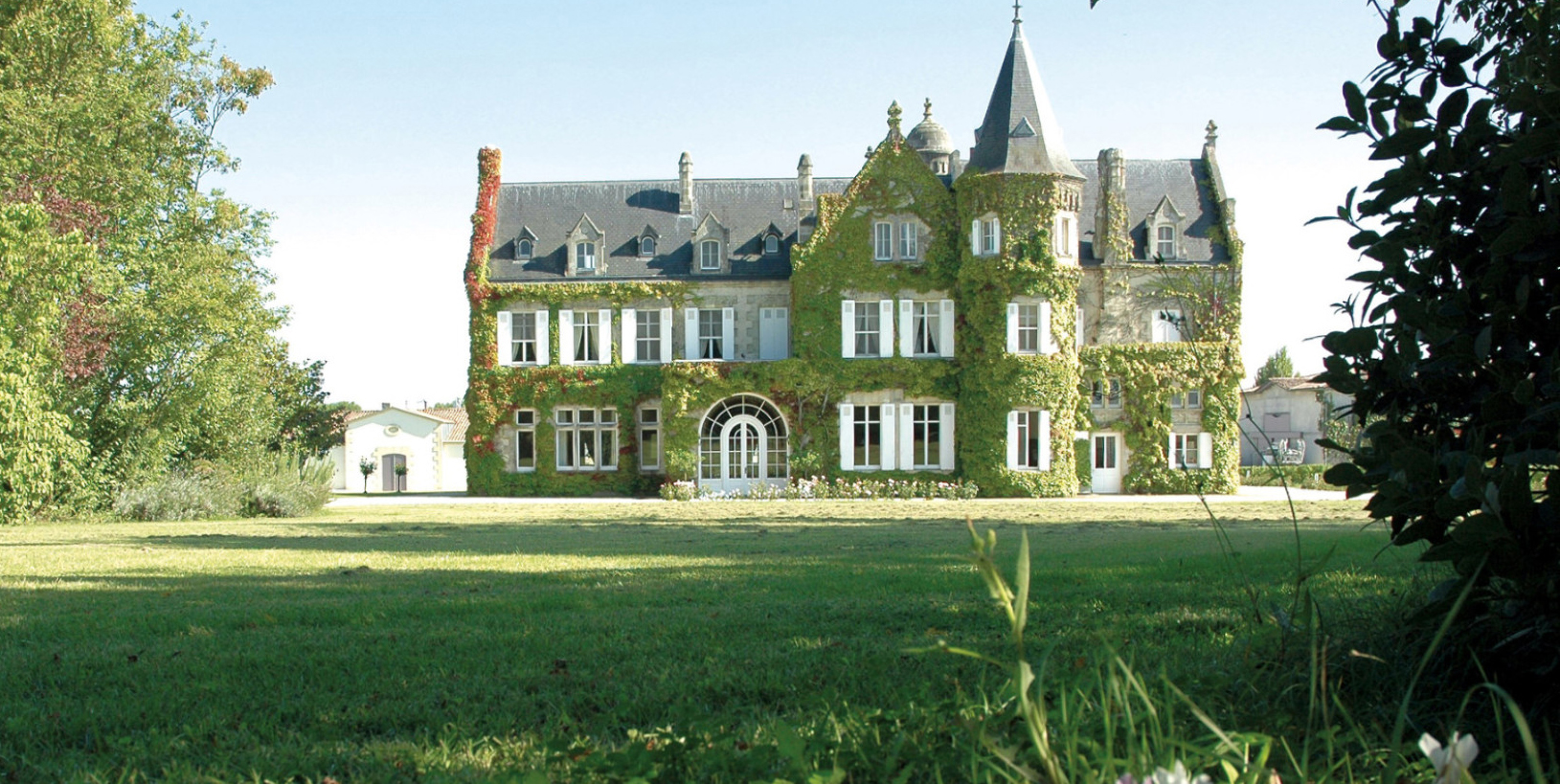
Every time I visit Chateau Lascombes, there is a different story about amibitions for the wine. Finally there is one with which I am in complete sympathy. Château Lascombes is one of the largest classified growths in the Médoc, and either the largest or second-largest in Margaux (Giscours being the competitor for size). With more than 100 ha of vineyards, it is not surprising it should have a checkered history.
Very highly rated in the 1855 classification, it was only just behind Mouton Rothschild. A revolving series of proprietors presided over a continuous decline, until the château was on the verge of extinction when it was rescued by a syndicate headed by Alexis Lichine in 1951, but Lichine was never able to bring it to real second growth status. It was sold to Bass Charrington in 1971, and although nominally there was more investment, it remained a perennial under-achiever. In 2001 it was acquired by Colony Capital, an American pension fund group for €50 million; another €50 million was invested over the next decade, before it was sold for €200 million in 2011 to MACSF, a French pension fund group. Then in 2022 it was sold to Gaylon Lawrence, a Tennessee billionaire who owns several wineries in Napa Valley. It was certainly a surprise when Axel Heinz, winemaker at Ornellaia in Bolgheri since 2005, was appointed to run the château in 2023.
It was hard to come to grips with the true character of Lascombes. The change in style after Colony Capital took over was been as dramatic as any in Bordeaux. Tasted at the château a few years back, the 1995 and 2005 seemed like night and day. The 1995 was light without much concentration; the rich and powerful 2005 seemed like one of the “international” styles in the Médoc.
The mandate now is to find and restore the true character of Lascombes. “The new intention is to bring it to the level of a great second growth. At this level there is not much room for a style that is not to some extent linked to tradition. We need to find a style that represents a specific character of the estate,” says Axel Heinz. “We want Lascombes to be recognized as a great and unique expression of its terroir and Margaux. The first step is to make a Lascombes that represents Margaux. The next step is to define what makes Lascombes Lascombes.”
“Colony attempted to give Lascombes a new impulse in terms of quality. The stylistic choice was implemented very efficiently, following the style that was fashionable in the Robert Parker era. We want to get way from the style of high ripeness and high extraction and fleshy new oak. We want to be more refined and elegant.”
Lascombes was only 20 ha in 1855, with vineyards around the chateau and to its north. Today it has blocks in three areas, the extra areas being farther north and to the south. About 50 ha in the central core have the same character that was classified in 1855 (at that time Lascombes had parts of plots where it now owns all or more). The extra plots to the north are in Soussans and the new vineyards to the south came from the purchase
of Chateaux Martinens. The Grand Vin in future will come from the central core. “We want to define the key terroir for Lascombes and that should always prevail in the blend.” The proportions of Grand Vin and second wine will reverse, the aim being 40% of Grand Vin.
It’s become a perennial question in Bordeaux whether the second wine should be an alternative to the grand vin with its own identity, a baby version of it, or something completely different that is simple and approachable but lifted by the halo of the grand vin. What are the plans at Lascombes? “We want the second wine to have a defined personality. Approachability will be part of it, but first we want it to be a Margaux, silky and perfumed, in a style that allows early drinking, but not a simple wine, a serious one, with a different character from Lascombes. Even if it’s silky and charming, if it’s lacking its own character it won’t be enough.”
Axel blended the 2022 vintage and vinified the 2023 vintage. I tasted the second wine (Chevalier de Lascombes) and the Grand Vin. The wines taste like Margaux again!
On the lines of something completely different, ever since Axel arrived at Lascombes, given his record with the Masseto Merlot at Ornellaia, there have been rumors about the introduction of a varietal Merlot at Lascombes. “We have a fair amount of clay and limestone, it is arguably known to be great terroir for Merlot, but no one associates that with the Médoc,” Axel says. ”It is time for the Médoc to innovate. There should be room for something outside the norm of the Grand Vin and second wine. Maybe there should be some vineyard-designated plots, although it’s part of the DNA of the Médoc to make blended wine.” So watch this space.
Tasting of 2023 Samples
Chevalier de Lascombes
Fruity nose shows mix of red and black fruits. Fruit impressions continue to very finely textured palate. Tannins are quite silky. Although this is quite approachable, it still has the classic reserve of Bordeaux. Some bitterness on the finish, and a touch of heat. This needs time for flavor variety to develop more than to resolve the tannins. You feel a slight lack of generosity (not at all surprising for young Margaux, especially in this vintage). 90 Drink 2028-2038
Château Lascombes
More of a black fruit nose than Chevalier de Lascombes and greater presence on the palate. Immediately showing as finer and smoother, it feels that it is so elegant it would (counter-intuitively) be possible to start it even sooner than the second wine. It is just so smooth and silky it has to be Margaux. There’s more aromatic lift on the palate than Chevalier, and it seems almost drinkable, although there is some bitter chocolate on the finish. Time is needed to develop flavor variety. 92 Drink 2029-2042
 Lewin on Wine
My father was one of Lichine’s investors, and I was the last to sell my holdings. While I agree with almost everything that has been said, I do believe an exception is that Lascombes had a very bright run under Lichine in the 60’s, when, counter to the comments made, I think he achieved the second growth promise in 62 (a tough year, but well done,) the 64 for sure (which was picked largely before the rains and was wonderfully soft, complex, and elegant for the vintage,) the 66 (probably the best vintage for Lascombes during Alexis’ tenure and in my opinion one of the very best seconds,) and the 67, which was an absolute treat in a year that has been vilified, but where Lascombes exhibited complexity and class,) and that was the end of it. A shame that so few of the wines from those years from seconds or thirds are still viable. I consider myself VERY fortunate to have been weaned on them.
Gregg Cook