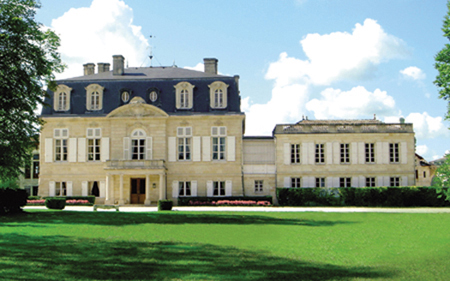
I’ve been visiting Pontet-Canet for almost 20 years. The château continues to look quite unchanged, but behind the façade there is as much change here as at any chateau in Bordeaux. On my first visit, Pontet-Canet was virtually the only chateau in Bordeaux to be trying biodynamics . On my next visit they had a horse to work the vineyards, pulling equipment that had been designed and constructed at Pontet-Canet. This year they have a new cuverie.
Château Pontet Canet was a pioneer in organic and biodynamic viticulture and continues to plough ahead, both literally and metaphorically. Vineyards are ploughed by a team of ten Percheron horses, and new stables have been constructed for them (in the style of the existing buildings: you feel you are going back to the 18th century when you visit.)
This has been a rotten year so far in Bordeaux (and for that matter, all over Northern France), not so much in terms of heat (although it has been relatively cool and not very sunny), but more for the constant mildew pressure. Mildew can spread like wildfire (to run the risk of Mixed Metaphor Disease), so it ‘s crucial to spray against it in a timely manner.
It’s an especially big issue for organic producers, who cannot use the steroid treatments of conventional viticulture. Copper is the treatment of choice, but the need to rely on a heavy metal has discouraged some producers from becoming organic. One chateau has suspended its plans to convert more of its vineyards to organic because they do not want to risk poisoning the soils; others may abandon organic viticulture this year.
Pontet Canet started biodynamics with 14 ha as an experiment in 2004, moved the whole estate to biodynamics in 2005, but then abandoned it in 2007 when they felt compelled to use conventional sprays against mildew to avoid losing the crop. It took another three years to get back to organic status. Régisseur Jean-Michel Comme, who was instrumental in committing to biodynamics, told me that if they had been biodynamic for longer at the time, the vineyards would have been better able to withstand the fungus. Mildew pressure may be just as great in 2024 as it was 2007, but the vineyards look healthy now.

Next to the stables is the tisanerie, a building dedicated to producing the biodynamic preparations. The chateau has designed all sorts of ingenious equipment for making the preparations. There’s a box full of cow horns that will be filled with manure, buried in the vineyard for 6 months, and then retrieved so the contents can be dissolved in water to make a spray that is applied to the vineyards. When a biodynamic vineyard is small, all this can be done by hand, but it’s a fair-sized operation to scale up for Pontet-Canet’s 80 ha, so they’ve built an apparatus for filling the cow horns automatically. Biodynamic preparations are made using ‘dynamized’ water, basically water that has been vigorously stirred, so there is a handsome series of waterfalls made out of stone that can be used to put the water through a vortex. The tisanerie has drawers full of dried preparations such as camomille or dandelion and has a wonderful smell like a very up-market tea room.

The winery itself goes beyond biodynamics in its emphasis on local products. A new cuverie has been constructed for the coming vintage. It has a large number of egg-shaped wooden fermentation vats and tulip-shaped concrete vats, as well as the old conical vats and underground concrete vats. The concrete vats are made with sand that comes from Pontet Canet and they are painted with clay from Pontet Canet. Local has a very defined meaning here. There is no electricity in the cuveries, everything is natural. Destemming is completely manual (no machines because no electricity). Sorting is on a table entirely by hand. Alfred Tesseron says no machine can replace the human eye.

Some years ago, commenting on the increase in quality and purity, Jean-Michel Comme said, “We changed our state of mind regarding the quality of the wine and viticulture, we could almost produce 100% of great wine, it is just a matter of parcels.” That prediction came true after 2016, when Pontet-Canet stopped producing its second wine: running counter to the trend to produce more second wine and less grand vin, now there is only the grand vin. The amount of the second wine had been declining, and the Tesserons decided it did not make sense to have a separate label for such a small amount. (Now any lots that do not make the grand vin are sold off.) The approach at Pontet-Canet is truly sui-generis.
 Lewin on Wine